

Naomi Meyer interviews filmmaker and author Aryan Kaganof about his film Decolon i sing Wits - an act of epistemic disobedience.

Hi Aryan, Decolon i sing Wits - an act of epistemic disobedience is about the subconscious colonisation of a people by another group of people. The conquest takes place in a subtle way: by means of a language, statues, art and architecture, to name but a few. This is my interpretation of your movie. I am interested to hear your view, though, so do tell.
Stockholm Syndrome
It is hard to decolonise because it is quite difficult to understand
what "colonised" means, especially when you're colonised.
For this reason I prefer to think of what happened in this
country in terms of kidnapping. So-called black people
were kidnapped over a period of hundreds of years
by so-called white people. It is a well-known
feature of the psychology of the kidnapped
that they soon display a tendency to FALL
IN LOVE with their kidnappers. This is
understandable in terms of the
POWER OF LIFE AND
DEATH that their kid
nappers have over
the kidnapped.
This condition
of being in
love with
one's kid
napper
is called
THE STOCK
HOLM SYNDROME.
I put it to you that all so-
called black South Af
ricans, to a greater or
lesser degree, suffer
from this syndrome
and that there is
no "post-apart
heid" pos
sible
until they
have received
psychiatric treatment
for this mental condition
which is a RESULT of having
been kidnapped. The idea of "re
conciling" with one's kidnappers is a
particularly virulent and absurd manifestation
of the Stockholm Syndrome, it is a manifestation
of psychic un-health. It is with no disrespect intended
whatsoever that I put it to you that the individual who suffered
most acutely from Stockholm Syndrome was Nelson Mandela.
The worldwide image of African people is often that of their being hungry, starving and poverty-stricken and I understand that this is diminishing and stereotypical. But there are people in Africa, as in any part of the world, who are hungry - what should be done about this situation?
On the "miracle" of 1994
It was mass-produced euphoria, a sophisticated form of crowd control.
I was there. I saw it happen. I remember walking up to those posters,
the ones advertising who you could vote for. It didn't matter which
party, when you looked carefully at the back of the posters, they
were all printed by the same printing company. Bang. Then I
got it. In a flash. It was all a sophisticated theatre, a set-up
with left and right carefully staged for us. We were per
mitted to think, to imagine WITHIN the setup, not
outside of it.
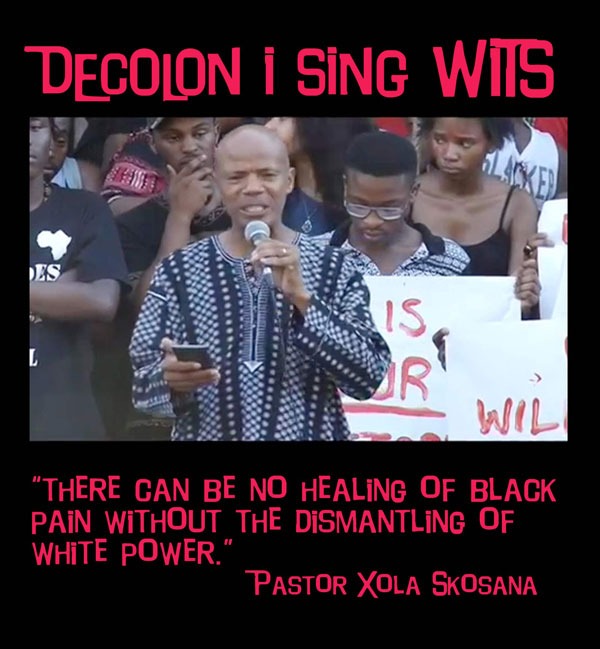
Your movie makes it clear that a revolution is inevitable – is the goal of the movie to engage in conversation, or to mobilise people to take up their weapons?
State of blood
Cyril Ramaphosa is a car guard of white power.
Riah Phiyega is a car guard of white power.
Jacob Zuma is a car guard of white power.
We are all of us complicit in the murders
of those striking miners if we allow
this government of car guards
to remain in power. Nkandla
is small change compared
with the trillions that have
been taken from this
country by the likes
of the Ruperts and
the Oppenheimers
but nobody is
screaming
"Pay back
the money"
to them? SETSHABA
MADI South Africa is a
STATE OF BLOOD with
no direction home. EKAYA.
The country has a complex racial history – but isn't this just sad? Can we not be brothers and sisters, regardless of the colours of our skins? Would this simplify your message?
The paradox of reconciliation
When black forGIVEs
white forever
TAKEs
because
the forGIVEness
is understood as an
invitation to TAKE more.
Your movie portrays white people as having arrived in the country and as colonising wherever they went (an ongoing process). The question is: What should be done with all the white people in this country?
How I passed for white
My mother told me not to speak loudly in public
Not to speak loudly in private too, We don't do that
we're WHITE then she pinched the skin of my forearm
and when I yelped in pain she pinched me harder and she
held my burning pink skin up to the light and she said No matter
how little money we have no matter how hard our circumstance we've
always got one thing that they'll never be, WE'RE WHITE and the litany
of what we were and what they weren't went on and on you might say it all
came down to this We were all things good and they were THE DEVIL person
ified and it wasn't a joke and you couldn't laugh it off because the kind of white we
were was trash, no dear people, it wasn't as easy as that, for what i re
member most clearly about my sinister cousins was the occasional
hint in their tightly curled hair or the snubness of their noses that
the white that we supposedly were wasn't quite as clearly de
lineated as my mother would have preferred and maybe
that's why she moved us out of her family's orbit and
we left Joburg for Durban where she acquired an
English accent (from the movies I suppose)
and taught me to stick my little finger out
when drinking tea because That's how
we do it we're WHITE and so i was
trained in a million tiny tropes
that would serve not to give
me away and I'm 51 now
and it's taken me so
long to piece to
gether all the
stolen parts
because
despite
what
my
mother
taught me
i've never been
white i've always
been human and what
I'd like to say to my so-called
black humans is that all those so-
called whites who are running very
fast have been wound up very tightly
to run away from themselves. WHITENESS
is a theatre, a performance of exclusion, it only
means anything because of slavery which granted
those who performed the theatre an unspeakable power
of life and death over those excluded from the performance.
The echoes of that power to extinguish black life continue to re
sonate today in every sick incident that screams WHITE POWER
over the increasingly growing self confidence and consciousness of
the black body. I cherish my so-called consciousness which rejects white
and black as simplistic illusions good for chess and pianos but not sophis
ticated enough to take on the human experience but nonetheless I un
derstand that I am embedded in a matrix of theatrical illusion that
murders some people without mercy, with impunity, merely be
cause they pass for BLACK.
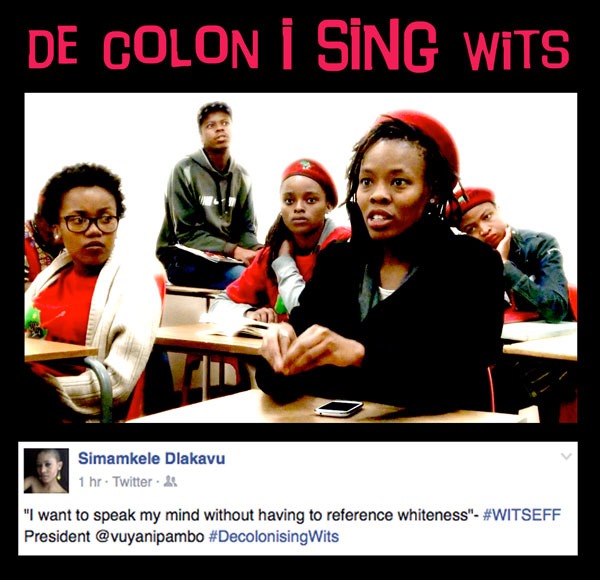
If Xhosa people speak Xhosa, Zulu people Zulu, Sotho people Sotho and Afrikaans people Afrikaans, can these languages also be seen as ways of communication? When is a language a means of oppression and when can it be a way of expressing itself in the most clear way to a fellow speaker of the same language?
In denial?
Because every white person you meet immediately claims to be an exception
to the rule we can deduce that Whiteness operates as an aggregation
of exceptions to its rule. It is precisely this exceptionality that
makes Whiteness so insidious. It is precisely its unstated
ness that makes Whiteness so hard to decipher FOR
WHITES. For blacks Whiteness does not need
to be (re)stated. It is always being stated
AGAINST THEM. The unstated
normative state of Whiteness
demands of blacks that
they be stated in
negative
terms.
Because
the black being
has to be stated as
such, as Black, its very
beingness, its IS, is a negative
quantity. Whiteness always
IS. Blackness's IS is
BLACK. (Hence
less than the
allness of
the unstated
White IS.) It is
the unstated White
IS that claims for itself
the TOTALITY of existence;
that claims the entire world as
we have hitherto known it. All that
is left for the Black world to claim for
itself is that negative quantity that must
always be appended (and hence limited)
by its Blackness (Black Music, Black Art, Black
Literature, Black History, Black Diaspora). In order
to claim the much vaunted "equality" the black subject
would need to invoke an ISness that did not require a priori
knowledge of his/her Blackness. This raises the question, can
the Black subject claim "I AM", or is this affirmation – in the world
as we have known it thus far – always and only "I AM BLACK"? In other
words, if a Black subject claims to exist – to be (I AM) – is that Black in denial?
What is your view of a university in a mother-tongue language of Xhosa speakers, or Sotho speakers, for example? Could this be a solution – something brand new?
On rereading the definition of black consciousness
The unnerving totality of whiteness
takes cognizance of God’s plan
in creating black people black
in order not to be seen from
the inside. Let me put this
another way: whiteness
has the black land, the
black labour and the
black past and now,
with the so-called
“new South
Africa” in
place, is
even
guaranteed
of having the
black future (as
amiably car-guarded
by the ANC) but, peerless
in its rapacity, whiteness craves
more than all these mere externals
of blackness, whiteness craves to own
precisely that black interiority its own rhetoric
of racism always claimed did not exist. This is the
unstoppable paradox of whiteness; it never begs “please
sir i want some more” it simply appropriates indiscriminately
that which it discriminates against ceaselessly. The tragic conun
drum of so-called Black Consciousness is that the more consciousness
it brings into being, the more (Black) Being whiteness has to seize.
It is precisely this Black Consciousness
of Biko’s that White Power
thrives on in its
Totality.
Kommentaar
I like your work guys, lets keep qhubaring.
Gwiz, worrying times indeed.