

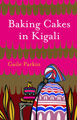
 Title: Baking Cakes in Kigali
Author: Gaile Parkin
Publisher: Atlantic Books
ISBN: 9781843547464
Publication date: January 2009
Pages: 272
Angel Tungaraza, the protagonist of Gaile Parkin’s debut novel, is a Tanzanian who finds herself in post-genocide Rwanda, baking cakes in Kigali, the city to which she, her husband, Pius, and their five grandchildren have recently moved for the uncertain duration of Pius’s teaching contract. Angel is an adept designer of sponges for all occasions, and her uninterrupted stream of customers for cakes provides Parkin with the mechanism by which the novel is structured and its array of characters made to appear and present their stories of life in a place struggling to come to terms with AIDS, the aftermath of genocide, and the uneven project of development. Fourteen chapters, focused around cake commissionings, have Angel, devotee of tea the Tanzanian way, pressing successive cups of the sweet and spicy beverage upon her clients as she urges them to think creatively about cake themes and icing colours. They in turn, as they sip at tea and sample cupcakes, pour their personal stories and secrets into Angel’s eager ear.
It would seem that the inducements of baked goods and professional confidentiality are sufficient to transform the space of cake-ordering into one of therapy and personal revelation. In a startling instance of the fulsome confessions Angel attracts, a soldier called Captain Calixte, would-be customer of chapter 8, manages (over the mandatory cup of tea) to reveal his brutalised history, to diagnose himself as having been so traumatised by what he has seen and done that he no longer possesses the capacity to feel anything, and to explain his plan to escape Rwanda by persuading a white woman to marry him on the grounds that he can produce a diamond stolen from the Congo, an outdated certificate proclaiming his freedom from HIV infection and, of course, a cake with which to celebrate the impending union. Together with the unsatisfactory ways in which Baking Cakes surveys clusters of social problems like AIDS and poverty, the novel’s untextured mode of characterisation abandons most of its cast to a parade of types – the soldier, the prostitute, the volunteer aid worker.
Which is why I was astonished to discover the flood of praise with which Baking Cakes in Kigali has been met by reviewers. The novel has been hailed as a delightful read, assured of a grateful audience among book club members; its protagonist has been described (in a review by Tom Adair for The Scotsman on 14 January 2009) as the book’s "towering achievement". Adair does follow his celebration of what he sees as the novel’s widespread appeal with the argument that its "plane of morality is shallow – issues arise but are rarely explored". But he ends with a judgement which, instead of taking his earlier critique seriously, significantly undoes it: "… Baking Cakes in Kigali manages to make you feel better about the world. But only just."
Is that margin for optimism, emerging as it does out of the novel’s failure to engage adequately with tough issues, cause for celebration? Margaret von Klemperer, writing in The Witness on 16 February 2009, seems to think so. She has two criticisms: the book tends towards the didactic as it nears its end, and Angel bears a striking resemblance to McCall-Smith’s Precious Ramotswe. Neither of these complaints seems minor to me, and the first is wrong in so far as, actually, the book is didactic from start to end, but Von Klemperer’s view is that we should focus rather on the fact that "good news from Africa, even if fictional, is a sufficiently rare commodity to be very welcome", and Parkin’s is an "upbeat and amusing" tale of a woman who "along with the sponge and brightly coloured icing, … dispenses her wisdom, Rwandan style and [helps] to heal the devastated city and its people". Is Angel's wisdom "Rwandan style"? Aren’t Angel and her cups of tea avowedly Tanzanian? Why is it difficult to keep the details of her life clearly in view? And is her style of dispensing wisdom really so compelling?
In another primarily positive account of Parkin’s novel, in the UK’s The Independent, the reviewer manages to admit of the book that "At times (notably tea times) it has a coy and formulaic feel to its description of domestic life."
The irresistible joke about tea time, judgements of the book based on wanting to feel a bit better about Africa, and the relish with which reviewers have characterised the enterprise of baking and icing cakes suggest the lightness of the book itself despite its efforts to thematise some of the most devastating issues facing the continent.
Am I suggesting that one cannot represent matters such as the aftermath of genocide and the reign of AIDS through domestic conversation otherwise preoccupied with the design of cakes? No, I’m not. Or: not exactly The domestic is a primary space in which trauma takes root and lives out its long afterlives. What I think is that the conjunction of celebration and terrible brokenness in the sphere of the domestic needs very skilful handling, very subtle writing, when the objects that are to come out of this meeting place comprise a procession of very brightly iced cakes.
The neat resolution of plot matters by the end of the book suggests a failure to imagine into the ways in which devastating experience does not mend. The worthy people of the novel find love with other worthy people; where there is a complication there is compensation in the form of Angel’s maternal love. Angel herself comes to terms with the fact that both her children had AIDS and would have died of the disease had other causes of death not intervened; she comes to exemplify the journey African parents need to make towards facing the virus that is killing their children. The prostitute who has been abused by men is provided with sympathy and the prospect of sewing classes, her relative innocence stridently proclaimed among Angel’s frequent, moral-making lines. Even the way in which Baking Cakes deals with the subjects of sex and AIDS leaves the reader skimming at the surface of the experience of a pandemic much invoked by the book. Parkin’s concern is very clearly directed towards the need for the education of the young about using condoms; sex as an absent subject is represented in Angel’s difficulty in discussing with her grandchildren how to proceed safely with sexual partners. What the book lacks is the complexity, the dissonance, the sophistication that would give us cause to ponder and that would be able to stand up to the issues Parkin has chosen to weave into her story. And I do want a novel to challenge me, to make some difference in me, when it chooses the difficult and urgent subjects of my time and place.
Baking Cakes in Kigali has its moving moments, but they all fall prey to damp-eyed sentimentalism; it is too late, unfortunately, to give the opposite warning against over-egging the pudding. A succession of personal travails and social maladies appear in the book, but there is no dwelling in or complicating of these phenomena, nor is there the slightest suggestion that such subjects – pandemic, the loss of children, genocide – are difficult to represent, difficult to imagine into.