

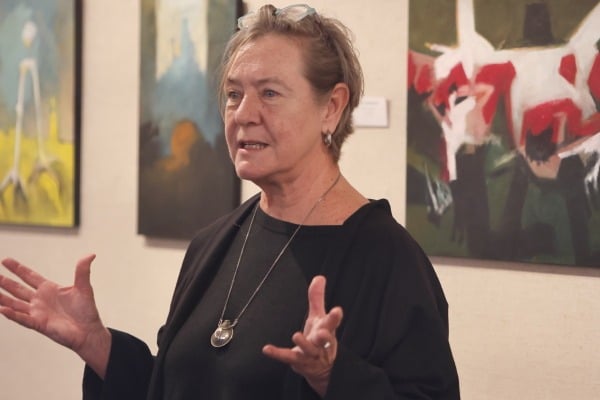
Theresa Hardman
What is creativity? Can it be taught?
Is creativity a conscious act or an intuitive process we have little control over? What is intuition? Is that something we can pinpoint?
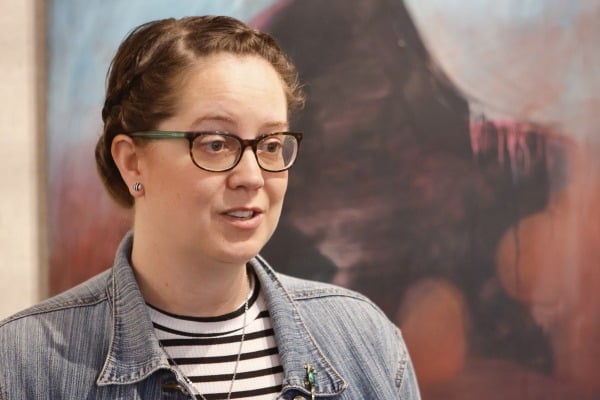
Anna Stewart, gallery manager at the GFI Art Gallery
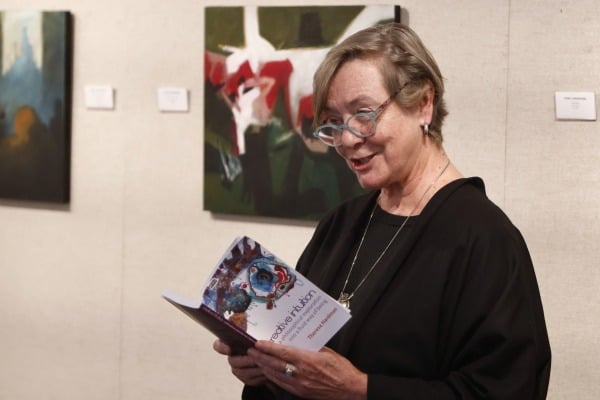
In a short, informal lecture, Theresa Hardman spoke on these subjects at the GFI Art Gallery in Gqeberha on Saturday, 16 May, while launching her new book, called Creative intuition: A philosophical exploration into a fluid way of being. Artists like Vulindlela Nyoni and Estelle Marais were in the audience and shared their own ideas on how intuition and flow might help in their work.
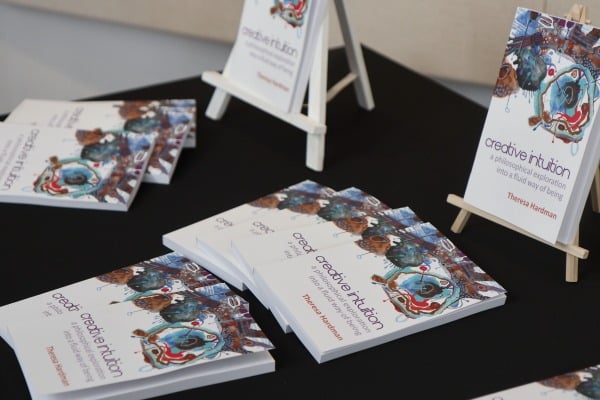
The text is essentially Hardman’s PhD that has now been published by Unisa Press. Soon, it will also be published by Routledge for the international market. South Africans can be thankful that local presses are willing to take on projects like these, because to import Routledge editions have become a strain on the pocket; but, thanks to Unisa Press, this fascinating study is available in South Africa at a very reasonable price.
Anyone who is interested in creativity may want to get hold of the book. While it is an academic text, Hardman writes fluently, and the bits that I have been reading since buying it are easy to understand.
The dancing, artistic lecturer of architecture
Hardman is a qualified architect with a particular passion for old houses in the Karoo. She has also taught architecture both in South Africa and at overseas universities.
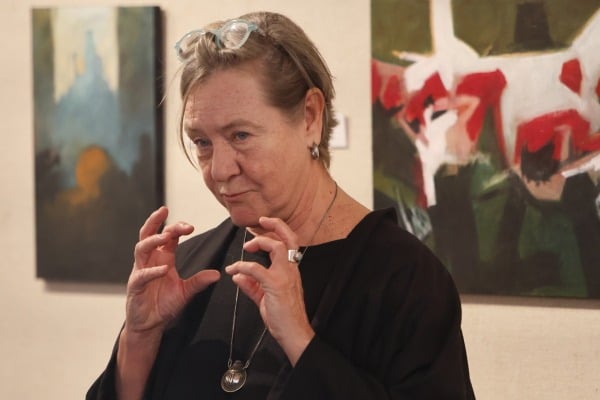
On Saturday, she explained that part of her curiosity came from teaching first-year students for 16 years. They were fresh out of our school system, which demands conformity, not creativity. How was she to help her students learn the skills of being creative?
She began reading about it. Her reading took her into psychology – the works of Jung spoke to her. She studied Eastern religions and local indigenous knowledge, and read numerous biographies of great artists.
Books helped, but she also had to draw from within herself. Ever since she was young, Hardman has loved dancing. When thinking back to her young self being lost in joyful, creative dancing, Hardman began exploring intuition. How does a young, untrained person move? Training, teaching and practising are very important for technique, but what drew her to dancing in the first place?
Architecture, too, is a blend of being incredibly focused on detail and being creative. Any architect has to understand the bylaws, the budget, the environmental impact, the client’s dream – all of which can only be taught and practised. But what about the creative part of being an architect?
Hardman took up painting as well, again learning the technical nuances and the dos and don’ts. But what set her work apart from others’?
Hardman organised workshops in creativity where she shared her readings with others, who, in turn, were able to share their ideas with her. All of this accumulated into a PhD. Hardman also published internationally in the Elsevier Journal of Creativity.
Now we have the book.
A fluid way of being
While her PhD was a rigorous academic work, her findings sound odd when we compare them with anything we have been taught at school. The title is enough to raise eyebrows: Creative intuition: A philosophical exploration into a fluid way of being. I would normally have assumed intuition to be a stepsister of scientific reasoning. Not so, says Hardman. Intuition and scientific reasoning are not opposites. We need both.
To her, creative intuition involves four principles:
- a state of expanded consciousness,
- an open, fluid way of being,
- a focus on the particular, rather than the general, and
- an act of fusion or identification which occurs through emotion or empathy.
Which brings us to the second part of her title: A philosophical exploration into a fluid way of being. What does that mean? On page 99, Hardman writes:
Because life is open-ended and unpredictable, it is not aimed at a terminal point or goal and its aim is to keep on going. The plant, the musician, the painter, in keeping on going by improvising, joins with the creative flow of life. And, as with all of life’s processes, in the process of human making, nothing is ever finished. Every artefact, every poem, every piece of music, every invention is the beginning of another process, and every thought and act of making is a passing moment in a process that continues indefinitely.
Nothing is ever finished.
This is, therefore, not a review, but merely the observations of a curious bystander who attended the launch and who will now read the book properly.