

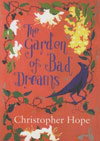
 Title: The Garden of Bad Dreams and other stories
Author: Christopher Hope
Publisher: Atlantic Books
Publication date: May 2008
Pages: 132
ISBN: 978-1-84354-772-3
Price: R210
After suffering through the pretentiousness of Christopher Hope’s last novel, My Mother’s Lovers, I was very apprehensive about reading his next book, but The Garden of Bad Dreams is a delightful collection of stories which surprises and sparkles on every page.
The first and titular piece sets the thematic tone for the entire book. Hope intertwines vast historical topics with issues of global migration and infuses them with a fable-like character to tell highly unusual stories of people who are mostly larger than life, but who do seem uncannily familiar. Thus from the beginning of the book we enter a kind of dream-like space where many things are possible, some are too good to be true and others seem too real for comfort.
In The Garden of Bad Dreams we travel to Hungary, where the Collector, our protagonist, wants to resurrect the Lilliputian Theatre which used to entertain people around Europe “in the days when disproportion of leg and head and physical form were not much bothered about – when small was small and you took your dwarfs with your midgets and didn’t bother about which was which.” But those times have gone past and most dwarfs and midgets have vanished, being “sent to a place run by the tall to do away with the small” during the time of the Second World War and being “officially abolished” when the Liberators came thereafter. Yet, the Collector does not abandon his “dreams of midgets.”
“I once knew a man who thought he was a singing dog” is the opening of "The Violin", which tells the story of Fred, the janitor of an old Parisian flat building. In the 1970s, Fred still believes that the Germans occupy Paris and thus is scared of leaving the house. When he does venture outside and is persuaded to travel to Moscow with one of the house residents, he unexpectedly and tragically falls in love with a Russian violinist.
Altogether thirteen stories make up the collection, many of which deal with (post-) colonial settings, such as "The White Witch", "Veterans", "Whose Zoo" or "St Francis in the Veld". The narrator of "The White Witch" remembers a woman in Malaysia who inhabited a foreign identity "so successfully that she convinced the only person that mattered – herself”. He himself, an Englishman by birth, belongs to the “nowhere people”, as a friend calls him on one of his journeys to the Cameron Highlands. Strikingly, the story reveals that colonised places often also become “nowhere” places through assimilation, so that when the narrator leaves Malaysia he has the feeling of leaving an English coastal resort: “Except for the size of the moths. And the frilly bits”, meaning golf, tea and greyhounds.
The story "Veterans" returns to the time when Indians were not allowed to reside in the Free State, exposing the sickening racial prejudices people lived by at the time. In "St Francis in the Veld" such prejudices prevail. It is the story of the De Tromp family: the industrious farmer Tookie, his wife Tina who talks to a doll by the name of Bella-Louise, and their son Jamie, “who got religious later”. Tookie is ordered by the government to build outhouses for the seasonal workers coming to help at his farm. While the enterprise explodes in excrement, some of the locals try to profit from what they call “a miracle”.
In most of these stories Hope employs sarcasm and humour to scratch under the veneer of our everyday prejudices, illusions and vices. "Whose Zoo" is an allegory of power changing hands as one regime takes over from another: “Once we had a country, and we shot it to pieces. Once we had a zoo, but we went and ate it.” Although probably based on the events which took place in Paris in 1871, "Whose Zoo" has a disquieting present-day African resonance.
The story "Gus" was also based on a real event when a gorilla was shot in the Johannesburg Zoo by a man trying to escape the hands of justice. In Hope’s version the narrator is present at the scene of the attack and recognises in the animal keeper taking care of the fictional gorilla Gus an old school-friend, Kelvin, who went on to become a priest and then decided to continue doing God’s work on earth by “shepherding” apes. Again, Hope mixes humour with tragedy and produces what seems to me the best story in the collection. (The real Johannesburg Zoo gorilla was called Max. He died a few years ago, but recently a statue commissioned in his honour has been unveiled in the zoo by no other than Professor Phillip Tobias.)
Some of the other pieces in the collection are even more bizarre, and the sinister undercurrents are ever present. "In the Way" tells the story of Monk Sava from Serbia who removes a mountain because it stands in the way of his church and his graveyard: “He feels about that mountain with its foot in the graveyard the way he feels about communists – so he got a bulldozer and began to move it.”
"The Day Out" and "Wall Story" describe distopian near-future scenarios. In the first a man is desperate to enjoy his “day out”, travelling to a centre where through an injection he can go on a holiday, but all sorts of forces stand in his way. In the second, the characters reminisce about the time when houses were not surrounded for protection by high-tech walls, and one could actually sneak into a neighbour’s house to seduce his wife.
"The Pink Shoes" and "How It Was", "Covered Bridge and Autumn Splendour" are stories about personal betrayals, whereas the last of the three could compete with "Gus" for my favourite in the collection. It is written with the kind of dry wit that only the best of the genre can offer.
The Garden of Bad Dreams is introduced by the following epigraph, an Old English proverb: “Danger and delight grow on one stalk.” It is a magnificent choice for this collection. The variety of voices, settings and characters Christopher Hope offers in The Garden of Bad Dreams explores the many possibilities of the short-story genre and makes it one of the best collections I have read in a long time.