

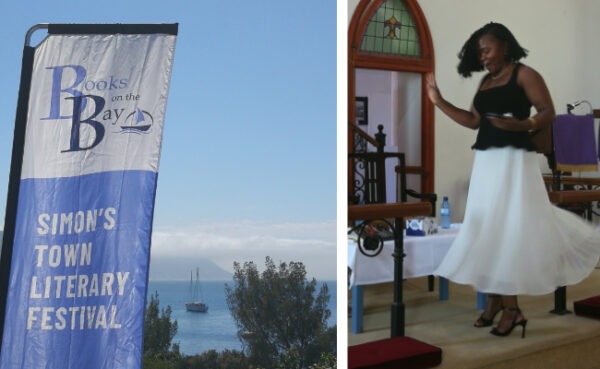
Picture of the festival banner and picture of Popina Khumanda: Karina Szczurek
- Karina Szczurek attended this year’s Books on the Bay Festival and shares her overview of the festival with LitNet’s readers.
Stories make the world go round. Some turn it upside down; others, the right way round.
In a recent article for Institute of Art and Ideas News, Elleke Boehmer pointed out that the original iconic 1972 image of Earth taken from Apollo 17 that we know as the “blue marble” was tilted to put the northern hemisphere on top, whereas “Apollo 17’s camera had first pictured the planet as bearing the vast, white cap of Antarctica”. For the past few years, Boehmer’s creative and theoretical writing has been focused on reimagining the way we see the world. She argues that by shifting our perspective to the far southern hemisphere, we can discover a more wholesome and grounding way of being that does not neglect an essential frame of reference for understanding the ecological and sociopolitical reality we find ourselves in.

Elleke Boehmer with David Attwell (picture: Karina Szczurek)
Boehmer launched her latest book, Southern imagining (Princeton & Wits UP), during her visit to South Africa earlier this month, and spoke to me about her novel, Ice shock (Karavan Press), at Books on the Bay, now in its fourth year. As one of the most southern literary festivals in Africa, Books on the Bay was the perfect occasion to begin dreaming from and in the South.
Ice shock is predominantly a love story, but it is also an environmental novel. In her incisive review of the book, Barbara Boswell mentioned the inescapable fact that “climate shapes destiny”. The story of Ice shock oscillates between the UK and the Antarctic, stopping a few times in South Africa in between. The love that binds the protagonists across the hemispheres is tested to the extreme and allows us to rethink our connectedness in personal and global terms, to understand how precarious our position is and to empower us to do something about it.
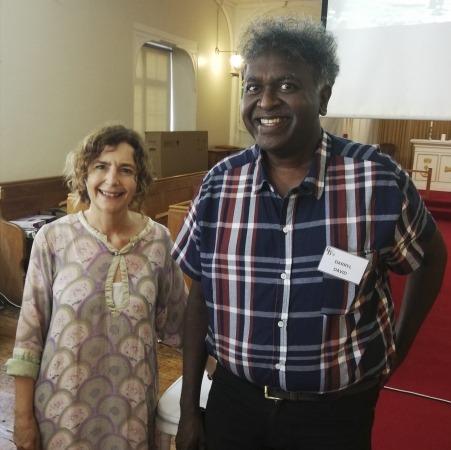
Finuala Dowling and Darryl David (picture: Karina Szczurek)
Books on the Bay took place between 13 and 15 March 2026 and hosted a myriad of amazing local and international literary stars. My festival began on Friday morning with an author whose writing has shaped and reshaped the Cape Peninsula – Finuala Dowling. Introducing her was one of the organisers of the festival, Darryl David. He said that Dowling not only is “one of the Far South’s most famous poets”, but should be declared as Poet Laureate in these parts of the world. Agreed!
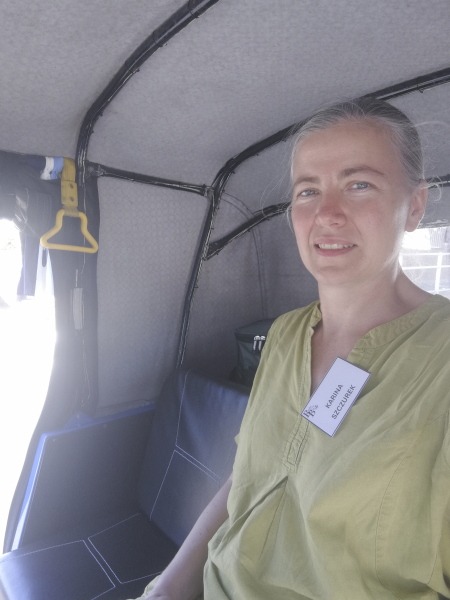
Karina Szczurek, travelling in a tuk tuk between venues
Driving to Lakeside, Muizenberg, Fish Hoek or Simon’s Town, I always think of her poem “Riches” (Notes from the dementia ward, 2008), which in a few lines captures the splendid beauty of this part of the peninsula. No wonder she has been invited to every Books on the Bay so far, and her talk this year was the ideal opener for my engagement with the rich offerings of the 2026 programme. Dowling spoke about four literary extracts from different centuries and authors – Anne Barnard, Olive Schreiner, JM Coetzee and Karen Press – to portray the seaside resort of Muizenberg in history. She ended with Press’s poem “Muizenberg”, which describes the place as “a weathered place that loves its people”. Love was central to all four excerpts. As Dowling said, referring to Schreiner’s famous unfinished novel, From man to man, at the core of all our stories is the reality that “from person to person, all that matters is love”.
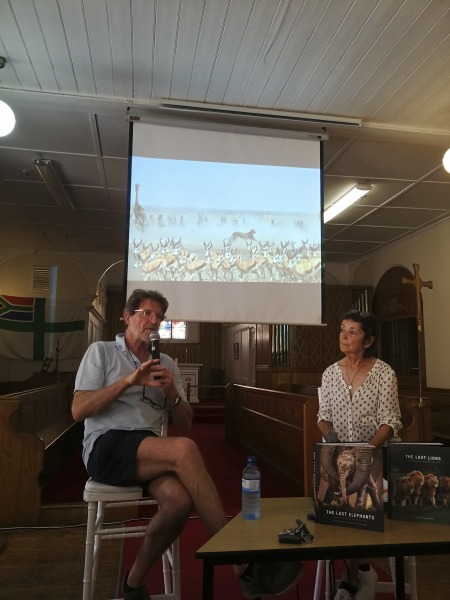
Colin Bell and Nancy Richards (picture: Karina Szczurek)
Love in its many guises dominated the rest of my Books on the Bay experience. I attended Colin Bell’s remarkable talk on the book he and Don Pinnock compiled, The last of the lions (Struik Nature). Bell’s love of nature and his passion for conservation were palpable. Lions seem to be everywhere as mythical creatures, he said, and pointed to the lion on the wall of the Naval Museum’s Dockyard Chapel, where his event was taking place – but they are disappearing in nature at an alarming rate. There is no denying the horror of the statistics and the reality of what challenges lions (among so many other species!) face – if we don’t act decisively now, lions in the wild might become the stuff of legends. What can we do? First and foremost: Educate ourselves. Extremely well-researched and gorgeously illustrated, The last of the lions is a great entry point to the necessary knowledge and subsequent needed action. Appropriately, Bell received a roaring applause at the end of his talk, and people were queuing up to chat to him afterwards.
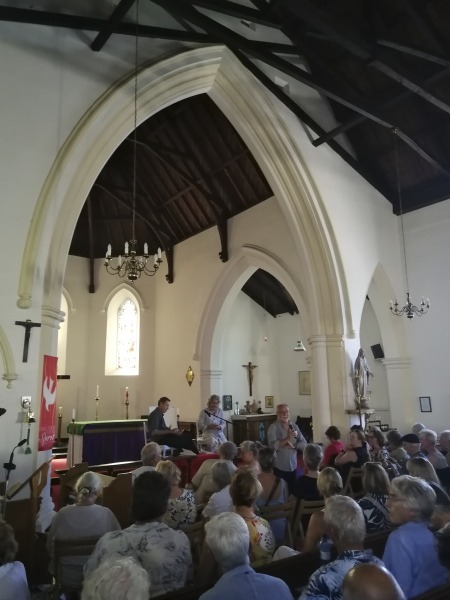
David Attwell introducing Peter Godwin and Shaun de Waal at the St Francis Church (picture: Karina Szczurek)
Peter Godwin was next on my festival schedule. I had heard him speak about Exit wounds: A story of love, loss and occasional wars (Pan Macmillan) at his Book Lounge launch, and was eager to listen again. Not surprisingly, the St Francis Church was jam-packed for his event. He spoke about his “annus horribilis”, in which he had to navigate the dissolution of his marriage and the loss of his formidable mother, who on her deathbed told him, “I find that you don’t annoy me, and most people do.” It was her way of expressing the deep love she had for him. Referring to his work as a war correspondent, Godwin mentioned how “the suffering of others stopped me from inhabiting my life”, and how he wishes he could have been an “opera correspondent” instead. On Saturday, as I drove into Simon’s Town for the first session of the day, the wind was blowing beach sand across the road, and I thought about the juxtaposition of war and art in Godwin’s life – how, even though he did not end up writing about opera, writing itself returned him to himself and allowed him to explore how he belonged in the world, especially a war-torn world.
After speaking to Boehmer in the morning, I stayed on in the Simon’s Town Methodist Church to listen to Popina Khumanda. She was being interviewed by one of the other festival organisers, Karin Cronjé, who began the event with silent tears and eventually the question, “How?” Those in the audience who knew Khumanda’s story, understood the reaction. It is nearly impossible to find the words to express the awe one feels for this young woman’s resilience and unquenchable thirst for life. Seeing her interlocutor’s distress, Khumanda jumped up and twirled around in front of the church to show off the fabulous outfit she had chosen for her appearance at the festival. This moment will stay with me forever. A beautiful young woman who had defied all odds and horrors was embracing life with an exuberance that can and will conquer the world – at the same time, it was a gesture of extraordinary empathy.
Khumanda chronicles her astounding story in The smallest ones: Two sisters’ escape from DRC rebels and their pursuit of freedom (Penguin). She was five when rebels invaded her village and captured her and her sister. After years of unimaginable torture, the two escaped, heading south. Arriving in South Africa on foot, having hoped to leave their harrowing past behind, they were only to have their strength tested to the limits of human endurance all over again.
“How?”
“Not today.” That is what Popina Khumanda repeatedly told herself, and she refused to give up no matter what life threw at her. She has no doubt that she survived because of the bond she shares with her sister. Through her, she learned “the true meaning of love”.
“The walk is what changed everything again,” she said. “I was reborn – I saw so much beauty in hardship.”
Today, Popina Khumanda has a degree in IT from the Nelson Mandela University and a specialisation in cybersecurity from the University of Cape Town. She is passionate about education and continues to inspire others to pursue their dreams, no matter how impossible they might seem. Despite everything she has been through, she has an unrivalled capacity for expressing joy.
Her story was a stark reminder of the times we live in – a time of hostility and war. How to overcome, how to survive? One of the greatest challenges we encounter in the everyday, is that the ability to hold conflicting views in our minds simultaneously in order to comprehend human suffering on all sides is becoming vanishingly rare. Sadly, we don’t seem to learn from history, and yet if there is one thing that stories like Popina Khumanda’s show us, it is that we have to hope for a different tomorrow, and we have to understand our past to sustain that hope.
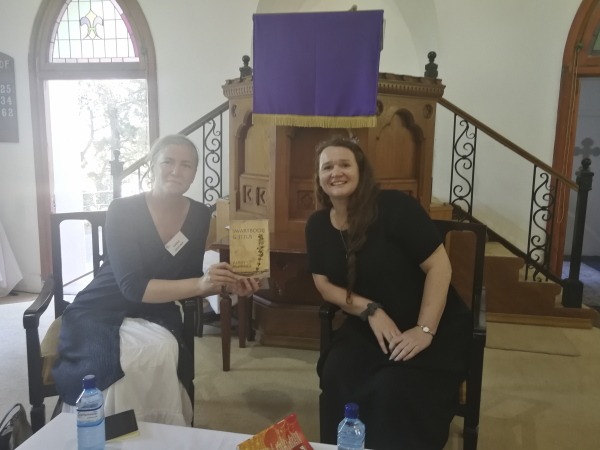
Karina Szczurek and Karen Jennings
This was one of the topics I asked Karen Jennings to touch on during our Books on the Bay conversation about her historical novella, Swartbooij and Titus (Karavan Press). Part prose, part poetry, and illustrated by collages that Jennings herself created, it tells the story of the two historical figures of the title, a father and his son, who played a key role in the wars of the northern frontier in the eighteenth century. It was another time in history characterised by endless cycles of revenge, cycles that had to be broken for other possibilities to surface.
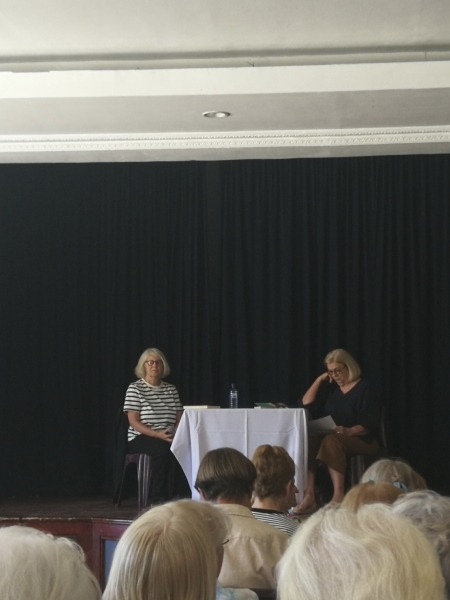
Antjie Krog and Louise Viljoen (picture: Karina Szczurek)
The story of a child and a parent is also at the heart of Antjie Krog’s last book, Blood’s inner rhyme (Penguin), an autobiographical novel she spoke about with Louise Viljoen in the Town Hall on a glorious, balmy Sunday morning, the last day of the festival, in Simon’s Town. “Her influence on me was enormous,” Krog said of her mother, who was also a writer. The conversation centred on ageing and our fragile lives, as well as on land – the love of it and its ownership – and how to map this precarious topic in the context of South Africa’s past and present. Discussing interracial relationships, Krog said that “we have to imagine each other to forge a different future”. The gap between us might seem wide, but we need to recognise it and honour the attempts to bridge it. “The best way to be is unbuffered and open to the other,” she said.
It is about perceiving the world from another perspective, about documenting war while dreaming about opera, about seeing someone’s tears and twirling in a stunning dress in front of them to make them smile, about knowing that all that matters is love. It is about not giving up.
Not today. Not ever.
Notes
Boehmer, Elleke. “There is no objective view of Earth”. IAI News, 27 February 2026. https://iai.tv/articles/there-is-no-objective-view-of-earth-auid-3507 (accessed 28 February 2026).
Boswell, Barbara. Review of Ice shock. Johannesburg Review of Books, 15 December 2025. https://johannesburgreviewofbooks.com/2025/12/15/a-reluctant-complicated-love-story-spanning-the-globe-and-a-myriad-natural-disasters-barbara-boswell-reviews-ice-shock-by-elleke-boehmer/ (accessed 16 December 2025).
Press, Karen. “Muizenberg”. Heart’s hunger: Selected poems. Deep South, 2024.