

Much has been made in recent years of the work of Gunther von Hagens, the Polish-born anatomist who is controversially well known for his unique dissection, preservation and exhibition of human bodies. Since October 31 this year his exhibition titled Body Worlds & the Cycle of Life has been on display at the V&A Waterfront in Cape Town – his first exhibition on the continent. The exhibition is scheduled to last until the January 31, 2013.
Von Hagens is the mind behind plastination, a method of preserving human bodies and halting decomposition. According to Von Hagens’s website the method involves embalming the deceased with formalin injections, dissecting the specimen and replacing body fluids with reactive resins and elastomers using a vacuum. The body is then positioned in its desired pose and rigidity is achieved through curing it with light, heat and gas. After developing this method in the late 1970s, Von Hagens founded the Institute of Plastination (IfP) in Heidelberg in 1993. Since the establishment of the IfP, Von Hagens’s “plastinates” have been exhibited worldwide. Body Worlds & the Cycle of Life, which is one of numerous plastinate collections, has been displayed in over 70 cities. Von Hagens relies on individuals donating their remains for this purpose after they have died. A large placard outside the entrance to the exhibition acknowledges Von Hagens’s donors and explains that the identities and the donors’ cause of death are not revealed.
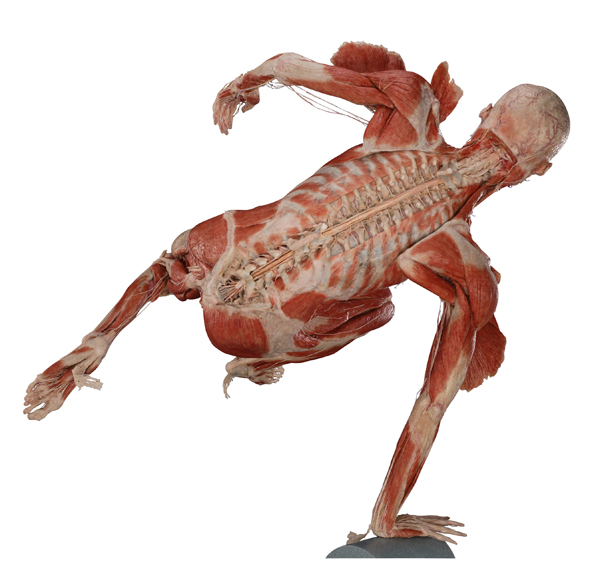
Walking into the exhibition is much the same as walking through the doors of a medical museum. Foetuses in various stages of development are on display in glass casings, an inevitable start to an exhibition partly titled … the Cycle of Life. Among the plastinated human bodies in various poses, human organs are on display, all of which gives the sense of being in a morphological museum rather than an art exhibition.
Yet, in Von Hagens’s defence, he does not claim his plastinates to be art, but rather displays that are scientific and educational. There is no doubt that comparing actual human lungs of smokers and non-smokers, the livers of alcoholics and non-alcoholics and placards with descriptions of eye disease and dementia serve some educational purpose in informing the general public about important health issues. Indeed, Von Hagen claims the skilfully dissected plastinates in which the skin is usually removed to reveal the inner structures, continue this cause in that the viewer is able to see how the body functions when acting out its respective tasks and activities. In this way, certain muscles and structures are emphasised (often pulled away from the bone) to give the impression of the structures being taut and in use. Von Hagen seems to endorse a philosophy that an understanding of the complexity and respect for the human form will encourage people to care for their own bodies.

The first posed specimen on display is female. Her skin is peeled away and she appears to be emerging from a piece of rock and leaving her skin behind her, revealing her underlying body. In line with Von Hagens’s educational claims she is accompanied by a wall poster which explains the importance of the skin as the largest organ of the human body. Another similarly dissected male specimen is turning the wheel of a ship, in a pose which accentuates the muscles in his arms. Another is playing a saxophone, while another plastinate is diving for a rugby ball and another is sitting on a swing. In one exhibit a female specimen is being held up by her male counterpart in a pose that resembles a kind of dancing scene, and the removal of structures around the woman’s knees and jaw reveals a prosthetic knee joint and pinned jaw.
Possibly the most controversial display is found in a sectioned-off portion of the exhibition venue: it reveals a male plastinate sitting on a chair, straddled by his plasinated female lover, resembling a couple in the throes of passion. In close proximity to the display is a board which discusses the risks of sexually transmitted diseases and HIV/AIDS. The woman specimen has been dissected so that her torso (from below the breasts to the hips) has been removed and replaced with a torso-shaped glass casing. Her spine is visible, but the casing also shows in no uncertain terms that the specimens are posed in the sexual act.
I found the idea of two dead bodies (consenting or not) posed in this way grotesque and macabre. But regardless of personal views on the moral propriety of such an exhibit it is at this point where I began to question Von Hagens’s claims of scientific, health and anatomical education more seriously. This is not the first time Von Hagens has posed his specimens in a “sex scene” which he refers to as “copulating corpses”. In an exhibition in Berlin, Von Hagens explained that the display “offers a deep understanding of the human body, the biology of reproduction, and the nature of sexuality”.
But does it really? Does this kind of display really aid us in our understanding of sexually related health issues? After all, the exhibit depicts (mainly) the sexual act (with which most people are familiar), without any ground-breaking facts on health issues and STDs or HIV that would help to further the general public’s understanding.
In addition, and despite Von Hagens’s scientific claims, artistic choices are certainly at play in the exhibition. The positions chosen for the various plastinates and their props, choices of dissection (in some cases eyebrows and bodily hair have been left despite the removal of the rest of the specimen’s skin) seem artistically inclined. In the case of the sex scene these types of decisions seem even more apparent and incomprehensible from an educational standpoint. The female body sports a pair of long black boots and large ear-rings and her nails have been painted black. Her lover, on the other hand, like the other specimens at the exhibit, is free of clothing and accessories. It is difficult to say what prompted this choice. The posters which warn against unsafe sex could suggest that the woman has been dressed to appear as promiscuous as possible. But what of her lover? If the implication is that the couple are engaging in unsafe sex, why has the emphasis of this been placed on the female? Whatever the intention here, I was certainly more confused than enlightened!
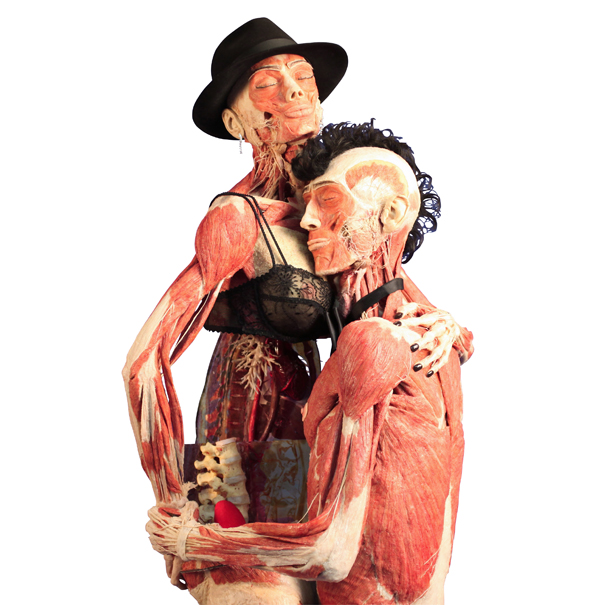
Finally, the “cycle of life” theme did not seem to be consistent throughout the exhibition. With the exception of the preserved foetuses and sex scene, none of the displays could directly be linked to the theme.
Critics in the past have claimed that Von Hagens breaks taboos simply to make money. Certainly, in the past people have gone to great lengths to make a fast buck, but with the idea of the “copulating corpses” in the back of my mind, I would say this money-making plan cannot be described as mainstream but rather as a macabre fascination.

Sources
Teken in op LitNet se gratis weeklikse nuusbrief. | Sign up for LitNet's free weekly newsletter.
Kommentaar
It begs the question: why not make body casts? Surely all of these could have been reproduced without actually putting the donated bodies on display?