

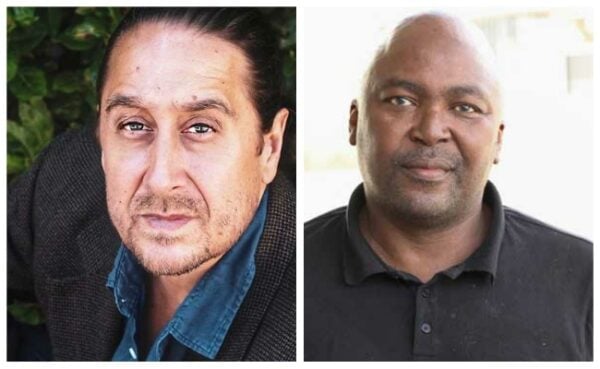
Vernon Head (credit: Kathleen Head); Mphuthumi Ntabeni (credit: Izak de Vries)
Vernon RL Head is a birdwatcher and an award-winning environmentalist. He is also a South African poet, a bestselling novelist and an internationally acclaimed architect. His first book – a nonfiction narrative – The search for the rarest bird in the world, was longlisted for the 2015 Sunday Times Alan Paton Literature Prize and has recently been translated into Arabic and other languages. His first novel, A tree for the birds, was longlisted for the Sunday Times Barry Ronge Fiction Prize and shortlisted for the National Institute of Humanities & Social Sciences 2020 Fiction Prize. His poetry was longlisted for the Sol Plaatje European Union Poetry Prize in 2014, 2017 and again in 2019. He has an MA in Creative Writing (UCT) and he writes for various international literary magazines.
In this interview, he talks to a fellow writer, Mphuthumi Ntabeni, for LitNet.
MN: Thank you very much for agreeing to do this.
I am sure you’re asked this a lot, but I’m going to dogpile on it anyway. Do you not get enough space to explore your creative juices in your architectural practice? What compelled you to be a writer – and not just any writer, but one that delves into various genres: from poetry to creative nonfiction with a scientific and environmental angle, to prose fiction with historical and philological interrogations in your recent novel, On that wave of gulls?
VH: Architecture is wonderfully creative; a rewarding profession, to be sure; perhaps even a way of life; and a kind of spatial journey that is really the manipulation of light. But that in itself is not enough for me, and so I seem to have turned to the wilderness in the hope of seeing more – more answers, more forms, more hope – and perhaps an enquiring glance at how that edge, where we end and nature begins, might have routes to our sense of place.
..........
Architecture is wonderfully creative; a rewarding profession, to be sure; perhaps even a way of life; and a kind of spatial journey that is really the manipulation of light. But that in itself is not enough for me, and so I seem to have turned to the wilderness in the hope of seeing more – more answers, more forms, more hope – and perhaps an enquiring glance at how that edge, where we end and nature begins, might have routes to our sense of place.
..............
The way light glitters through the leaves of a tree is, for me, immensely life-affirming and is of that tranquillity-holding sanctuary that we surely seek at every moment – inspiring, of course, in an artistic sense, and full of answers and literary music. And it was this searching – the birdwatching really, I guess – that led me to writing (very much like architecture comes initially as explorative, loose sketching, led by idea, concept, story). In a way, for me, writing is another kind of view of the world, with words and sentences and stanzas that seem to have allowed me to redefine myself under the trees: to re-see. And to have an opportunity to move between the poem, the traditional prose form, the nonfiction narrative and even the literary collage that I am now exploring, is to linger in the in between, a wholly new adventure.
Of course, what I have said here is really a pursuit of the beginnings of an interrogation of liminality: edges are fecund in every way. We need to roam there as artists. And philological questions wait like things of pure joy there. Where poetry becomes prose, for example, what a place for light, for tree light.
MN: Indeed, someone once said that writing is a way of paying attention to the world. And, as you know, architecture is also a way of looking into the world conceptually – a creative and meaningful way of wasting space.
You do say something along those lines and more in your book, The search for the rarest bird in the world, which was praised by none other than the global grandpa of environmental programmes narration David Attenborough, and blurbed by Athol Fugard. I think this passage of yours sums this up:
It occurred to me that birdwatching is like reading a book. And – as it can be with the arrangement of words – I have taken the simile to a different place: my special little landscape in the literary, each simile is of course a bird. Just as maps take us home safely at the end of every day, they also get us wonderfully lost.
Perhaps you could expound and share with us, if you would, the experience of going to the mountains of Ethiopia with the Cambridge group in search of this rarest bird, and tell us what inspired you to join the expedition.
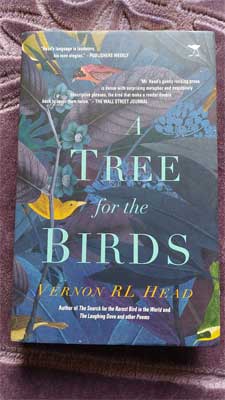
Picture: Mphuthumi Ntabeni
VH: When I watch birds, they move through the natural world that seems to touch our existence with the proudest intimacy. As birds move – or even pause, for they surely do, like breath, in the most elegant magnificence, and in a kind of mist that forests give, an unveiling in a way – it is as if they are making sentences then, “linkings” of land and sky, sea and shore, leaf becoming the next leaf, a narration or comment on an interconnected world, a mapping. When you watch a bird, you see everything else. One word becomes the next. Perhaps a sentence should never end? Nature speaks that way. An environment speaking forever.
Going to Ethiopia was to search for the rarest bird in the world, a bird no one had ever seen, the only bird named but never seen, the only living species described to science by just a single wing found squashed in dried mud along a smuggler’s trail high in the mountains, in one of the remotest places on the planet – a mythical bird! How could I not want to see it, watch it, let it tell me its story! Of course, looking for the rarest of the rare is to celebrate the most common, to treasure commonness. For me, writing is, in a way, about searching the space between the common and the rare. What a void within which to learn – and I’ll never stop.
Picture: Mphuthumi Ntabeni
MN: Your father was an architect, also. I wonder whether you ever felt too much under his shadow. Please tell us a little bit about him. Also, there’s one of your poems I like, titled, The end, in The laughing dove and other poems:
March Lily of the Lawn
In blushing dews,
Pink-pushed, up like a fist of
Bending bungles reaching for sound;
Lips with a link to the ground.
I drove my father to the hospital in a slow emergency,
Ageing the end of summer:
Fire Lily of the Lawn.
Alone on the verge of memories,
On a road of black,
Sifting the air near
The flower of Fear, we went.
And the distant chimney smoked of bones and skins,
Curling birds in Grey’s from within.
I wonder whether the exquisite detail of the poem comes from personal experience. I ask because in the last months before my mother succumbed to breast cancer, I used to drive her every morning to hospital for her treatment, and the details of those mornings are sometimes urgently clear to me: the manner in which the sun slants, the traffic noise like the wish-washing of the sea waves, etc. Was this the same for you?
VH: Please let me straightaway say that I am so terribly sorry for your loss.
My dad died of cancer, and I drove him back and forth to the hospitals; back, and then forth, and back again, to his death, in a kind of grey light. He died many times, and it was only the glimpses of the wilderness that seemed to comfort us as we went in and out of deaths. In between those tall hospital buildings and ambulance lights, there was a reminder somehow of a resilience that the natural world seems to scream in birdsong in the city sky, a call that says: after one death, breathe before the next, just like a day becomes a night and then another day.
I did not want to be an architect. For this reason, I shunned art at school – anything to do with the humanities, in fact – even history was a no-no. Instead, I turned to biology. I used to collect biology textbooks as a kid and write stuff about nature – behavioural stuff, observations that were largely scientific – and if I look back, weaved in between this science was the writing and the seeing. Dad was wise, though. He let me race on, and when I decided to do A-levels at school (we called it “post matric” back then), he said, why don’t you just give art a go. And I did, studying Roman and Greek antiquity, particularly kouroi; and that was it – I fell in love with art.
I registered for architecture the minute UCT opened for applications. (It should be noted that my dad was the greatest creative inspiration in my life, a gifted and celebrated architect of a level of genius I can’t begin to describe. He could draw a house in three dimensions on the wall in front of a client at a site, with the edge of a piece of broken brick and in perfect proportion.)
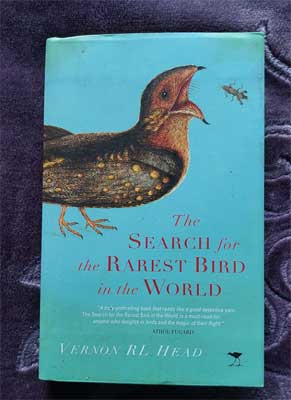
Picture: Mphuthumi Ntabeni
MN: Wonderful. My deepest condolences for your loss, also; it seems like your father was a fascinating person and a wonderful creative soul. I am starting to see similarities now in architectural spirits, if there’s such a thing.
The sea and birds are a very strong influence in your psyche. It is no wonder that one of your narrators in your recently published book, On that wave of gulls, is a seagull. I recently read the book Ada’s realm by an English-born Ghanaian lady who lives in Germany, Sharon Dodua Otoo. Her narrators range from a broom to a doorknob to a room to a passport.
What makes you guys go to this ancient trick of using inanimate objects and animals to narrate your stories – from Ovid’s Metamorphoses to Japanese classical writer Mishima? And, of course, this is a very common thing in African mythology and fables that you touch on. Most amusing to me is that almost all these non-human narrators display anthropological tendencies. And your architect protagonist seems to be unburdening himself of accumulated guilt from history. Pray, tell us more.
VH: Pray, indeed! Yes, I guess if one is going to write about the sea – a major theme in the book – one needs to explore where it ends: the land. And it is that edge where we begin. So, one of the points of view in this novel must surely be a celebration of the tide, the back and forth, the poetry that waves make, the tumbling words; and what better way to see it than through the eyes of a searching gull?
As for the architect, he was necessary to unpack citiness: an abomination in many ways – a single creature of greed and excess and poisonous walls, yet also a strange canvas, latticed by fertile cracks that are light (sometimes a glass window pane can twinkle like a quiet bay); a place of edges changing all the time, all of it in our name, for our name is our identity. Our name is all we have to mark our place on the map.
The architect character is a conglomeration of all the architects I have ever known, good and bad. In some ways, the book is about a toxic architectural language that has become our interpretation of the coast!
MN: I don’t suppose your mother’s name was Charlotte, who is your architect protagonist’s wife in On that wave of gulls? He also calls her his seagull. Why? That part reminds me of what Louise Glück said in her celebrated poem, “Nostos”: “We look at the world once, in childhood./ The rest is memory.”
VN: No Charlottes in my family! My architect protagonist calls his wife his seagull for a number of reasons. One, perhaps, is because as a boy he was taught by his father to see women as seagulls, in a certain way – not a good way, really. And then, there is an unreachable, untameable quality to a seagull, a certain freedom, a need for it to drift beyond our grasp: the seagull’s desire for the sea and the islands of the sea – all qualities that help describe the architect’s wife.
MN: Of course, Charlotte is the black wife of your architect protagonist. She hails from the Caribbean and loves Walcott; she’s even reading him when they meet in London. Basically, she is the one who brings the love and influence of poetry and the sea to him. She is born out of the Windrush generation, with fluid and syncretic cultural identity; the diasporic existence is something deep in her ancestry. Is this why, even when they’re married and living in Cape Town, she continues with the dualities of a semi-immigrant within her life, going frequently to the Caribbean and the UK? Her character has qualities of the sea: the perennial restlessness, the changing moods seen by different colours, the capaciousness of her feelings, etc. She seems to be both a guide and a haunt – a bird of passage, a seagull adaptable to living in multiple worlds. What is her main role in this novel?
VN: Charlotte is there to remind us that the world is changing: the powers of the North came to Africa long ago, taking people away on the sea, only for the takers to be transformed by the taken. Captured is not captured, you see; captured is just a time to think, and from the thinking came poetry and a musical sound of defiance and reflection and learning. And having Charlotte come back to Africa is all there for the reader to see – metaphor abounding, of course – the power of an inevitable and unstoppable tide. Charlotte is our future, our homecoming, and she will not be silenced; that is not the nature of a gull, even if you try to rip her tongue out!
MN: “Captured is not captured.” The Roman poet and satirist Horace had a similar saying: “Captive Greece captured her rude conqueror.”
Your writing – prose and poems alike – is suffused with deep appreciation of the city of Cape Town. These days, Cape Town as a literary muse is getting overtaken by Joburg, which now seems to have a more vibrant literary scene than the Mother City.
Those who have no extensive knowledge of Cape Town, who perhaps come here only on the urging of a tourist pamphlet or something, know of Long Street. But your muse – as far as Cape Town streets are concerned – likes Kloof Street, which, in a way, is a continuation of Long Street beyond the carnival-noise, clubbing lifestyle. Kloof is one of the oldest streets in the city; it also begins in the city bowl, but seems to move away from the madding, touristy noise of Long and the too-bustling hustle of Adderley, if not the now business smoke corridor that is St George’s Mall. Kloof is close enough to things, yet pushes up to the old money areas, like Oranjezicht, at the foot of Table Mountain. You even make one of your protagonists praise the street for bringing up “a few mega-house commissions” from fawning tourists there. He says:
I’d long considered Kloof Street a perfect street for me, a bridge between worlds: between me and the bank, between my house and place of work, between my wife and me, between my moods, my personalities, my faces.
Could you tell us more about your connection to Kloof Street?
VN: As for the geographical relevance of Kloof Street in the novel, it’s really just an example of an old colonial street that forms part of a city grid, which forms part of the many rigid, sick, often sterile routes between the land and the sea. It’s a street that is all about the moments of people, as if the roads and pavements were filled with a single, multi-headed creature of greed. The word kloof is, of course, quite useful here: an Afrikaans word, appropriate in that top; and it has a meaning that is about the physical landscape, “the steep-sided” ravine or the steeply sloped valley, the way the land might have perhaps been before we came, before whites arrived in manipulation, brought by the sea, brought by a tide carrying a past that became a future – some would even say leaving a scar, a straight and deep cut, a relic of language.
MN: My query here had selfish motives, because the protagonist of my current work lives in Vredehoek, close to Deer Park, and later on in his life at Kloof Nek. So, I was just fascinated by the coincidence of our inspiration.
You dedicate your latest book to Caribbean author and Nobel Prize laureate for literature Derek Walcott. He is also known as the poet of the sea and exile. So, it doesn’t surprise me to see that he has a great influence on your writing. I share his perennial love for Homer, especially in his book Omeros. In that book, he localises the story of the Odyssey to the Caribbean. It seems to me that On that wave of gulls is also written as an epic poem of subtle lyricism in the tradition of Omeros whose roots are in the Odyssey. Were these associations deliberate on your part? Do you also have a favourite book from Walcott’s oeuvre?
Perhaps you could give us a short thesis of the book that doesn’t necessarily reveal the plots?
VN: I am completely obsessed with the question: what is the edge of language, our language, any language, all languages? For me, it is poetry: our finest communication, our true definition of self, our finest achievement as a species. In language, we say everything about ourselves at once – a sort of living reflection, as terrifying as it is beautiful. And I see it when I see the waves, mirror after mirror. After all, it was Derek Walcott who called the waves “the pages of the sea”. And if we turn to Walcott, to his famous poem The sea is history, the very first stanza reads:
Where are your monuments, your battles, martyrs?/ Where is your tribal memory? Sirs,/ in that grey vault. The sea. The sea/ has locked them up. The sea is History ...
I find answers here, affirmation of a searching for a past that opens a way forward into unfathomable light. How could I not want to write of such a thing when I gaze across Cape Town and where it ends in the deepest tides? Of course, it has to be that in the sea historical memory is located in a way that is beyond time, moving, rolling, sifting, sucking, speaking line after line after line after line of words. The sea – for many people, all people – is where connections are formed, where we are formed, in the cultural, in the physical, in the dark depths of the mind.
The plot of the book is really about the various ways the sea might touch us, told from three points of view, with the narratives set up in a circadian rhythm of back and forth, such as with the push and pull of the moon.
MN: All this talk about the sea and the landscape of the Mother City has made me recall our recent quarrels when there was a suggestion about renaming the Cape Town airport. I think the most favourable name to the majority of the people was Krotoa, which I didn’t mind. But my bias was for Umlindi, which is what the XhoSan people used to call Table Mountain. Umlindi translates to “The One Who Waits”. There’s no perfect word translation for it in English, but “Hostess” comes close. The XhoSan word has an added urgency, because it doesn’t mean only one who waits, but one who does so with enthusiastic eagerness. I think a historical novel with Umlindi (Table Mountain) as a narrator would make for a great book, since, after all, the mountain of Camissa (sweet waters) has seen it all. Remember how the EFF wanted Winnie Mandela Airport. Some from the First Nations wanted Hoerikwaggo. What was your preferred name change for our airport?
VN: To name gateway spaces into cities is a toxic exercise, nothing more than cheap political nonsense. I suggest that any airport, seaport, bridge or four-stop traffic interchange into any city – anywhere – be more concerned with the place actually functioning properly, and less concerned with its name. Cape Town is a neutral name as it is. As it is, the city has more urgent problems to deal with than its placeholder on a map! If we are privileged enough to name things, name those with names that link to its history.
The names on the world map have almost destroyed the world. I’m so tired of cultures dominating by the simple act of naming and mapping other people’s lands after their own heroes; it is very sad! How dare a man name a mountain or a river or a valley or a sea just because he or she sees it, when those living in its shadow or at its edge for thousands of years have in fact already given it a name – an intimate name, a “proper” name!
MN: I agree with you. Personally, I am uncomfortable with the practice of naming things after people because everyone is fallible. Our animals, landscapes and vegetation are unique and neutral. I prefer naming things after them.
Anyway, I noticed that metaphors multiply in your recent book, On that wave of gulls, especially when the seagull voice comes to the fore: from the nests, as houses, competing for space on a small island, to calling Walcott “my genius islandmaleface”, to identifying her eggs as his poems. Do you want to expound for our readers how all this joins together?
You use a lot of KhoeSan mythology in your storytelling, like somewhere you say that the ostrich eggshell beads tell a story. What kind of story?
Also, were you not afraid of being accused of cultural appropriation in this overly sensitive age?
VH: Let’s jump straight to the issue of cultural appropriation or, to be more accurate – in this novel – cultural misappropriation, or perhaps even a little bit further: I think, as a white South African writer, it is important – and perhaps my responsibility – to write about white racism, the subtle Cape Town edge of it, as embodied in the architect character in the book, and so this architect needs to see in a very particular way.
..........
Let’s jump straight to the issue of cultural appropriation or, to be more accurate – in this novel – cultural misappropriation, or perhaps even a little bit further: I think, as a white South African writer, it is important – and perhaps my responsibility – to write about white racism, the subtle Cape Town edge of it, as embodied in the architect character in the book, and so this architect needs to see in a very particular way.
............
He needs to “embody”, “fantasise”, misinterpret and then dissociate – I can’t say more without giving the story away – and thus the emergence of ancient indigenous ways of seeing and walking, of the ritual of free movement, of defining ownership of the coast before the arrival of colonial ships, of the meaning behind cultural footprints, of a sense of real belonging, another’s belonging, of the emergence of strange stone cairns (or are they totems, or even buildings?), all fundamental to the true story of a city at the sea. Once again, the words of Walcott scream “the sea is history”, just as perhaps the edge of the sea is history, too.
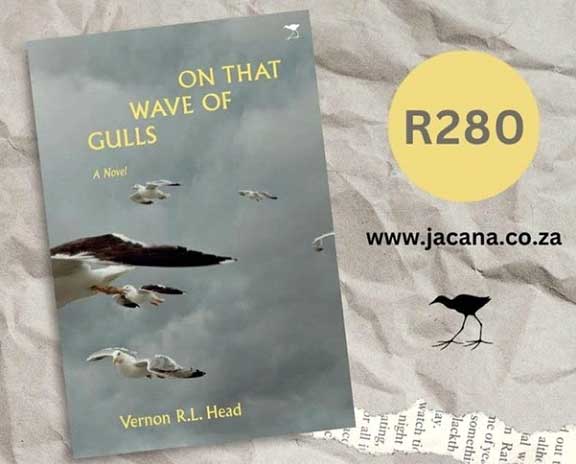
Of course, the device of using the seagull to say things is a little easier, with metaphor obviously clear all over the place, and the perspective vastly useful and even liberating, otherworldly. Look out for metaphors in the architect, too, and in Pooi! Their connections – all three of them actually intertwined – are just that! But I can’t say more; my reader needs to read to the end.
Picture: Jacana
MN: Tell us about the significance of the butterflies in your life, rather than the mere metaphoric role they play in the life of your character?
VN: My life is very much about engaging with the natural world, in all kinds of ways. Whether it be through travelling around the world looking for birds for my bird list, watching birds from my bedroom window at home or trying to help conserve them, it is through birds that I find an inspiring connection with the wilderness. (I can’t write without thinking of their wings and song.) And when one sees the birds, one sees the butterflies (and the flowers and trees, and the rivers and valleys and coastlines, of course). Butterflies are part of it all: a sort of joyous celebration, a dance between the sentimental and the dispassionate; for the gaze upon them is both of love and of rigour, of hope and of a kind of fear, a reminder of beauty and what teeters alongside it all the time. Butterflies are beautiful, like little fragile paintings in the sky. In the novel, butterflies embody much of this, but they also remind us of changing forms – of the ability to change, to crawl and wiggle and then to fly – and there is a kind of freedom in that transition.
MN: Though, like the rest, he’s inevitably drawn to the sea for peace, Pooi, the vagrant of Khoekhoe descent, seems to detonate a pent-up Pan African anger that only the sea assuages. He’s angry at everyone and everything. In real life, I have also discovered homeless people to be this angry. Do you think they feel themselves visible signs of a failing civilization – that is, gulls without a nest in which to lay their own eggs, thus having no meaningful contribution to the future generations? And, in this case, feeling robbed of their past and abode (land)?
VN: It might be that the homeless, the disposed of, the discarded, are those on the perimeter who might indeed see us best. There is a story which the street tells at night, when vast glass windows act like theatre curtains when one looks in, the yellow light glowing warm and dry – two worlds so close to each other, yet so terribly far apart, if you think about it. That’s Cape Town: a place divided by a skin of glass.
MN: Indeed, you even enact that in your book when talking about the house in Oranjezicht, or something. Your architect seems to be someone full of deeply felt regrets and frustrated insights, which perhaps is small wonder since, as John Ruskin puts it in his popular book, The poetry of architecture: “No man can be an architect, who is not a metaphysician.” He does embody someone driven by what is sometimes referred to as architecture, the science of feeling and seeing. Tell us more about his regrets and how they relate to you as the author of this book.
VN: I am an architect sometimes, but I am a writer and birdwatcher always, every moment of the day and every moment of the night. And yet, there are days when all I am and all I want to be is an architect. It doesn’t happen often these days, but it comes when I least expect it, like that one day when I was walking down Kloof Street and the lights glittered through the oaks, softening a wall into a trillion silver butterfly wings, and I thought of the mist the whiteness of the sea makes on the black rocks, and how buildings can heal and maybe make us better friends – for we forget sometimes that we are all friends.
MN: How do buildings heal, beyond their mere task of providing shelter? This is not rhetorical. I sense something which I can’t properly grasp in what you say. For me, it is even the discarded old buildings that deeply affect me: the sense of forlornness that they’re left with by the departed habitants. They seem lost and hapless, inspiring in me what I can call only a Nietzschean, surrendering sense of love and protection, like over the horse he saw being whipped on the street. I find that refurbishing old buildings, giving them new identity based on their DNA history, is what heals me if we talk about the healing we get from buildings.
VH: Perhaps some buildings heal beyond their architecture of utility, offering something that is more about memory, entering that space in our community that needs a sense of belonging, identity, commonality. Such buildings do not need to be monuments in the cityscape; they can be modest background buildings, standing side by side, making a street in which we might gather and meet. An architecture of healing is very much needed in Cape Town, our city of high glass walls and high glass palaces. (Some would say that the homes along the Atlantic Seaboard are nothing but a string of someone else’s jewels.)
MN: We know that architecture is thoroughly mediated by history, politics, industries and the flow of capital. Thus it is often criticised as a tool of the elite, even as it likes to portray itself as design art for providing for human habitation. Your architect character seems to feel the weight of this burden, like most architects of our age. He feels that his energy has been expended on superfluities of money; that even where he is allowed space for real creative design, he’s expected to create the fantastic rather than the graceful, because most of his rich clients in places like Camp’s Bay have no taste (unity of feeling) and are inspired by Hollywood sensibilities.
When looking at what prevails in modern architecture, do you sometimes get the depressing Ruskin feeling that: “All unity of feeling (which is the first principle of good taste) is neglected; we see nothing but incongruous combination: we have pinnacles without height, windows without light, columns with nothing to sustain, and buttresses with nothing to support.”
VN: What a privilege it has been for me here, to be interviewed by a great South African writer who also happens to be an architect! I still believe – with all my heart – that after taking the client’s brief (perhaps it’s an interpreted dream), the architect must turn to the site and let it say what the building must be. There is no other way. A site never lies about its primordial past: its ancient geological language of movement, of natural light and natural dark; the way air chooses to touch it; the shape of a rock that has been cast there in memory; the nature of birding above, perhaps, or the twinkle of a visiting insect. And, every now and then, there is the great privilege of being the architect on a site that might touch the line where the sea begins; at all such places, architecture happens if you let it come, as it is supposed to come.
MN: I think I would be remiss if I missed the opportunity to get your comments on the recent Venice Architecture Biennale. Patrik Schumacher, the principal architect of Zaha Hadid Architects, had this to say about it on Facebook, post title “Venice Biennale Blues”: “The Venice ‘Architecture’ Biennale is mislabelled and should stop laying claim to the title of architecture. This title is just generating confusion and disappointment. … Assuming Venice to be not only the most important item on our global architectural itinerary, but also representative of our discourse in general: What we are witnessing here is the discursive self-annihilation of the discipline.”
VN: While we are here (until the time of our extinction), there will always be a need for us to define the spaces we inhabit; and that is architecture – even if it’s just a line in the sand or a dot on the ground, which becomes a ripple that is the making of threshold or some sort of boundary or beginning or ending of our edge. I do predict that the architect of the future – in order to defend us from the rise of AI – will need to turn away from drawing, and embrace writing the poetry of place instead, which can be found in the words of light in between the leaves of a tree next door, or in those mirrors inside a curling wave in the bay.
MN: It has been my greatest pleasure having an opportunity to talk and explore with you common interests in writing and spatial design. You’ve assured me that life with an insatiable creative appetite is not an anomaly. I wish you all the best in your quest to be a man fully alive, which Saint Irenaeus said is the glory of God.
Also read: