

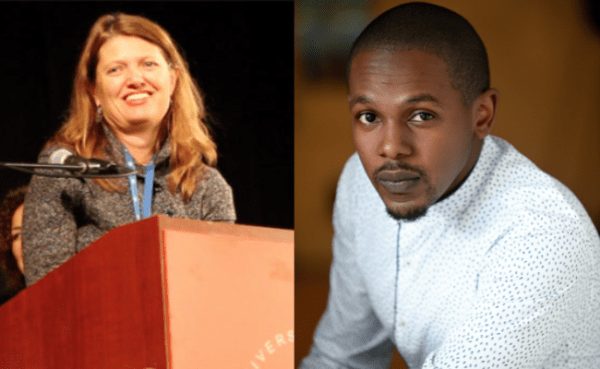
Pictures of Yvette Hardie and Mthokozisi Mntanda: provided
Mthokozisi Zulu from TADA (Theatre and Dance Alliance) and Yvette Hardie from STAND (Sustaining Theatre and Dance Foundation) talk to Naomi Meyer about their joint open letter to Minister Gayton McKenzie (read the letter here). (STAND also replied to LitNet: “We are pleased to inform you that the Honourable Minister Gayton McKenzie has acknowledged receipt of our open letter. He has expressed his willingness to meet with our sector to discuss the issues outlined in our correspondence.”)
Mthokozisi and Yvette, both of you are theatre practitioners, filmmakers and acting coaches involved in numerous theatre companies and productions. Please would you tell me a bit about your research in theatre practice, and how theatre has changed and evolved since your studies up to today?
M: Thank God for Professor Debbie Lütge! She cooked and prepared us at DUT for what is keeping us alive today. We always knew that we had to create our own work, but it became all the more real after we graduated. Having been blessed with a car in my first year out of university, I soon realised that I would have to use the tools I learned in tertiary, to continue adapting in order to survive in the industry and pay for car insurance! I decided to learn from the late Themi Venturas, and it was then that I realised the gold mines we’re sitting on with the state-funded theatres that we have. Themi opened up my eyes to many things that were not happening the way they were supposed to be. In one of my presentations to the minister of arts and culture, Nathi Mthethwa, when he invited representatives of both theatre and dance from each province to tell him how things were at the time, I spoke about how I did not understand why the youth do not have proper access to state-funded theatres. I spoke about one of the things I had learned and experienced in Germany: theatres flourish because they use what they have. We, too, should be doing that. We have the theatres, the rehearsal venues, the sets, the costumes and the talent. Why don’t we have a company of actors, dancers, technicians, etc? If we had such a structure, we would be producing shows throughout the year. The theatres would never be dark, and graduates from tertiary institutions would have a place to work and make a living. We would have subscribing audiences, and theatre would be doing so much more than it is doing now. We would be building the nation and contributing much more to our national economy. I have, unfortunately, since my studies up to today, seen theatre depreciate, and the lockdown did not help it. Through it all, however, I have seen the artist expand and transform. The artist grows, but who will house him? When I visited Zimbabwe in the year 2014, I couldn’t believe that they did not have state-funded theatres. It broke my heart. It breaks my heart even more when I see artists being refused access here, where we have such spaces. I owe all the acknowledgment for the work that I have created, to the research I obtained in Germany through the Next Generation Programme 2015 (Augenblick Mal), 2017 and 2018 (Starke Stücke). I believe that we have the same gold, if not better, here within these borders of South Africa our land. We just need the shafts to those mines opened for the muddy boots as well.
........
In one of my presentations to the minister of arts and culture, Nathi Mthethwa, when he invited representatives of both theatre and dance from each province to tell him how things were at the time, I spoke about how I did not understand why the youth do not have proper access to state-funded theatres.
........
Y: When I studied theatre at UCT in the late ’80s, we were essentially prepared for a life as an actor within some kind of permanent company structure – the performing arts councils were still in existence at the time – and there was little awareness of the need for artists to chart their own paths, create their own work, be producer, director, educator, technician or anything else, apart from their chosen specialisation. I soon discovered, however, that surviving in the industry required great resilience and great flexibility, and that, in order to survive, I would need to take on challenges in these other areas and not focus solely on acting. I also soon learned that as an actor one has little control over one’s own career, unless one is immensely successful, and that I needed to find ways to take charge within my own career and life for my own mental health. I think that training has changed somewhat now, and there is more focus at tertiary institutions on aspects such as theatre-making, but there is still not sufficient focus on arts administration and career management, in my view.
Theatre practice in more general terms is also evolving, and one of the interesting things has been to see how community-based research, scientific research and the performing arts are working more closely together. The idea of co-creation (which has always been a strength of the theatre community in South Africa) has been extended to a different way of engaging with people, where theatre can be a space for collecting information, reflecting back to people some of the research which has been gathered, and being a catalyst for social change. The work of Empatheatre, Karoo Kaarte and others is very inspiring in this respect.
You respectively represent TADA and the STAND Foundation, and recently TADA, together with the STAND Foundation, released an open letter to McKenzie. Please could you summarise the main aspects of this letter?
M: It welcomes the minister and urges him to communicate with the sector. Our industry seems to have not been heard by previous ministers, so our letter introduces our new leadership to our world. It informs him that he is coming into a mess left by his predecessors, but we are here, ready, willing and available to assist him as we all work together to improve the state of the arts. The letter was meant to start a conversation with the minister, and it has. This has given hope to many of us who have been fighting for the industry to be heard. We are confident that we are moving forward positively!
........
Our industry seems to have not been heard by previous ministers, so our letter introduces our new leadership to our world.
........
Y: Essentially, it calls the minister to action, to respect artists, to view the arts in general as a necessity and social good, and to be informed about the processes in which artists have already engaged in order to articulate their rights, their needs and their wishes for the industry. It also draws his attention to some of the unresolved and problematic decisions by recent ministers and urges him to find a productive way forward. We hoped it would introduce him to some of the more pressing needs of the sector, in order to cut through some of the noise and hopefully bring about real action and engagement.
Why write an open letter to McKenzie? Can artists not simply go on creating art without waiting for the government’s support?
M: Many of us are already creating work without the government’s support. If we waited, we wouldn’t have anything to put on the table. We wouldn’t be alive. We are not asking for money. We are asking for respect, an ear and collaboration. It is frustrating watching the industry that is supposed to house your God-given talent, moving back instead of making lives better. Arts and culture are all around us. In fact, they are used even by industries that are seen and respected more in comparison with ours. Our purpose at TADA is to advance and defend the interests of the dance and theatre sector as a whole and the interests of the individuals active within it, so we cannot just sit back and do nothing when we see what the problems are. We envision a just society in which all citizens enjoy the fundamental right “to participate in the cultural life of the community and to enjoy the arts” (Article 27 of the Universal Declaration of Human Rights), and in which the dignity, value and rights of creative workers are recognised and upheld. So, that’s why we wrote an open letter to the minister.
Y: Artists will always create work with or without government support, and indeed are doing so. This is not about funding for artists to make productions or anything else; rather, this is about the creation of a functional ecosystem that supports artists, that grows audiences and that encourages a vigorous and healthy sector. This means that there needs to be attention given to lifelong and life-wide arts education, and the true value of the arts on the personal, social and economic levels needs to be realised. The CCIS (cultural and creative industries) are as important to the economy as agriculture, and yet they are unregulated, and the people working within the sector are regularly subjected to exploitation, abuse and a precarious livelihood. Anything we can do to strengthen the conditions in which artists do their work is valuable, since ultimately it is about growing a society that has access to the arts, no matter where you come from or how much you earn.
........
Artists will always create work with or without government support, and indeed are doing so. This is not about funding for artists to make productions or anything else; rather, this is about the creation of a functional ecosystem that supports artists, that grows audiences and that encourages a vigorous and healthy sector.
........
I recently attended a musical theatre event in Camps Bay, presented by LAMTA (Hollywood – amazingly impressive!). I became acutely aware of the fact that contemporary artists now need to be not only actors, but also dancers and singers. Forget funding – what if you are simply not talented enough in all three areas of expertise to land a job in theatre at all? You have been involved in training young people, so I will ask you this difficult question. What if art is your passion, but you simply are not talented in all regards? Any advice for young people who wish to become involved in theatre? Why even consider this career if you are not naturally an actor and dancer and singer? Or will hard work help you reap some benefits?
M: If you are a triple threat, great! You can be casted as a dancer or singer if there is no role for you as an actor. However, even if you are a triple threat, you need to be a “threat”. Excellence is what separates award-winning work from work that just exposes and celebrates talent. If you are not a triple threat – if you are just an actor – be an excellent one! The work we do is heavily collaborative. We all come together to create, so there is a place for you even if you have just one skill. I have to do the same, and the reasoning is in my first answer: to encourage the young people I train to challenge themselves and be more. It doesn’t have to be only one of the three mentioned. There are many other skills you can learn within the theatre industry that can take you very far. I have friends I sometimes work with onstage and offstage. In this show, I may be lead, but in the next one I may be an assistant stage manager. Hard work will help you reap the benefits. And this applies to the one we all know is a star and the one hiding behind that acting block.
Y: If you are passionate about the arts, or theatre in this case, even if you are not very talented in the view of some people, there are still a number of reasons to pursue it. The skills that theatre training gives you – the capacity to communicate, to work with others, to listen effectively, to be flexible and creative in decision-making, to be empathetic, for example – are things which can take you successfully into other careers as well – law, journalism, teaching, business, design, architecture, you name it – should that be necessary down the line. And if you are very dedicated, you may indeed be able to find a way to make your career work for you in the arts. Self-belief, hard work and originality can go a long way. But you do need to want what the life has to offer. And while AI may be replacing many careers, the live experience of human connection that encountering the performing arts gives us, is still a powerful and necessary engagement which cannot be easily replaced.
........
The skills that theatre training gives you – the capacity to communicate, to work with others, to listen effectively, to be flexible and creative in decision-making, to be empathetic, for example – are things which can take you successfully into other careers as well – law, journalism, teaching, business, design, architecture, you name it – should that be necessary down the line.
........
Why is art important – in fact, why is it essential and vital in a country like ours?
M: We have freedom of expression – all of us, not only the artist. Stress is a killer, and the arts save many. The work we do is sacred. If you look at the theatre of ancient Greece, you find how Athens became both political and religious. We create conversations that confront and heal. We speak for those who don’t have a voice and take those who need to escape, to far-away places. Audiences leave changed. Art is so important, and without it I see an odourless, colourless, tasteless, silent and dead world. We see the benefits of arts education from the foundation stages, and its power does not die out as we grow. Art is both essential and vital not only in our country, but in the world at large.
Y: The arts give us the space and capacity to express ourselves freely on any topic and any concern, to meet those who are most unlike us, and to understand their points of view; the arts are a safe place to debate, contest, provoke, understand and create consensus. For a country where there is such inequality, such diversity, it is important that we get to hear and see one another, and that we also find spaces for humour, joy and celebration that draw us closer together. Empatheatre speaks of theatre as “acupuncture for the soul”, and I think this is a great analogy. Essentially, I think expressing ourselves artistically or experiencing someone else’s artistry is a form of medicine, as ancient as humanity itself. It is essential to who we are as human beings. It is not just a “nice to have”, and as such every community should be able to access the arts on their doorstep.
Also read:
LitNet | STAND: Teaterresensieslypskool 2023 | Theatre review workshop 2023