

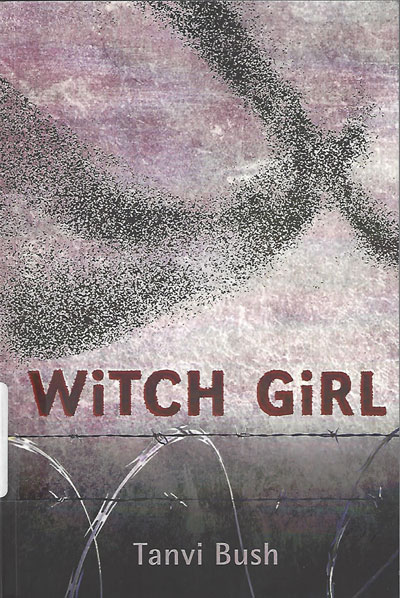
Tanvi Bush: Witch Girl (2015)
Narrated in a style initially resembling that of the typical adventure tale or the traditional “rollicking yarn” (but with several intriguing twists), Witch Girl is a novel that darkens as it moves along into the sinister aspects of a modernising African society. The text uses an enterprising, 11-year-old Zambian girl to tell a shocking tale which becomes the main evidence for a process of detection of a series of horrific acts and a terrifying organisation with international clientele and a new kind of African “raw material” used for export. It also takes on the dubious role that is played by certain so-called Christian organisations on the African continent.
Set mainly in Lusaka, where the author was brought up until the age of 10 – the city to which she returned in her twenties and remained until her deteriorating eyesight forced her to relocate to the UK and to change the medium of her creative work to writing – the novel reflects Bush’s affectionate but open-eyed awareness of the quality of life of those who live on the streets of the teeming city.
Before writing Witch Girl, her first novel, Bush had directed an award-winning film about a group of Aids-affected street children. She had loved living in Zambia, but was informed just before her return there in the late nineties that the degenerative eye condition of retinitis pigmentosa from which she suffers would eventually cost her her sight. Her response was to study filmmaking and to make the film Choka – Get Lost! (with the aid of an international crew).
The novel is constructed to resemble a detective story; it involves a death that later proves to have been a murder, as well as the uncovering of the criminal activities of a supposedly Christian, humanitarian body that turns out not to play the role of “saviour” as it claims to do, but to enslave, indoctrinate and prey on the street children of Lusaka (and other places). The novel contrasts the mysterious but wholesome capacity for visionary insight and the healing skills of the African herbalist with the evil witchcraft of some terrifying criminals, also juxtaposing the practice of medicine by an expatriate medic with the acts of a “doctor” whose ghastly “operations” chill the blood. Tanvi Bush’s text gives a balanced impression of both the vulnerability and the courageous strength and resilience of Africa’s children, particularly exemplified in the spirited Luse, whose own narration of her experiences forms and informs the novel. Bush’s interest in depicting the effect of Aids on children’s lives in her film, as in this novel, grew from her respect for her father’s practice – he had done sterling work as a doctor concerned to alleviate the sufferings of HIV/Aids patients in Zambia, and in 2005 was awarded an OBE for this.
In Zambia, as in several other parts of the African continent, traditional family structures are collapsing under the strain of the Aids pandemic, extreme poverty, or war. Whereas the extended family could in the past be relied on to take in children who had lost their parents, a disturbing new pattern of behaviour is to blame the parents’ death on their children, labelling them “witch children”. Hence the title of this text. However, the story starts well beyond the death of Luse’s father and the collapse of her mother – at a point when Luse and the little brother who is now in her sole care have lived on the streets of Lusaka for about four months. It opens on a night-time scene where the tired girl, on guard duty for the group of street children that she has joined (all but one of them believing her to be a boy), has fallen asleep standing up. She is woken up by a large drop of rain, a warning sign of the impending storm that might drown or sweep away the street children sheltering in a huge storm drain for the night. Luse searches desperately in the pitch-dark confusion to find her little brother in time and run with him to safety:
“Get up, you idiots!” Luse screams again. “Rain! Rain!” As alarm begins to spread among the ragged piles, movement erupts all around her. Children shout and call to each other in Bemba, Tonga, Nyanja, Lingala, English. Luse pushes and pummels her way back through the melee. Over the racket, she can already hear the low roar of storm water from all over the city rushing like some filthy, furious beast down a thousand pipes towards this main drain. Her feet are now sloshing through foul sewage water gushing from the ground pipes. It is rising fast. She steps on something sharp with her bare foot and yelps, nearly falling over, but there is no time to check the damage. She wades further in. “Joshua!” she shouts. ”Josh! Josh! Where are you?” (2–3)
As the story unfolds, Bush introduces a parallel account of a British-born medic, Dr Georgia Shapiro, devastated by the death of her dearest friend, a Zambian Rastafarian; a man overflowing with life and love of fun, who was killed in a car accident.
We also learn that Luse and little Josh not only live on the streets, but have had indications that there are people hunting for them. They were recently in the company of the man who died, who had told them before he disappeared that they should contact Georgia. Finding her takes some ingenuity, as the clinic where she works is in an area controlled by the dreadful Twins, Lusaka’s most fearful criminals (protected by their brother, a top police officer), who are particularly “interested” in Luse and Josh. Georgia’s receptionist tries to block the two scruffy street children from access to the young doctor, but fortunately a kindly priest, Father Bernard (who has an appointment with Georgia), takes an interest in the children and brings them into Georgia’s consulting room with him when called. Georgia soon discovers that Luse is very ill from the now dangerously infected wound on her foot. She treats Luse in time and saves her life before taking the girl (as she soon discovers the “boy” to be) with her to her home for recuperation – doing this also because Luse has indicated that she brings a message from Harry, her deceased friend. He had helped the children to make their way (back) to Lusaka, but had disappeared after telling them to wait for him. Father Bernard being unusually upset by the reference to the cult group from which the children had escaped, Georgia tries to make sense of the situation:
As a doctor she has seen many of the consequences of fear, stigma and superstition that cast a murky fog around the treatment of HIV and Aids. She has treated other children and adults cast out by their families through fear and shame, has seen first-hand the wounds and scars inflicted by fake traditional healers on sufferers too. Far too many unscrupulous men and women set up as doctors and healers here, faking cures for money and making fortunes out of blood and death. Ironically, it is often the unsterilized razors and sharpened bones the fake witch-doctors use that spread the HIV infection – along with tetanus, septicaemia and false hope. (42)
Georgia learns from Father Bernard, after the exhausted siblings have been put to bed, that he himself had played a role in permitting the group that had kidnapped the children, and a terrible film called Witch Children that they used to publicise their ministry and exorcism practices, to work and to be shown in Zambia. He had been horrified once he actually saw the film, but he had been very favourably impressed by the pastor of this church, a woman priest, who claimed that they were very successful in helping people. Father Bernard knows now that the woman who deceived him is called Selena Clarke and that she is nicknamed “the Priestess”.
Georgia has in the meantime contacted her deceased friend’s older brother Gus, a military man whom she had met at Harry’s funeral, since both Luse’s story and an envelope left for her by Harry with their barman point to the need to investigate Harry’s death. They know now that Harry had acted as a “fixer” for two young Danish investigative filmmakers. When he arrives, Gus brings with him an associate with forensic skills. Georgia is later on dismayed to hear Gus’s admission that he had pressured Harry into continuing to assist the Danish filmmakers even though he had been aware of how dangerous a task they were undertaking, having himself fruitlessly taken on a UN-assigned investigation of child trafficking and the international marketing of human body parts from Zambia. Interpol too had warned Zambia of criminal practices of this kind being carried out under the cloak of religion or healing. Gus makes the difficult admission to Georgia, who had so dearly loved Harry, that “he always spoke about [her] as the one person he could trust. It was you, not me, that was his real family,” he adds (55).
Bush gives us just a glimpse of how difficult it is for a girl as young as Luse to tell the story she has been asked to relate to Georgia, Gus and Father Bernard:
She needs to bring the sweepings of her memories together, to slot them into some kind of order so that she can speak clearly about what has happened to her family, to the Rasta. Her head feels swollen with memories. They bulge behind her closed eyes, but they scare her and she resists them. Finding the right ones and the safe ones is like trying to pluck a single ant from a nest. Others always end up crawling up your arm no matter how careful you are … (57)
She even worries, in a panic, that these memories will turn the now sheltering adults against her as the terrible details emerge. The reader hears for the first time here about the peaceful family that Luse, Josh and their parents had been, often visiting her maternal grandmother Ba’Neene, who lived on the shores of Lake Kariba in a lovely home that had been built by her late Tsonga husband, a successful entrepreneur in the fishing business. It was Ba’Neene who had helped Luse, when the girl became inexplicably uncooperative and unpleasant in her conduct, to understand that her misbehaviour stemmed from her having been unfairly stigmatised and mocked at school as the daughter of an Aids-infected father – “a pig-sick, disgusting, infectious AIDS baby” (72). And after the painful story was told Ba’Neene could explain to Luse that she and her brother were uninfected and healthy and would stay that way if they behaved sensibly.
When the scene is set in Georgia’s home, after the evening meal, for Luse to tell her story to the adults, it is Georgia who notices how the girl is clenching and unclenching her fists. They ask her soothingly to begin by telling them how her family became involved with the Blood of Christ Church.
Luse starts her story at the point where her father, his health deteriorating, had begun drinking heavily and frequenting a particular pub. On an evening when this strong-willed child (then about 8 or 9) had decided to go and call her father home to honour an appointment, she found him listening raptly to a striking, tall, beautifully dressed but strange woman (the Priestess), who had come to the pub with an associate to proselytise. From that point on, Luse’s father was hooked, believing utterly in the fanatic proclamations of the Blood of Christ Church. The family’s ordinary, middle-class practices and pleasures had to be curtailed or cancelled accordingly. On one occasion, Luse was taken by her father to a gathering of his new church to witness for herself a horrifying event – a supposed exorcism. A boy slightly older than herself attending the “service” with his recently widowed mother is identified by the Priestess as supposedly possessed by the “demon” that allegedly killed his father, an Aids sufferer. The Priestess’s masterful, melodramatic staging of this event, which ends with the boy running from the congregation, all of whose members are instructed to ostracise him for refusing to be “cleansed” of an evil that is not in him, horrified and terrified Luse. Perhaps even more frightening to the girl was the realisation that parents would betray their duty to protect their own children in order to comply with the Priestess’s demonic demands and fake claims against the children. Her destructive influence is further apparent when “the very next day, Luse’s father takes his packets of antiretrovirals […] and starts emptying them down the kitchen sink” (89).
In contrast with Luse’s father’s initiation cum seduction into the Church of the Blood of Christ, Bush evokes in great detail Luse’s own vivid and detailed memories of how her beloved Ba’Neene (her maternal grandmother) had introduced her to the shrine of her people; a deeply hidden, beautiful and secret place where her ancestors on her mother’s side were buried. Going there, even though she was led and guided into how to behave by Ba’neene, took courage in so young a child – and great love and trust in Ba’neene. “Keep right behind Ba’neene, she thinks. You can do it for her … This is for her …” (95). They crawl through a pitch-dark, narrow cave tunnel, chewing a special kind of stick to keep bad spirits from entering them during their arduous climb to the sacred place, but at the end of the tunnel, where the cave roof had collapsed a long time ago, they emerge in the open to see a small hidden valley graced by a waterfall and a deep pool and filled with lush vegetation. The valley is musical; it resounds with birdsong. In it, Ba’neene shows Luse where they need to sweep a certain area clear of fallen leaves and bird droppings. This is where the graves and gravestones of Luse’s ancestors, including Ba’neene’s late husband, are. It is a place of great peace, Luse feels.
After they have washed in and drunk from the pool, Ba’neene leads Luse to her grandfather’s grave and as she kneels down with her granddaughter, she says, simply, “Chipo, meet your granddaughter” (96). Luse has also now realised that a recently dug, six-feet-deep cavity dug in the earth in the area that they swept is intended for Ba’neene. That same night, Ba’neene declines to join the evening festivities in the valley. In the morning, Luse soon realises that the beloved grandmother in whose heart she had a special place, and who had taught her so much plant lore (Ba’neene had been a great herbalist), has passed away. But since this death has been planned for, expected and was a peaceful transition, no one in the family or community treats it as a tragedy. Luse will, in the often harrowing situations she will be faced with in the future, feel her grandmother’s continuing presence, advice and guardianship.
Not long after her grandmother’s passing, Luse and little Josh awake one morning to witness the tail end of an awful quarrel between their parents. Their mother has shattered a glass on the kitchen floor in her fury at being told that her husband has, without consulting her in the matter, resigned from his banking job to become a pastor in the Church of the Blood of Christ. As Esther utters her objections (in no uncertain terms, overcome with indignant anger), Paul (Luse’s father) steps forward and heavily slaps her, so that “the crack of his palm across her face echoes off the empty, unfurnished walls like a gunshot” (107). What makes the event especially appalling to both the children and their mother is that Paul has never before been physically violent towards her. Luse sees her father’s “mouth working as if trying to apologise, but Esther backs away from him”.
Then Luse sees something happen to her father. He straightens and his eyes go dead as a goat’s and in a strange, monotone voice he says as if in a play, “Wives, submit yourselves unto your own husbands, as unto the Lord. For the husband is the head of the wife, even as Christ is the head of the church [.…] [Then he declares:] I will stop working for Mammon. I will be a pastor here for The Blood of Christ Church. […] and […] I will be respected in my own household. Now pull yourself together.”
With those final, dismissive words, Paul walks around his shocked wife and stalks out of the kitchen, slamming the bedroom door behind him (108). He has earlier stopped taking his antiretrovirals as his Church disapproves of “Western medicine” and takes a patient’s rejection of the medication as a sign of their faith in the Lord’s healing powers. Now Paul will rapidly and visibly weaken as his health declines, and additionally money becomes tight in the formerly prosperous household, now living in the countryside in Ba’neene’s former home.
A year later, Esther and her sister Miriam (who has come over specially from Canada, where she lives) go to the shrine in the hidden valley for their late mother’s memorial. Paul has remained at home with members of his church group, and as Esther is about to enter their home upon her, her sister’s and the children’s return from the shrine, Paul brushes her fiercely with a cross held in one hand and splashes her with water from a bottle in his other hand, while the shout “Cast out your demons!” rings out from behind him. But Aunt Miriam is quick to put him in his place, calling Paul a “fucking asshole”, a “damn idiot” and a “sick bastard” (112), in that order, for attempting to perform an exorcism on her sister, particularly when they have just returned from the memorial for Ba’neene. This time Paul slinks away, defeated. But not long after, the great crisis in the children’s lives brought about by Paul’s affiliation to the Church of the Blood of Christ erupts, engulfing and shattering their formerly happy, tight-knit family. As Paul’s health deteriorates alarmingly and he becomes permanently bed-ridden, Esther (who is in long-term employment as a nurse) has to spend more and more of her spare time and sleeping hours taking care of him.
The night before Luse’s 11th birthday she sees her mother sitting in despair and all but collapsed from exhaustion, slumped in a kitchen chair. She takes Esther to bed, but the next morning Josh raises the alarm: not only has their mother forgotten to give them breakfast and take them to school, but she has driven off (a telling detail, as this clever little boy realises) without wearing her work shoes. Not long after, Esther (in a dazed and confused condition) is brought home by the police; she had driven the car off the road and into a ditch, probably overwhelmed by fatigue. The vultures from the church group have come upon the scene and use it to insert themselves and their authority into the family’s home. Esther never recovers her strength or competence during these few days and is at best semi-conscious; the father of the family is a physical wreck, near death.
After Paul’s death the “congregation” members start looting furniture from the house. There is nothing that the children can do. Luse attempts to get her mother to hospital and to eject the church people, but to no avail, and when she becomes ever fiercer in her objections to their presence and ministrations to her parents, they lock her and Josh in a small burglar-proofed bedroom, giving them neither food nor water for two full days. They have, hysterically, proclaimed that the two of them are witch children who were and are “devouring” their parents. Esther is taken away from her home and children and in her enfeebled condition she, too, can do nothing. The Priestess again makes her appearance in their home and the two children, who have been forcibly kidnapped by having sacks put over their heads, are driven off at night to a faraway, unknown destination that turns out to be the Blood of Christ Street Children Rehabilitation Centre (as it grandly styles its bogus role).
Two “footnotes’ can be added to this part of Luse’s lengthy and detailed narrative, told as it is over several days to Georgia, Gus and Father Bernard. One is that on the second night, as Georgia tucks an exhausted Luse into bed, the little girl whispers to her that she fears she did in fact kill her father, or at least was responsible for his death. Prompted to explain, she tells Georgia that on one of the last afternoons when he was still able to move from his bed, he had called her over to him and mumbled what seemed to be an apology and a request that she get him his retroviral medication, but she was so disgusted by what his conduct had done to their family and so repelled by the odour that emanated from his ailing body that she ran away. Even though Georgia patiently and very gently explains to Luse that she knows, as a doctor, that Paul was far beyond curing at that stage, Luse is still unable to forgive herself – yet another burden carried by the afflicted child. Still, she had vividly recalled the way in which Ba’neene had come to her aid when she and Josh were locked in the small room just before the kidnapping: she had “appeared” in Luse’s mind and assured her that, since the church people were scared of her, she should use that; it gave her some power over such superstitious people. And this Luse did, even biting a chunk out of one of the kidnapper’s cheeks, a small girl terrifying a huge man.
At the school, Luse and Josh (the little brother that Luse has been constantly comforting and reassuring) are “processed” by the staff after their night-time arrival, both bruised, battered, dirty and desperately hungry. They are washed, quickly physically examined by the Chinese doctor with the scarred cheek (who establishes inter alia that Luse is a virgin) and fed food that turns out to have been lightly drugged. They are at this time still in the strange building that seems to dominate the enclosed school grounds, known as the Dome. The next day they will be placed in a dormitory with other children. When Luse wakes up during the night and sees that Josh is missing, she immediately starts searching for him, being careful not to be seen (and as she surmises, no doubt correctly), stopped and forcibly taken back to bed. This is how Luse stumbles on what is undoubtedly the most horrifying scene in the novel. [Sensitive readers are seriously warned to skip to the next paragraph.] She finds that she is on a suspended viewing platform overlooking an operating theatre where there is a small form prone on the table, over which the Chinese doctor (she now knows he is Dr Lin) is leaning, brandishing a scalpel. There is much blood. Luse overhears a staff member give an order to another to “go and tell reception to start the count-down. They are nearly at the heart” even as she sees one of the viewers, a massive black woman, leap from her seat, unable to restrain herself, to go and stand with her hands “against the grubby glass window”; this woman “looks down at the child on the operating table as if she is starving and the tip of a pink tongue comes out of her mouth and rolls around her lips” (147). Soon after, Dr Lin “leans in over the child, cutting away at the open chest, while white bones and bright red muscle stick up from between his fingers”. He then makes a “jerking motion” and a moment later “holds up the bundle of bloody red meat” which he “brandishes […] at the viewing gallery” to an “eruption” of cheering and stamping feet, with some excited shouts coming over the many telephone lines (148).
Luse manages to dash back to the room she came from and there, in the bath, finds Joshua fast asleep; he had wet his bed earlier and got out of it to sleep in the bath. Still shivering, Luse (naturally without breathing a word of what she has just witnessed) takes her brother to sleep with her in the bed assigned to her, where they curl up together for comfort.
Describing the weeks spent at the “school”, and the both sinister and banal aspects of the way the school is run, would take too long, so a few details must suffice.
Ever alert, Luse notices that even as more and more children are brought to the school (among them a large contingent of savvy Lusaka street children whose daring and rebelliousness she strongly admires), some keep quietly disappearing – no one knows exactly where to. There are “reassuring” rumours that such children have been chosen for adoption by “Western” families, but Luse is not fooled. Slowly and carefully, she thinks up an escape plan; her one friend, an older boy named Eli, will be joining her and Joshua. None of the other children is brave enough to follow these three out of the school grounds, knowing that pursuit would be fierce and punishment severe if they were caught.
It is once they are over the electrified fence (with the aid of a big rain storm and a toppled tree) that the three children discover an injured man in a ditch outside the school grounds. Readers know that this is/was Harry – Georgia’s friend and Gus’s younger brother, but to the children he is simply “the Rasta”. Luse’s grandmother comes into her body to help the children and the adult in need of assistance; working inexplicably but effectively “through” and “in” Luse’s body, Ba’neene locates a specific plant which is first crushed and, when placed in the Rasta’s mouth, allows him to forcibly expel something horrible and poisonous that had clogged his breathing and would soon have caused his death. Although he is quite badly injured, they now have an adult and a fellow “escapee” on their side. Luse pretends to be knocked down by a passing Chinese vegetable farmer in a truck and they snatch the poor man’s vehicle to drive back to Lusaka. Just as they reach the central section of the city, the Rasta (painfully driving the truck with Eli to help change the gears) wildly swings the truck across two oncoming lanes of traffic. He explains to the shocked children that a car (which the reader knows to be the Priestess’s Mercedes) had been following them; now they have escaped pursuit.
Harry enjoins the children to wait in the truck while he goes for help. He never returns. We know it is because those working for the Priestess tracked him down and killed him in an engineered accident, but not before he had managed to leave his silver cigarette box with Luse for Georgia and had delivered an envelope containing the juju that was used to poison him, the Priestess’s cross and one Danish filmmaker’s driver’s licence with their barman, who later gave it to Georgia.
As Luse’s tale continues, she describes how she managed to get accepted in a Lusaka gang of street children with the aid of one canny boy, the only one into her secret of being a girl.
There is a further harrowing twist to the tale, however. When Luse woke up in the truck to find that Harry had not returned as promised and that Eli had also gone missing (to find food), she and Josh were “discovered” by a uniformed young Zambian woman who claimed to bring them a message from Eli that they should come and join him at an NGO shelter and feeding centre for street children. There, Eli eventually shows up, evidently the captive of a gang of young thugs under the command of two huge and terrifying men – the Twins, whose criminal territory commands all of central Lusaka and who are flourishing and causing dread and perpetual mayhem under the protection of their brother, a high-ranking police officer, as was mentioned earlier. They are both employees and partners of the Priestess and use the NGO as a catchment area to kidnap street children for her “school”. They have, of course, been given specific instructions to recapture Luse, Josh and Eli. In the horrifying moments at the shelter, the drunken police officer who is with them attempts to rape Luse as his “reward”, but with her grandmother’s spiritual presence strengthening her, Luse manages to throw him off her and give him a great shove. He falls on to the stove where food is being cooked; his clothes are set alight and then the whole shelter catches fire. Under the “protection” of the ensuing chaos, Luse escapes with Josh and Eli, guided by a boy street child named Bligh who has taken to Luse. He is as ugly as he is canny; an excellent ally. The children live by begging, stealing and sharing, but life on the street is very, very hard – especially initially.
Luse and Josh are camped under a stairwell in a half-demolished block of flats. They are trying to sleep on piled up rubbish and the flies and mosquitoes, even at this time of night, are dreadful. The stink they hardly notice anymore. Bligh and Eli have gone to beg outside the Omega Bar, a popular nightspot near the Lebanese supermarket, but Joshua has had a bad bout of diarrhoea and Luse can’t leave him. It is hardly surprising. The rain has failed to make a proper appearance and the heat means everything rots so quickly that any scraps they find in the trash are putrefying. All of them, except Bligh, have been sick and for the first time Luse has had to deal with the fact that being homeless means there is no way of finding adequate and private places to be sick in or to clean up afterwards. They shit balanced precariously over open sewers, sometimes, if the cramps are bad, just in the nearby bushes. Sickness leaves them weak and dizzy and vulnerable to attack from other kids or adults. Luse’s bundle of spare clothes [stolen] from the market has been stolen and Joshua no longer has any shoes, which means she has to lug him around on her hip when she feels strong enough. God, how Luse hates never being clean. (204–5)
Eli, who was injured by the Twins’ thugs, steadily deteriorates in health, and one morning they find him dead. Luse and Josh last saw Bligh when he refused to follow them into the Twins’ territory to locate Georgia at her clinic.
Luse’s and Georgia’s stories have now joined up. Gus remarks that locating the children’s Aunt Miriam by finding out her married name would be the next step for the children, apart from following up the criminals. It is Luse who reminds them all of the “silver” cigarette box that Harry (“the Rasta”) had entrusted to the little girl. Opening it, they find a memory card from a camcorder containing four files that can be opened. In them is the vital evidence of the murderous activities and ruthless procedures of the Priestess, Doctor Lin and the Church of the Blood of Christ. But the very next day, while she is at her clinic, Georgia’s car is tampered with and she narrowly escapes serious injury or death in a car accident, rushing home to find that while she was away (as were Gus and Luse, who were buying clothes for the children), the Priestess’s people broke into her home, attacked and tied up her domestic worker and the gardener, and took Joshua – as Luse immediately surmises, returning him to the school for “organ harvesting”, as the horrifying practice has come to be known.
During the last part of the story we hear how the small group of allies, now with the aid of a Zambian military contingent, locate the evil school and rescue Joshua – just in time, in the tradition of the adventure story. The Priestess and most of her allies are killed, eventually, but not before other terribly tense moments and scary experiences. As Father Bush says later about the locals and foreigners who are the funders and clients of murky and terrible “businesses”, such as the Church of the Blood of Christ: “It’s insane. These people … Either they buy our children or they eat them” (257). Gus comments: “You know, … I’m beginning to think the Priestess wasn’t in charge of it all. The Phiris [the weird couple who owned the land on which the ‘school’ stands] and Dr Lin have been working together for years on the black market” (257–8).
Bush shows us, delicately, how Ba’neene’s strong spirit continues to guide and assist Luse and helps her to resist despair, panic and (inappropriate, but nevertheless severe) self-blame. She reassures her granddaughter that she is not a witch; that she and her grandmother are like all other people, open to the entire universe and to the past, present and future. There is only one small but vital difference that sets them off: unlike most other people, they “choose to listen” to the rushing universe, and so people like them hear and feel what it communicates (249). Further comforting words come to Luse from the kindly, seriously injured, giant guard at the school, Samuel Yomba, who had helped them. “You know, little sister [he asks Luse], that when you ring a bell the sound goes on for a long time after?” When she nods, he adds: “Well, a night like that is the same. It will be ringing in your ears for a while, but it will go, I promise” (259).
Bush ends her novel on a scene of reunion that is also immensely painful. First, Aunt Miriam is brought to Georgia’s house. I conclude my profile of the text by simply quoting from the last few vividly, poignantly and beautifully imagined paragraphs:
“It’s Auntie Miriam,” [Josh] says slowly and carefully, tasting the words. As what that really means begins to filter into his head, he twitches, jumps with excitement, runs in a circle. “It’s Auntie Miriam!” he shouts and abruptly he bursts into huge racking sobs and collapses, head on his arms on the floor in front of her. Ever so gently Miriam crawls to him, pulling him into her arms and cuddling him tight […] “Luse,” says Georgia quietly and takes her hand. “Come outside.” [A car is parked there and] on the far side of the car […] someone else is slowly climbing out of the car. Georgia is talking, saying words like “hospice” and “missing records”, but Luse hears nothing. Baama. Her mother looks different, so thin and she is leaning on a stick. As she moves around the car […] Luse has moved too without knowing and now she is standing in front of her mother and still they say nothing and still they gaze at each other. And then slowly and with difficulty, as if she is an old woman, Esther kneels down in front of her daughter and opens her arms. (260)