

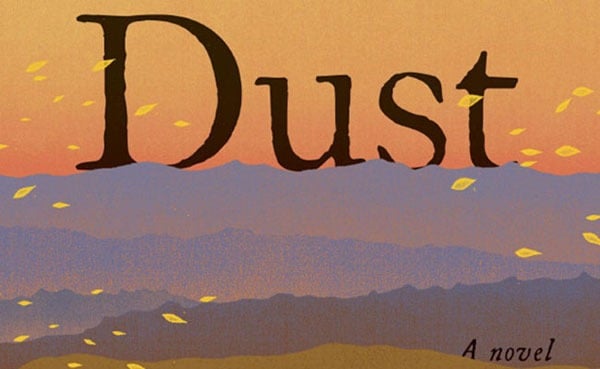
Dust
by Yvonne Adhiambo Owuor (2014)
Dust is a major novel – a complex text that takes on a huge topic: no less than nearly five decades of Kenya’s fraught history, linked to the experiences of a core of characters who are either members of, or whose stories are entangled with, an unusual family from the dry, far north of Kenya. This is Turkana territory, though neither Nyipir Oganda (the father) nor Akai (the mother) is originally from this area. The homestead in which they live is a colonial construction that is slowly crumbling under the onslaught of time, weather and termites, forming something of a parallel to a collapsing national social fabric – the text opening just as the 2007 post-election violence erupts in Nairobi and harking back to numerous earlier instances of political predation, fomented ethnically targeted mass killings, political assassinations and ruthless, corrupt practices. The novel is at once fierce in its indictments, relentless in its slowly deployed exposures and profoundly compassionate. There is no facile Afro-pessimism in this deeply committed novel, whose passionate strength evidently springs from the author’s indelible association with the country of her birth. A prize-winning writer of short fiction and an admired public intellectual, Owuor reportedly took ten years to construct this novel, an effort that shows in the density of texture, artful narrative construction and emotionally finely tuned writing.
The main theme of the novel is the culture of secrecy and hushed-up wrongs that prevails and has dominated in Kenyan society, according to Owuor’s diagnostic vision. In profiling her challenging novel in an account like this African Library entry, it is necessary to mention that the text becomes to an extent (inevitably?) diluted as its slowly, carefully deployed revelations are more simply and straightforwardly represented in a disentangling process that misrepresents its satisfying intricacies. It is, however, necessary for the sake of a reasonable degree of readerly comprehensibility (for instance) to reorder in the account offered the major characters’ remembered, retold experiences that are woven together in Owuor’s narrative. Her layered novel uncovers the deep roots from which characters’ actions, choices and reorienting personal changes derive. Within the diverse histories and circumstances of the wide range of (mainly Kenyan) characters one begins to perceive the humanity of Owuor’s authorial vision; a grasp of the sometimes unbearable pressures and ugly survival choices that are necessitated within an extremely difficult social and political (and familial) environment (though the family is as often unavailable or lost as demandingly present).
Nyipir Oganda, in some sense the main character of Dust, grew up in the south-western Kenyan region of Nyanza. His father and older brother were summoned by their chief to join the King’s African Rifles in World War I and never returned from Burma. Not long after, his mother dies – soon followed by his little sister. The orphaned boy’s inheritance is confiscated by a bullying uncle who takes him out of school to herd cattle and attacks him with a whip when two of his goats die after eating poisonous plants. Unbearably provoked, the boy picks up a hoe and splits his vicious uncle’s skull, very possibly killing him, and goes into hiding, protected and helped to get away by a former WWI soldier, an old friend of his father’s.
Nyipir’s story contains some of the deepest and most harrowing secrets of this secretive society with its many terrible and dangerously divisive loyalties. He is not only a man of many sorrows and losses, but also brave, fiercely independent and a deeply loving though at times wrongheaded father whose authoritarianism drove his only son from him. It is only far along in the text that the reader gets Nyipir into clearer focus, and realises his centrality to the Kenyan narrative which Owuor uses him to tell. He is a very private man, though deeply involved in his family; the many secrets in his life range from forgotten associations to dangerous, shameful and guilty ones.
Baba Jimmy takes Nyipir to a Catholic mission orphanage and school in western Kenya, where he gets his primary education. With no one to sponsor his secondary schooling, a priest sends the boy to Fort Hall in central Kenya, a mission station where a “non-Kikuyu” youngster is needed to work in the garden and do other chores for board, lodging and a pittance with which he can supposedly save money for further education. The boy’s dream is to go to Burma to find his father and brother. So little does he earn that he readily agrees to assist a “vulture” (a man who at night buries the bodies of those who have been “disappeared” by the state or ethnically dominant groups) for a tiny hourly payment.
So begins Nyipir’s entanglement in and contamination by his country’s nefarious, secretive murderous practices. The boy learns more, at this point, about human hatred and viciousness, as unrestricted to his familial experience. He writes long letters to Baba Jimmy: “The body of a human being cannot live without kindness” is one of his discoveries; “it stops trusting in life,” he writes to Baba Jimmy, “when it meets hatred” and it is this that “weakens men” (172, original emphasis). Without Owuor’s spelling it out, one gathers that it is around this time that the Kikuyu-dominated Kenyan Land and Freedom Army (KLFA), widely known as the Mau Mau, began their struggle against the British occupation of Kenya. The suppression by the colonial authorities was brutal and involved atrocities that were later exposed. The Mau Maus’ struggle was, however, both an anti-colonial war and a type of civil war against those who opposed them or refused to co-operate and they were feared and hated by many indigenes. These divisions occurred among Kikuyus and also had bloody inter-ethnic dimensions. While the boy Nyipir assists in the gruesome task of burying secretly murdered compatriots, he encounters the corpse (and the history) of someone he never knew, but who becomes an inspiration in his life. The dead man was a teacher named Aloys Kamau who abjured the Mau Mau oath of loyalty and secrecy and tried to save the life of a fellow teacher who was “being chopped up by seven men in front of his students” (171). Of course he, too, was killed for this act of self-sacrificial courage.
Soon after this, Nyipir discovers evidence of a planned attack either on the mission or on the military camp next door. Knowing that there is a reward for reporting this to the military he does so, and becomes (presumably at first unofficially) enrolled in the colonial army and its attempts to capture and punish or “turn” Mau Mau members. And in the ensuing period, when a new British volunteer joins the colonial effort to control and subdue the Mau Mau, Nyipir becomes the personal aide to this man, Hugh Bolton – the person who designed Wuoth Ogik, the supposed “ancestral” home of the Oganda family – as we find out later.
Bolton is one of those ruthless colonial adventurers found in many parts of Africa, but Nyipir initially admires his disciplined lifestyle and efficiency. Bolton came out to Kenya with a new wife just after the First World War, but tires of or grows away from her, and undertakes endless hunting and later military expeditions.
When Bolton (a tiresome presence to the colonial authorities) is sent to the far northern territories, Nyipir goes with him; it is here that the two men first encounter Akai Lokorijom, at the time just expelled from school for her “mutinous, indecorous, and impious” conduct (226, original italicised). For both, the meeting with this young woman is fatal. Akai, even in her later life, is evoked as being “dark, difficult and dangerous” and “mystifying”, so “ferocious” a person that “even her most tender glance scalds” (33). While Nyipir immediately wants this beautiful, fascinating woman, she in turn decides that she wants the British man, Bolton – soon after this becoming his mistress. Early on in the text, when Bolton’s presumed son Isaiah Bolton arrives at Wuoth Ogik in search of his supposed father (who had disappeared 40 years earlier), a painting of a pregnant Akai (made by Hugh) is displayed, but its implied meaning is discovered only much, much later in the text. Isaiah was sent one of Hugh’s signed books by Odidi, Nyipir’s only son, and invited to meet him at Wuoth Ogik to further his (Isaiah’s) quest for Hugh, who had been invoked by Isaiah’s mother in her dying moments, but about whom he knew very little.
The novel opens on the chasing by police (aided by citizens) of a man running for his life. This is Moses Odidi Oganda, a brilliant and civic-minded engineer who has been turned into a criminal because of his discovery of state criminality in post-colonial Kenya. Odidi, as an idealistic young student, had an ugly fight with Nyipir when he declared his refusal to win personal safety at the point of a gun. Nyipir broke Odidi’s arm in the ensuing scuffle and the son left his parental home, never to return in his lifetime. In the prologue of the novel Odidi flees desperately through the Nairobi streets to be with his pregnant, beloved Justina, but is gunned down and killed in the street before he can reach safety, having been set up and ambushed by the police. An unnamed older man reaches him just before he dies and is mistaken by the dying Odidi for his father.
Nyipir and this man’s involvement goes back to the period immediately following Kenyan independence and the still unsolved murder of the beloved leader Tom Mboya, then a minister in the Kenyatta government. Mboya’s killing is perhaps the most damning of Kenya’s many festering political secrets and this death is given prominence in Owuor’s novel. One major aspect of Mboya’s role was his attempt to de-ethnicise Kenyan politics. A Luo (as Nyipir probably is, too), he joined the Kikuyu Jomo Kenyatta’s post-liberation party, but his murder reignited inter- and intra-ethnic hatreds. Nyipir soon found himself one of the many victims of these turbulent, vicious passions. He was fired from the police, imprisoned and severely tortured – especially by the man who later appears at his dying son’s side – and the attempt was made to get him to swear the Mau Mau oath of loyalty.
It was the memory of the self-forgetful death of Aloys Kamau, the murdered teacher he had buried as a boy, which inspired him to resist. This stubborn refusal in turn won him the respect of the intelligence officer who was his chief torturer, a strange, aloof man named Petrus Keah. Petrus helped engineer the release of Nyipir, but the latter came out a broken man, bearing the burden of too many secrets, with malformed hands.
Assisted by local friends and the fugitive who had been given shelter by and adopted into his family as their herder, Galgalu, Nyipir slowly rebuilt his life, becoming prosperous through cattle-rustling and gun-running across north-east Africa. But he is unable to resume sexual relations with Akai, to their mutual grief. His hardness towards his aspirational son, who wants to do things to uplift his compatriots, stems from this time, when Nyipir turned against the idea of Kenya as a nation worthy of his loyalty.
When Akai demanded that Nyipir go and rescue Odidi and bring him back to her, he was too fearful to face Nairobi and instead implored Petrus Keah, his torturer (still an important police officer) to protect Odidi from harm, a debt of honour for the damage done to him in detention. Even though he sincerely intended and attempted to do so, however, Petrus arrived only in time to play a fatherly role as Odidi bled to death. Petrus in turn had assigned another mysterious police officer, one Ali Dida Hada – probably originally from Eritrea (though this is unknown to most) and who has an old association with the Oganda family – to help look after Odidi. Ali Dida Hada had, moreover, for years been stationed in the north, assigned, as one of his main tasks, to find or discover the remains of Hugh Bolton; an investigation funded from Britain. He was directed to Wuoth Ogik, not knowing that this had been Hugh Bolton’s home. Masquerading as a wandering herder, Ali, too, fell in love with Akai, wooing her with his “camel water songs” in Tigrinya. Unaware of Akai and Hugh Bolton’s earlier relationship, he never discovered the latter’s whereabouts or knew him to be the architect and owner of Wuoth Ogik. Ali’s own wife, irritated by his years of absence and increasingly alienated from him, had already left him (and Kenya) for the UK with another man.
This is something of a parallel with Hugh Bolton’s English wife (Isaiah’s mother) who had eventually left Hugh and returned to Britain, pregnant, and remarried. As a way of retaining a connection with Akai, Ali (after working for the family for years as a herder) had discovered Nyipir’s source of income and forced him to take him on as his secret partner in the lucrative weapon smuggling and cattle-rustling “business”, but Ali later returns to Nairobi, having given up on Akai.
The novel’s first chapter depicts the grief-stricken meeting between Nyipir and his only daughter, Arabel Ajany, whom he had implored to return to Kenya from Brazil, where she (a painter) had lived for seven years. Ajany’s is perhaps the second most important narrative voice and perspective in the text. She had, in Bahia, had a relationship with a fiery local musician which ended badly on the same day that she received the news of Odidi’s death from her father. Ajany had discovered that Bernardo (the musician) had “replaced” her with another woman and attacked him with a knife. Ajany hence needed to flee even as she was drawn back to Kenya by her father’s plea that she “come home” (48) – to a country which (as the narrative voice informs us) is at this time again “shooting its people and tearing out its own heart” (22).
Ajany had lovingly idolised her big brother, who had teased, loved and protected her throughout her childhood; he was her best friend and closest ally. The opening chapters show Nyipir and Ajany having to cope with bureaucratic hurdles concerning Odidi’s death, but with Petrus Keah’s and Ali Dida Hada’s assistance they return (overwhelmed with the sorrow of it) to Wuoth Ogik on a small plane carrying Odidi’s coffined body.
Soon after they disembark, Akai (seemingly unaware of, or unable to believe in, her son’s death) arrives on the scene, demanding to see Odidi. Terrified of her fierce grief and cutting reproaches (that he had not, as she had implored him, previously rescued Odidi from Nairobi’s violence), Nyipir cowers before Akai, anguished in his own grief and baffled, thwarted love of Akai. And Ajany, who is only briefly acknowledged by her mother despite her seven-year absence, cannot get close to her in the extremity of her fury over her son’s death. Having keened over Odidi’s body, Akai rushes off in the family jeep, leaving it to Galgalu and Nyipir to comfort Ajany as best they can, and the three of them struggle home with Odidi’s coffin.
It is into this whirlpool of passionate grief and loss that Isaiah Bolton arrives, having been directed to come to Wuoth Ogik by Nyipir, who knew that many traces of Hugh Bolton (for whom, or for whose memory, Isaiah is searching) are to be found there. But on hearing Isaiah’s surname, Nyipir freezes into animosity. It is Ajany who eventually relents and gives him water and offers him shelter, as he has walked many miles to get here.
Nyipir is building a funeral cairn for Odidi – a way of channelling or diverting his sorrows, for Akai is nowhere to be seen either. The delayed shock of Odidi’s sudden death descends like a psychic blackout on Ajany, who remains virtually unconscious for more than two days. Revived, she, too, walks away from Wuoth Ogik and returns to Nairobi to “find Odidi” – as if he were still alive.
Incensed by the unwanted presence of Isaiah and his probing questions, now, at a time when he wants no outsider intruding into the family’s sorrows and secrets, Nyipir goes as far as planning the murder of the younger man who has stubbornly refused to leave without getting answers in his search for Hugh Bolton (whose signature is in nearly all the Wuoth Ogik books). Isaiah is warned that night to leave – by Galgalu, who instructs him to return to Nairobi and to contact Ali Dida Hadi for further answers. Bitter, fiercely disappointed and increasingly confused, Isaiah takes the earnest warning seriously. At the police headquarters he meets both Petrus Keah and Ali Dida Hada – cagey and secretive as the latter is. He also finds out that Ajany is in Nairobi and takes a room at the same hotel. He begins to see that she, too, might have some answers for him in his quest for his father.
Arabel for her part has at last, in her persistent quest for “Odidi”’, met Justina (not that the latter is altogether friendly or welcoming, possessive as she is of her own memories of Odidi), discovered that Justina and he had had a relationship and that she is pregnant by him and that he had intended coming to Brazil with Justina to visit her there. Ajany’s difficult encounter with Justina nevertheless allows her to see the traces of Odidi’s life in the room he had shared with Justina (who survives as a sex worker and nightclub dancer). She also gives her money for the unborn child.
Isaiah approaches Ajany in her hotel room, determined to find answers to his questions about Hugh Bolton. Out of their fierce mutual resentment (even including a quite violent physical fight) erupts a passionate mutual attraction that engulfs Ajany and Isaiah – two hurt, lost people who unexpectedly make a deep connection.
Not long after, they return to Wuoth Ogik with Petrus Keah and Ali Dida Hada, who are going there to follow up old, unfinished business. They find Nyipir a devastated man. Petrus Keah, before he had decided to go to Wuoth Ogik and account to Nyipir for his son’s death, had spoken to Ali Dida Hada in pressurising him to go back there, too, and leave Nairobi and the police force. Hearing of a planned demonstration for reconciliation, Petrus intones “Peace and goodwill for the nation”; then asks, “But as a people, do we even want to live together?” He continues: “You and I, Ali – our terms of references include dying for the nation. Others, our ‘masters’ …” He pauses and shakes his head. “Asked to choose Kenya, fall over exits trying to save their fat buttocks. […] [N]ow there are those who are waiting for any excuse to light up the nation again. […] I met Nyipir Oganda in ’69. After Mboya was murdered” (257).
This was when Nyipir had been dismissed from the police force because of his “suspicious” ethnicity and tortured while imprisoned to try to force him to take the loyalty oath to postcolonial Kikuyu rule. Referring to Nyipir’s deformed fingers, Petrus explains to Ali: “I did it […] [t]o save him” (257). What he means is that Nyipir had to appear to have yielded so that Petrus could contrive his release by substituting an alternative victim (a university professor, already gone insane beyond recovery) for the punishment (secret murder) that was meant for Nyipir.
Petrus describes the 2007 flare-up of ethnically coloured violence as the result of the nation’s earlier “unfinished business” (257). It seems clear that Owuor shares this conviction of his. Petrus also tells Ali: “Oganda made me an apostate [in that he] [t]urned my eyes away from the mesmerizing glower of my deathless president” (262). What he means is that Nyipir’s torture and even death-defying courage in refusing to swear the oath made him (Petrus) recognie other, larger and deeper loyalties than to the new post-colonial government of the time. At the time, however:
No one would ask after men who had been erased.
It was as if they had never been born.
Kenya’s official languages: English, KiSwahili, and Silence.
But there was also memory. (274)
The narrator informs us that “Still, nobody dared talk about 1969 and why Tom Mboya died, not even Nyipir”, “until the day Nyipir washed his son’s naked and unmoving body, and heard how a grieving Kenya, to receive a new year, 2008, had set itself on fire” (275).
At Wuoth Ogik, Petrus, Ali, Ajany and Isaiah find that a crumpled Nyipir is alone but for the faithful Galgalu at a homestead deserted even of its livestock. Akai had set fire to the surrounding dry grazing, hit Galgalu over the head to prevent him from stopping her and taken away all the Wuoth Ogik animals – every single one of the sheep, camels, goats, even Nyipir’s treasured dancing ox and the three hunting dogs. Her motive, we learn later, had been an obscure urge to “sacrifice” something big for Odidi. Aware of Ali Dida Hada’s tracking skills and of his passion for Akai, Nyipir asks him to go after her and to bring back the animals. Significantly, having at last given up on her, he does not ask Ali to bring back his wife. He has been hurt by her to a point beyond return.
When he first sees Petrus, Nyipir rushes at him in fury and knocks him down. Petrus does not defend himself, but eventually manages to convey to Nyipir that he has come to apologise and to account for his failure to protect Odidi, as he had promised Nyipir. He also conveys to him that he wants to emerge from the engulfment in violence that ensued from service in the police force.
Slowly, a sort of alliance grows between them. At the end of the novel the two of them set off together for Burma, so that Nyipir can at last fulfil his childhood promise to himself that he will go there in search of his father and brother.
Akai does return with Ali Dida Hada – “the only man whose stillness gives her peace” (330). She asks Nyipir’s forgiveness (303). Both parents are at last able to tell their daughter something of their earlier lives and what they had had to endure; accounts that are deeply affecting and explain something of how they became the sort of people they did.
It is only now that Akai can assure Ajany that she had always loved her, but why she was afraid to do so – convinced that she would lose her. She will always be the mother cherishing her, she tells Ajany, although for now she is leaving again – with Ali.
Isaiah, who had soon after their return to Wuoth Ogik become convinced that Ajany had deceived him concerning her knowledge of Hugh Bolton and his fate, is enlightened by Akai and turns again to Ajany, whom he now knows he loves irretrievably.
They all eventually leave the crumbling Wuoth Ogik homestead – even Galgalu, who goes to try and find the place from which he came as an ejected and scapegoated child.
Dust (if the inappropriate metaphor may be allowed) is constructed like a great river with many intertwining currents: streams of violence and blood, of love, and of anguish intertwine in it, and the particles and traces of many, many lives and deaths are swept along in it. It cannot be contained in a profile like the present, but something of its richness of meaning and depth of feeling has hopefully been conveyed in the course of this piece. Many details have been omitted from this account of the text, and some of its secrets left for readers to discover only by reading the novel for themselves.
It remains to convey something more of the gravitasand deep passion with which Dust has been endowed by its author in this final section, by citing some further key passages, such as the following:
Nyipir had lost his Kenya on July 5, 1969, in Nairobi, when Tom Mboya was assassinated. The murder was the culmination of fears, swirling rumours, the meaning of clandestine oaths that made the rest of the country enemy territory to be owned. It was the purpose of the silences that had started before. (271)
Early in the narrative, Nyipir evokes his proudest moment, when he led a mounted parade held to celebrate Kenya’s independence, full of hope because of “Tom Joseph Mboya, who had coloured in the red, green, white, and black flag” of a free Kenya, but soon after, “the voracious, frenzied seizing of lives” and “entitled brigandage” (25) that soiled and bloodied the country began. As Nyipir and Ajany fly home with Odidi’s coffin, Owuor evokes Nyipir’s memories of that time: “National doors slammed over vaults of secrets”; Kenya became “the dread-filled nation” (23). These national secrets parallel the Oganda family’s habit of secrecy and silence (77), of not telling one another their full (hi)stories.
One horrifying example demonstrating the violence that permeated Kenyan society during this time – when political and ethnic “loyalties” overrode all other human obligations – must suffice (Owuor is in fact sparing in her deployment of such scenes):
The Trader [who is listening on his transistor radio] sighs. “Aieee! Godless news.” [….] A fisherman left his home on the day after the [vote] counting. He went to Lake Navaisha. […] He left his wives – there were two, and eight children in their house. But when he was on the water, neighbors wrote out his name and those of his wives and children. Neighbors whom he brought fish. They wrote out his name and gave it to demons that came to seal his house, pour petrol, strike a match, and dance while the family inside died screaming. Those neighbors watched. They ate food. (83)
Dust focuses primarily on Kenyan indigenes and their troubled history, but takes cognisance (mainly in the figure of Hugh Bolton) of the British colonial presence. Owuor also makes reference to a more recent and sinister foreign presence: an American mission station and hospital in the far north of Kenya: “[T]he Jacobses were still plowing seeds of light across unheeding desert people of Kenya. In keeping with the times, they had also become spotters of terrorists and pirates. Their medical center was a web, a rich pond for mass baptisms and extraordinary renditions” (130).
To help us understand how and why Petrus Keah became a man who wanted to change his life and why Owuor’s forgiving vision can see and show softness resurfacing in hard men like him and Nyipir, we are given insight fairly early in the novel into what feelings go through Petrus’s mind and heart as he witnesses Odidi’s death and is mistaken by the dying younger man for his father (Nyipir):
It had been so many years since Petrus had cried. This is how we lose our country, one child at a time. […] He had thought: All my life I’ve been enforcing silence by chopping off noisy human parts. His face was distorted by a rictus of self-mockery. A mere class prefect, fwakni, in a derelict school where every headmaster is a murderous pickpocket. […] This is a dense land, he thinks, its memories a deluge that crave atonement. (187, original italicised)
By contrast, Owuor’s vision (through Ajany’s eyes) of the now prosperous women who had been her classmates is filled with profound scorn at the sight of their complacency: “enmeshed in national sub-texts, still hiding from anonymous bogeymen, still trying to plaster, with easy words, the fetid moral swamps engorged by what a nation does, or does not do, with its freedom” (177). One of the women in the tea-drinking scene had been fiercely taunted by another, aware of supposedly “secret oath-gobbling covens” that she is known to host. But Nyipir is overjoyed to hear (from Ajany) that Odidi’s child (“Perhaps a son?” as he typically but poignantly asks) will be born after some months.
Owuor does not omit mentioning bloody acts of “exorcism” (such as the Trader’s) or fiercely private revenge taken (such as his wife Selena’s on Hugh Bolton), but the last part of her text emphasises the notions of atonement and necessary forgiveness (303). As Nyipir puts it to Ajany, it is time to “create room for trying again. Breathing” (361).
On that note, I conclude this account.
Kommentaar
Thank you for this explanation. It solved many of my confusions while reading this book.