

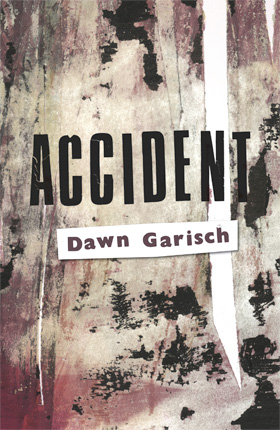
 Accident
Dawn Garisch
Publisher: Modjaji Books
ISBN: 9781928215332
Authors on their new books: Dawn Garisch chats to Naomi Meyer about Garisch's novel, Accident.
Hi Dawn, thanks for the opportunity to talk to you. Please tell me a bit about yourself.
I have been drawn to the arts, especially reading and writing, for as long as I remember, but my family decided that I should study to become a doctor. I didn't object, as medicine was interesting, and it is a valuable occupation. However, I am fortunate to have been born into a time when the discipline of medical humanities has come into existence – how the arts and the social sciences can intersect with the health sciences to make medical practice more humane and more effective. This split in myself and in our society around art and science informs my life, my writing and my work. I am currently self-employed as a medical doctor, a writer in many categories, and a teacher of writing and creative method. Recently, I have raised funds to start an NPO called Life Righting Collective, to assist people from all walks of life to write their stories to help us understand ourselves and each other. We will be bringing out an anthology of life writing next year.
Is your book, Accident, autobiographical? If so, in which respects?
I think effective fiction writing stems from some personal disturbance that the author extrapolates into another very different imaginative scenario. This means that the emotional experience of the writing feels authentic, and that the author can explore her dilemmas outside the confines of her own life. So, yes, I am a part-time general practitioner, and yes, I would have loved to have been an artist (although not as extreme as Max), and yes, I have two sons, who have, at times, done things and made choices that have been extremely worrying to me. But Carol is not like me, Max is not like either of my sons, and what happens in their relationship has nothing to do with me. And I have never had a relationship with someone like Neil or Jack!
Your book, Accident, is about the relationship between a mother and her grown-up son. And the accident the title refers to, is about the young man in the story who set himself alight. Was this an accident?
No, Max sets himself on fire as a performance piece. The title refers to several accidents in the novel, from the circumstances of Max's conception, to his friend's death, to Carol's midlife crisis, where she feels that she has not been an active agent, but that she has lived in response to accidents that have shaped her life. It also refers to our perception that many illnesses that befall us are accidental, instead of noticing that how we behave towards the homes of our bodies, each other and the earth is making us ill.
We need to talk about Kevin ... I mean, Max. You also wrote a short story called “What to do about Ricky”. Is this story also on somebody’s son? Is this complex relationship between a parent and a grown child something you like exploring?
Ricky would definitely have been somebody's son, but the story is about a woman who doesn't know what to do about know how to get out of a dead-end relationship with a married man called Ricky (with a twist in the end). Actually, four of my novels – Stoning the tree, Babyshoes, Trespass and Once, two islands – all have a thread running through about parenting.
Or do we need to talk about Max’s mother? Tell me about her.
Carol is like me, in that she is frustrated by the limitations of medicine – how to change people's awareness of how self-destructive we are towards our own bodies and the earth. I am interested in the recent findings in neuroscience, that facts rarely change behaviour, because we make decisions from an image or narrative that is not readily accessible to the conscious mind. Max is an artist, and knows how powerful images can be to make people pay attention, and to encourage them to reconsider the way they do things. Carol, of course, cannot initially see what her son is trying to achieve through his art form, and is concerned about his mental health and what she has done to cause his extreme behaviour.
Do you think that there are all kinds of guilt issues in any parental-child relationship? But is it not the case that no parent is perfect, that all parents will damage their children in some way? And that children should take responsibilty for their own actions, as well?
I think it's impossible to get parenting right. Mostly, we are either too much or too little. Carol is treading that tightrope. As a parent of a baby, you are entirely responsible for its well-being, and as the child grows into an adult, the trick is to know when to hold on and when to let go, as an incremental dance. Ultimately, a young person must take full responsibility for his own life, of course, but there is a transition phase that is very tricky in human beings, in late adolescence and early twenties, when the frontal lobes are not fully engaged to help an individual make good choices – resulting in those which are not necessarily safe ones or ones that a parent would approve of.
Then, by accident, something happens not to the son, but to the mother. What can you tell our readers about this, without giving too much away?
Carol is so involved in her son's story, she is not paying attention to her own. It's usually easier to see what is problematic in someone else's lifestyle, and more difficult to see one's own issues clearly. Yet, her issues help her find her way back to herself and her son, and to engage with the meaning of his work.
Accident is also about art, art happenings, performance art – art happening by accident, if you will. What kind of art do you like? Visual, theatre, music?
I respond to all forms of art. I feel as though I was born into an interdisciplinary zone, where artistic practice in general attracts my attention. Journalists report back on everyday happenings, while artists report back on the zeitgeist – the nature and fashion of the times we are living in. They reflect on our cultural, political, spiritual and psychological practices, and, in doing so, help us reflect on them, too. As for theatre, I have recently completed two plays: a one-woman show, which is an adaptation of Trespass, the novel that came out in 2009, and which will be on at the AFDA Theatre in Observatory in September; and a two-hander called “To get to the moon”, which is about a couple who lose a child (there it is again!).
What are you reading at the moment?
The third reel by SJ Naudé – we are on the same panel together at the Open Book Festival. A wonderful writer.
Are you busy writing something else at present?
I am writing another play, this time about mothers and daughters – biological and symbolic.