

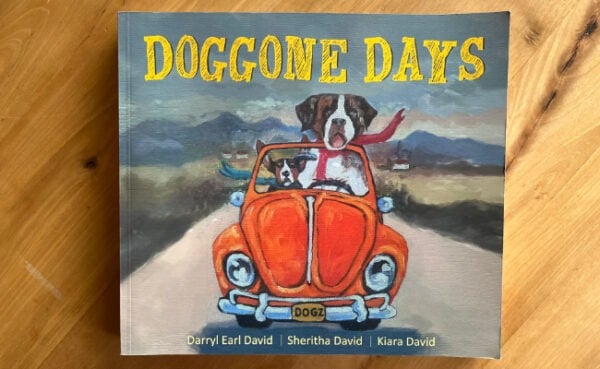
This reader’s impression was written and sent to LitNet on the writer’s own initiative.
On page 69 of Darryl, Sheritha and Kiara David’s book, Doggone days, there is a poem by Hester Hesse next to the steps leading up to the veranda of the building in the photograph, which reads:
My gedagtes het vlerke
Wat my vinnig wegdra
Na die plek van my drome
Waar ek kry wat ek vra
Translated, this reads:
With wings my thoughts
Transport me sleek
To the place of my dreams
Where I see what I seek
Those lines seem to epitomise what has driven the Davids during their years of travel, down roads that have led them – and now lead the reader/viewer – to the beckoning invitation of magnificent vistas, ending in sojourns in an abecedarius of small towns (dorpe) – such as the one on page 69, appropriately named De Rust: places of rest for them and their treasured canine companions.
Doggone days is an anthology, a florilegium, of vibrant seeing in its colour photos, enhanced by Darryl’s use of the artistic/photographic triangular structure to create powerful vistas, landscapes and portraits. This can most obviously be seen in his photos of roads, church spires, lighthouses and gabled buildings, but is present in many, perhaps most, of the photos. The photograph on page 105 of the spire of the church in Hanover in KZN, framed by the triangles of the surrounding trees, is an excellent example, as is the full-plate photograph on page 216. The latter photograph, incidentally, would at first glance seem to suggest that the two human figures are of no importance, surrounded as they are by the magnificence of the towering trees. But two tiny details refute this idea: the colours of the clothing of the two figures, which contrast with the dominant yellows, greys and greens of the trees; and, especially, at bottom right, a detail one could easily miss at first glance, namely, the bench: tiny amid the height of the trees, but nevertheless saying, “Stay. Sit. Contemplate. This is where humans belong.” That bench is by implication present in all the places visited in this volume.
Seeing is the core of this book. This is perfectly summed up in Chris Mann’s poem, “Cookhouse station” (55), where the phrase “make certain you see …” is repeated four times, and where the last line emphasises that if you have not seen every detail there is to see, “you have not passed that way at all”.
Colour is at the heart of seeing. At times, you almost feel a visual sensory overload from the colour on every page, but its importance is contained in the phrase, “today it is painted white and has lost all of its charm”, referring to the Amalienstein Church, which was originally (as in the photograph on page 19) painted in hues of ochre and terracotta, emphasised by some white detailing. Darryl David laments the “de-colouring” of the church, but it is also an indication of the impoverishment of the human spirit (“has lost all of its charm”) when mere blandness, or erasure, is imposed.
There are a number of instances in the book where the richness of colour on buildings and its effect on the human spirit is pointed out, for example, in the following:
- the Bo-Kaap’s “kaleidoscopic facades” (28), which reflect the “joy of emancipation after slavery’s abolition, each brushstroke a quiet declaration of freedom and individuality in defiance of erasure”;
- the buildings in Calvinia (35): “what a stunning town”;
- the ochre yellow cottages of Genadendal (82) – the entire town is a declared national monument – “the birthplace of education in South Africa”; and
- the spiritually uplifting interior of “Underberg’s glorious Reichenau Trappist mission” church (282).
There are any number of other instances of the effect on the human mind, emotions and spirit in the book. Travel slowly through it and discover them.
White is, of course, also a colour, shown in the many photographs of buildings where white is both correct and traditional: churches, fishermen’s cottages and the gabled facades of buildings in the style of Cape Dutch architecture. Here, white is as fitting, as important and as uplifting as colour.
The very few monochrome photos in the book would seem to belie what has been said about colour, but they show how striking the colours black and white – chiaroscuro – can be. (Compare pages 94, 206, 238 and 253.)
The colours are, for the most part, vivid, often even startling. But even in a photo where the colours are muted, there is no escaping their effect on the viewer. Compare the photo on page 283: “Underberg misty winter trees”.
Doggone days is colour. Look at any page, but pause especially at the full-plate vistas, which are so essential a part of the text and of the journey the reader takes in and through this book.
But Doggone days is also a multilayered play on words, with doggone being a mild expletive, a euphemism for “God-damned”, expressing frustration, even some anger. And there is certainly some of this in the reactions to the behaviour of the David dogs. The word also hints at the dog star Sirius, visible during the nights of the hottest but also often the laziest days of summer, and which the reader can find in a number of “doggone places” of rest – in the pit stops of the David adventures.
But, perhaps most tellingly in the context of the book, the word can be read as “Dog gone”, celebrated in the kontakia for the dogs which died. These intensely emotional hymns reveal the almost overwhelming love of the Davids for their dogs. The Davids emerge as empathic carers who find joy in nurturing their SPCA rescues. Theirs is an oxytocin-releasing bond, which turns “doggone” into “doglove” – a bond which provides the silent promise of unwavering companionship.
Read these tributes: “A sarcophagus of the heart”, with its reference to His Master’s Voice (64-5); “Two tears for two ears (133-4); “Mischief’s inarticulate speech of the heart (181); “Grave diggers (186-7); “The saddest dog story” (291); “Droopy” (302); and, best of all, at the end of the book, the beautifully controlled, Paton-esque “Kontakion for you departed”, which, with the final full-plate photo of Darryl and “The Five”, explains why the most telling of the many dog quotes throughout the book, is the one by Milan Kundera:
Dogs are our link to paradise. They don’t know evil, or jealousy or discontent. To sit with a dog on a hillside on a glorious afternoon is to be back in Eden, where doing nothing was not boring – it was peace. (22)
Or else, just linger on the plethora of photos of the David dogs, which show just how joyfully attached the authors are to their canine friends – and their canine companions to the Davids.
There are, of course, some interesting non-David dogs in the book: “the biggest Springbok supporter” (85); the two “Bliksems” (two most amusing stories about dogs on pages 119 and 262); and in the “Pitstop” on page 210, where there is the story of Olive Schreiner and her dog, Nita, who lies buried with her. And then there is perhaps South Africa’s most famous dog (he even had a naval title, with freedom of the town of Simonstown, where there’s a more-than-life-size statue of him): the Great Dane Just Nuisance (287).
And, for a good laugh, indulge in the “Pis stop” on page 152, where Darryl tries to come to terms with threatened baldness, suggesting that it is the result of “the golden shower of affection” unleashed on his head from hugging his Saint Bernard puppy, Mischief. “And they call it puppy love.”
Doggone days is dogs. The journeys don’t exist without dogs.
“Which is more important,” asked the Dog, “the journey or the destination?”
“The company,” said the Cat. (8)
The company with Darryl on these two decades of journeys has been his wife, Sheritha, and his daughter, Kiara, but also their dogs: dogs.
On page 280, there is an anonymous poem which has, over the years, had different titles: “The creation”, “When God made the earth and sky” and “How dogs got their name”. Whatever the title, it encapsulates the love and emotional ties that the Davids have with each dog, and why dogs have that name.
Pictures speak to those who see, and even some of the photos without captions in the book speak for themselves. However, on occasion, there are photos which cry out for captions, such as the unusual building on page 73 and the church on page 160, especially as there is an interesting, painted statue to the left of the entrance. And, on occasion, there should have been photos where a specific feature of a town is mentioned as central to that town. For example, in Bathurst, the “oldest unaltered Anglican church building in South Africa” is mentioned, and one could expect an image; the “defining feature” of Howick is the “majestic Howick Falls, right in the heart of town”, which begs a photo rather than the peripheral glimpse of it in the photo of Zulu dancers on page 129; the Big Hole in Jagersfontein, deeper than Kimberley’s, merits a picture; and the prominent feature of Philippolis is the Dutch Reformed Church, but there is no photo. Even though the book is already a photographic cornucopia, there are omissions.
There is poetry in photographs. Linger, for example, at the many full-plate ones. And there is a sense of poetry in curating scores of photos, done sensitively and with obvious joy in Doggone days. There is also a keen sense of poetry in the descriptions of some of the places visited. That of the Drakensberg (72) comes to mind. It is there in phrases such as “vast introspective landscape”; “a curious little oasis”; “peaceful, pastoral spirit”; “rustic tranquillity”; “old-world serenity”; “quiet magic”; “sunsets paint the sky in hues of gold and rose”; “sun-drenched jewels”; “a place of stillness, grandeur and soul-restoring beauty”; and “where peace comes dropping slow”.
Paging through this book must be done at the pace of a Sedgefield tortoise. Take the wings of travel, as you are invited to do on every page; but pause, linger with the authors, and discover the awe in the beautiful, in the suddenly glorious, in the places “where time slows”. Let the book “put the paljas on you”. The photos are gateways to places unknown, invitations to admire and be uplifted. Experience with the dogs their miraculous change at the scent of the Outeniquas – a “scent” that pervades the book – and be immersed in the “pulse of creation”, which is at the heart of the journeys you undertake with the writers and their dogs.
Doggone days covers journeys over 20 years, cleverly seen in the photos of Kiara: from a babe in arms, through toddlership and teenage growth, to the graduate of the Michaelis School of Fine Art.
Egyptian-born Greek poet Constantine Cavafy, in his poem “Ithaka”, builds on the familiar story of Odysseus and his many stops and adventures on his way home from the siege of Troy. But it is also an invitation to explore the wonders of the world, and to learn while doing so. These lines from “Ithaka” (in Edmund Keeley’s translation) are most apt for Doggone days – for the explorations and the journeys of discovery, but also paradoxically for the groundedness and the roots of culture and tradition which shape the journeys, even if they take 20 years (for “Ithaka”, read any of the places, the paused-at “islands”, found in Doggone days):
As you set out for Ithaka
Hope your road is a long one
Full of adventure, full of discovery ….
As long as you keep your thoughts
Raised high, as long as a rare excitement
Stirs your spirit and your body.
Hope your road is a long one.
May there be many summer mornings when,
With what pleasure, what joy,
You enter harbours you’re seeing for the first time.
But don’t hurry the journey at all.
Better if it lasts for years …
Wealthy with all you’ve gained on the way.
Ithaka gave you the marvellous journey.
Without her you wouldn’t have set out …
Wise as you will have become, so full of
experience,
You’ll have understood by then what
these Ithakas mean.