

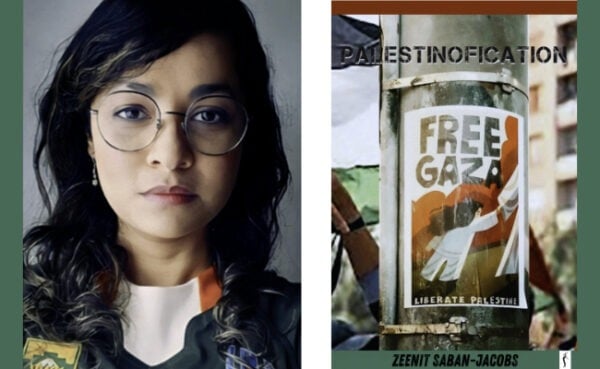
Zeenit Saban-Jacobs’s Palestinofication (Botsotso) is a chapbook consisting of ten prose poems and ten colour photographs. In the words of Saban-Jacobs, “it is an attempt to combine moral outrage with artistic sensibility even as the merciless Israeli onslaught on the people and physical space of Gaza continues”.
In this Q&A, Saban-Jacobs speaks to author, editor and art critic David Mann (Once removed) about the process of putting together the chapbook, and what art and poetry can do in the face of great injustice and inhumanity.
Palestinofication is a clear response to the ongoing genocide of the Palestinian people in Gaza, by Israel. Are the poems themselves a direct response? Have they all been written in the period following 7 October 2023?
Yes. Palestinofication is a compact chapbook consisting of ten prose poems born from the chaos of doubt and uncertainty – or what I like to call the “new world”, that is, the tumultuous timeline we find ourselves in, especially post-October 7th. We are living in a timeline where racism, bigotry and the celebration of the destruction of nations are widespread. Palestine is a mirror being held up to the world, and the masks are off. It is a battle for the soul of the world, and there are so-called civilised nations and peoples who are failing dismally.
Tell me about the term “Palestinofication”. What does it mean and how does it inform this publication?
I coined the term “Palestinofication”, and it is defined as follows: making positive changes in your community through intellectual discussions, peaceful demonstrations, music, art, poetry and film – the result of being inspired by the resilience, bravery and humility of the Palestinians. I was also inspired by many movements in South Africa and across the world. Similar to the watermelon symbol, the aim is to humanise Palestinians, since critics of the movement – including legacy media and tech corporations – have attempted to taint the term and make the word “dirty”. This is part of the dehumanisation campaign against the Palestinian people and those who support the movement.
The chapbook consists of ten prose poems. Could you speak a bit about this form and why it’s the style of writing that emerged in this instance?
Yes, the style and flow are different from my previous collection because it is very narrative-driven. Each piece is a story and, in certain instances, follows a person detailing their close encounter with death, the loss of a lover or the burial of a loved one. In other instances, there are fictional elements and metaphorical representations that draw the reader into a dreamlike fantasy. Think of this as a temporary break from reality, similar to a mind under enormous stress and duress as it attempts to make sense of a mad world. My aim with this chapbook is to humanise the Palestinian people by relaying their stories and their reality – matters of love, loss, struggle and even death. Some prose poems are written in the first person, and this is purposeful; it is meant to personalise the characters, upping the emotional ante. I want the reader to “be in the shoes” of the different characters, eg, in “Khalid from Khan Younis”. This piece, like many in the book, was inspired by the many news articles I have read.
The poems are accompanied by colour images, some quiet, others striking in their depiction of pain and suffering. What was your thinking in deciding to include images alongside your poetry?
According to the United Nations, Amnesty International, Human Rights Watch, Israeli NGO B’Tselem and other reputable organisations, 81% of Gaza has been destroyed by Israel and the IDF since 7 October. Gaza is essentially a crime scene and a graveyard – this is genocide. I believe that the dystopian imagery of destruction, loss and ruin encapsulates the essence of the book; seeing the scale of the devastation leaves little room for doubt about the ongoing genocide of the Palestinian people.
Similarly, you speak of the particular everyday violence that comes with the virtual live-streaming of this particular genocide – “a wickedness I believe the psyche was not designed for”. Does poetry provide a kind of salve for this wickedness, do you think? Can art help us to process or make sense of this pain and confusion we are experiencing?
Gosh, this is a tough question. Art, poetry and creative expression in general can provide a kind of relief from turmoil, but in the case of Palestine, the mental anguish of witnessing the decay of morality, humanity and, by extension, international law in real time is a very bitter pill to swallow – a problem to which many at present don’t have a solution. I do, however, hope that poetry of this nature can galvanise the masses to continue the good fight. The world belongs to us all, whether we are Christian, Jew, Muslim, Hindu or atheist – regardless of culture or creed, a better future is worth fighting for. Struggle poetry has for the longest time been the “quiet” voice and mood of oppressed nations, and when we look at our history as South Africans, we understand why.
Palestinofication follows the release of Inside an eyeball, which was recently shortlisted for the Ingrid Jonker Prize for Poetry. Congratulations! How have you found the reception of Inside an eyeball, and what, if anything, is carried through from that collection into Palestinofication?
Thank you. I am truly humbled. The Ingrid Jonker Prize is a very prestigious award, and I am overjoyed that my work has made an impression on the judges and adjudicators. Yes, there are elements from Inside an eyeball that have carried through, but they are not as oneiric or surrealistic. An example can be found in the prose poem “Heaven’s lover”. There are aspects of Sufism – “the devotee and new lovers” – as well as matters concerning the afterlife in the final stanza. In “The animus”, Sufi symbolism features once again. Also, in the poem “Gaza, interrupted”, there are religious inferences; the poem is a condemnation of religion altogether, since the destruction of Gaza and the West Bank (ergo Palestine) is a prominent feature in the “end-times prophecies” of the three major Abrahamic belief systems.
Considering the specific focus of this collection of poems, do you have a specific reader in mind? And what do you hope the reader of Palestinofication finds in its pages?
Palestinofication is for everyone, even those who wholeheartedly disagree with my position. I hope those in support find comfort, and I hope those who are neutral become enlightened. It is incumbent upon us, as sentient beings, to stand with the oppressed. The final prose poem, titled “Star politician”, is a message to Israelis and their politicians. “Star politician” was inspired by Gideon Levy, the Israeli journalist for Haaretz; Ilan Pappé, the Israeli academic; Avi Shlaim, the Israeli historian; and many other Israeli and Jewish men and women who are standing up for justice – those who utter the phrases “never again” and “not in my name”. The poem is complex and loaded. It challenges Israeli society by pointing out uncomfortable truths about Israeli policy: that its existence comes at the expense of the Palestinian, Lebanese and Syrian peoples, and that when you dehumanise others, you only dehumanise yourself.