

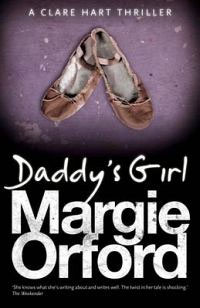
 Daddy’s Girl
Margie Orford
Publisher: Jonathan Ball
ISBN: 9781868423262
Click here to buy a copy from Kalahari.net.
Margie, you said in an interview that Daddy’s Girl is a prequel to your two other Dr Clare Hart novels, Like Clockwork and Blood Rose. It is my favourite of all your Clare Hart novels to date. Did you find it difficult to go back in fictional time to write about events preceding the other two novels? Did this happen by accident or did you plan to write the prequel even before you wrote the other two? Is it difficult to write in reverse, as it were?
Daddy’s Girl is the prequel – but I had not planned it that way. With Like Clockwork I just held my breath and jumped into the deep end of the crime fiction pool. I had not realised, though, how central the relationship between Clare Hart and Captain Riedwaan Faizal was going to be to all the novels. Milan Kundera wrote that the rules of a relationship are set within the first 20 minutes of their meeting. I thought I needed to know what happened in those first 20 minutes between Clare and Riedwaan. The kernel of the back-story was there in Like Clockwork. So I went back to it. I loved writing Daddy’s Girl – harrowing as it is – because the time of the novel was so tight – 72 hours. It is hard to predict where a writing path will take one – so writing the prequel was just part of the path that I have set myself on. One always writes without a map, so Daddy’s Girl was a way of discovering the topography of my characters’ world.
I was out of South Africa for about five years when we lived in the UK, and so have missed out on the early development of some of our local authors. You seem to have arrived on the South African literary stage fully dressed and ready to play the lead role of female krimi writer supreme. Is this apparently “overnight success” as simple as it seems? What were the origins of your writing? Have you always written or did your vocation as a writer crystallise for you later in your life?
It takes a long time to become an overnight success! I returned to South Africa in 2001 – I had been in New York (on a Fulbright scholarship), Namibia (producing films and two babies) and England (being confused and having one baby) before that. So I always was working, but the two-year sojourn in New York was pivotal for me. I decided then to focus on writing, but instead of doing my thesis and getting my PhD I turned my fascination with violence, memory and history into fiction. I had done a series of investigative pieces on crime – organised and otherwise – on my return. And it seemed that the best way of getting at the truth about South Africa was in fiction rather than in the shorter journalistic pieces I was writing. So Clare Hart came to me – and I have been her amanuensis ever since.
 I’ve read an interview with you in wordsetc where you spoke about writing about crime almost as a talisman to keep the violence from your own door. You have three daughters and felt the need to “write the crime away” from them, if I can put it that way. Your novels are extremely real, and have a raw explicitness about the horrendous acts of violence committed on young girls and women in particular in this country. Don’t you feel that your research, which shines through as very thorough in your novels, makes you even more aware of the threats to your loved ones in South Africa?
Yes, the research does make me see things that many people do not see. However, I have really lost my fear – my paranoia – about crime. I have never believed that not knowing about things makes them go away – I now understand how and where things are dangerous – and for whom. Middle-class people – and I am one – are cushioned in South Africa much of the time. I think what I have worked out is my own demons – psychic ones – and that is useful.
Talking about research, how much research do you do before you start the actual writing of a novel? And do you know exactly where your story will go when you start working on the research aspect of your novel? Do your early ideas about where your story is going change much after doing research into the subject, or is your story pretty much set in stone when you start and your research is made to fit around it?
I do a great deal of research – I love science and forensics and bones and Petri dishes and autopsies and the order that asking questions brings. I have discovered the most wonderful characters through this research and made some very good friends too. I am so curious about how the police, the forensic services, pathologists deal with and process violence and death. Ours is a secular society, and they have taken on the role of tidying up the ends of peoples lives. I do plan out the stories – I have an agent who I must give synopses to. That said, though, sometimes things take their own course –so it is a play between the pattern (the structure) and the detail of the writing. Very often new things I find out are kept as notes – little nuggets that work their way into the next book. Or another book.
The second part of that question is whether you sometimes find the research process overwhelming. I assume you have to go into some fairly awful areas and deal with real atrocities to explore the scope of your subject matter. Does the reality of what you are writing about sometimes get you down or are you able to keep it in the fictional sphere and thereby distance yourself from it?
What would I write if I had not seen things as they are? One cannot make those things up, surely. Where would the emotion be? The real responses? I have no interest in the cosies – like Agatha Christie used to write. I am curious to know how people live through and survive the worst. I am interested in resilience. I am also interested in the people who deal in an official way with the mayhem around us. I am not squeamish or afraid of things – so I look at them and try to write about them with compassion. To make it real for people. We are all fascinated by these things, I think.
I was greatly moved by the choice of plot and characters you’ve made in your novels, especially as the protection of the rights of women and children is closer to my heart than any other cause. So Dr Clare Hart is an inspired choice of protagonist. How did you “find” her? Or did she “find” you?
Clare Hart came to me – fully clad in her armour, so to speak. She gets pissed off about the things that piss me off, but she is just better at doing some things. She is, for me, a way of seeing and judging my world.
Your writing has an elegance which I find very appealing. It’s not the usual format for mainstream crime novels, but I like the way you make the genre work for you rather than restricting yourself to a narrower and more run-of-the-mill frame of reference. Do you consciously go about pushing the boundaries of the genre, or do you find that your characters dictate how you express what happens to them? Does the fact that your main protagonist is an intelligent and elegant woman result in a slightly different expression of the genre?
Thank you. Elegance is something I value, so I am flattered to hear my writing described in those terms. To tell the truth, I did not think about writing a crime novel. I just thought I wanted to write a book that told how South Africa actually is, rather than a book that describes how it was meant to be. Much so-called literary fiction is dull: it lacks plot, drive and catharsis – all things that can be found in well-written crime fiction. I am also interested in writing books that are about people out in the world. Interior monologues are best kept for one’s therapist – you should pay someone to listen to them rather than fleecing an innocent book-buyer. Clare Hart also has aspects of my very elegant and fierce grandmother – a woman who dressed for dinner every night no matter what. There is a great deal to be said for repression and good manners in the face of adversity.
Women’s and children’s rights are obviously vitally important to you, as they are to your heroine, Dr Clare Hart. Is this issue something that has always driven you? Do you feel that writing about it in a fictional setting is the best way to create an awareness of the atrocities committed against women in our country?
Like most women I don’t like getting fucked around. Clare Hart is the same. I think most of us are like that – and so are many men. So I did not think of writing about women’s issues per se. Rape is a political crime, a crime of war very often. It is an assault on the integrity of a human being and it has grave repercussions. That said, I keep soapbox politics out of my novels.
You are also the spokesperson for a few women’s rights organisations, am I right? Can you tell us more about these and how you feel these are making a difference in our country?
I am the patron of Rape Crisis and also executive vice-president of South African PEN, which focuses on issues to do with freedom of expression. Violence against women and infringements on freedom of expression are long-term interests of mine, hence my involvement.
You and Clare Hart seem to share a lot of the same ideas and motivations, as both of you are driven by a desire to make a difference to the perceptions about the rights of women and children. Where does Margie Orford end and Clare Hart begin?
I am embarking on the fifth novel of the series, so Clare Hart has been with me for a long time now. But a novel is fiction that one fashions out of the reality of one’s life, experiences, readings and observation. But in the end one makes it up. If I could make myself up I would be four inches taller, and four inches thinner – kind of like Clare Hart.
When you received the Fulbright scholarship to study in New York from 1999 to 2001, how did this impact on your family? Did they go with you or did you go to the States and do the course on your own?
I was there on my own for the first year. My three daughters joined me for the second year. Here is a piece I wrote about this recently.
I’ve noted over the past few weeks on Facebook that you were in seclusion while writing your next novel. As a mother of three rather demanding children myself, I’ve wondered how you find the time to separate and focus on your own work. Do you go off for a long time on your own and do you have a separate house or apartment somewhere? My writing shed in the garden doesn’t seem to keep me far away enough from all the crises, so I was wondering how on earth you managed to be so prolific with a large family.
I chose my writing over my family – that said, I do love them and I occasionally feed them. Writing is my career and my vocation. Motherhood has been a surprise and a pleasure – but it is only one aspect of my life. Childcare is the answer when they are small, obviously. But I feel no guilt at all about working hard and for long hours. I have a co-parent in their father. And they are self-sufficient and independent girls with a mother who works – so it’s fairly simple, really. When I need real solitude I go away for weeks at a time and write – then they come and see me on Saturday nights – but by early Sunday morning I want my solitude back.
Lastly, you have just completed your last novel. Can you tell the readers of LitNet a little about it? Could you also tell us how the sales of your novels are going? You seem to be the most successful crime novelist, second only to Deon Meyer, and I wondered whether you have finally achieved the luxury of relying only on your writing to survive.
Gallows Hill came out last year. And I am now writing Water Music. I have lived off my writing for the past five years – I have been very lucky.