

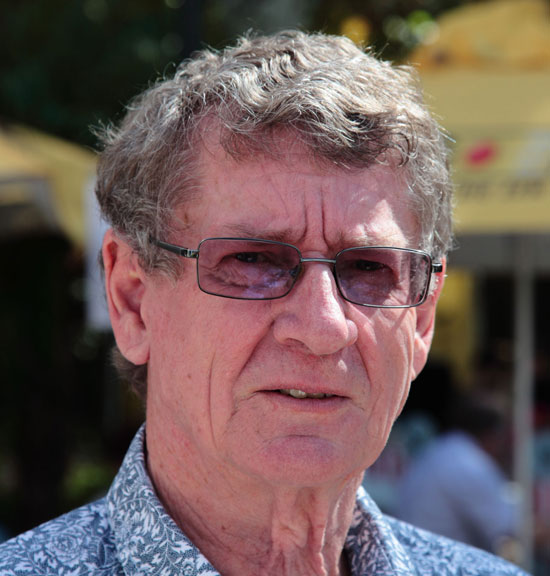
At home in London this morning, waking to the shocking news of André’s death, I gazed at my shelf of novels by him. So many memories of him come to mind.
I first heard of him in 1974. In my late 20s, I had started a new job as Rights Manager at UK publisher WH Allen, but had made a mistake: they published downmarket novels and third-rate celebrity biographies. But the sales director came back from a trip to South Africa, having bought world rights excluding Afrikaans in a novel that we were to publish as Looking on Darkness. I fell in love with the writing, submitted it internationally and six weeks later went to the Frankfurt Book Fair. During that fair I sold it to six languages; and that was only the beginning. The American editor who bought it shared a train to Paris with a French editor; when they got to Paris he made me an offer for French rights, and so it went on. Publishers who had bought it were so passionate about it, they persuaded others to do the same. Eventually we had dozens of publishers translating it.
André came to London for publication and we quickly became friends. I introduced him to many of his publishers. The novel became a huge international success. The Swedish edition sold more than 100 000 hardback copies and 30 years later the publisher still thanked me for selling it to him.
I left that company after only a year, because André’s books were among the few they published that I could bear to read. But our friendship endured. André’s stance against apartheid meant his books were often banned in South Africa. He was in physical danger (he always looked under his car before driving it, it told me) and he couldn’t even subscribe to magazines that he wanted to read. It amused me to have his subscription to Playboy sent via my home address for many years. I would wrap it in three layers of brown paper, put it in a plain envelope and mail it on to him. A very small way of defying the state system, but a satisfying one.
Several times when he visited Britain, André would stay with my husband and me for a weekend at our cottage in the country. I was always shocked to hear his stories, such as about the time a brick was thrown through the window of his house. I so admired him for speaking out.
Our paths diverged. We saw each other less, but the odd e-mail would connect us again. When my book about how to get published came out, to my surprise he wrote to me out of the blue with praise and allowed me to quote his generous words.
The last time we sat down together was some years ago in London. He was visiting to celebrate another publication, and we chatted over coffee. A big catch-up. I confessed to my second divorce (from a South African!). He told me of another marriage. We looked at each other seriously for a moment and then, clutching each other’s hands, laughed and laughed. I never met his wife Karina, but loved the affectionate way he talked to me about her.
Wonderful to think that his last day was spent accepting yet another international accolade, with – I am told – a splendid speech delivered in fluent French. Awful to realise he will not be around to accept more honours.
“Silence in the face of evil is itself evil: God will not hold us guiltless. Not to speak is to speak. Not to act is to act,” said Dietrich Bonhoeffer.
André was never guilty of not speaking.
Not only did working on his novels introduce me to his fine writing, but his political commitment made me aware of a situation I had been ignorant of. Meeting him gave me a dear friend. Losing him is painful. Something I share with so many. Raising a glass to you now in London, dear André, friend for 41 years.