

 |
| “In 1826 a few temporary licenses were issued for those wishing to trade beyond the Kei River. The pickings were so rich that within a very short time there were at least 20 traders operating beyond the frontier. In 1830 the border was thrown open and trade beyond the Kei was legalised. For the first time people living on the Wild Coast were able legally to exchange their hides, cattle, ivory and later tobacco, grain and wool, for blankets, beads, agricultural implements, knives, horses and firearms, and the settler traders found a ready market and eager customers.” – Hazel Crampton, The Sunburnt Queen |
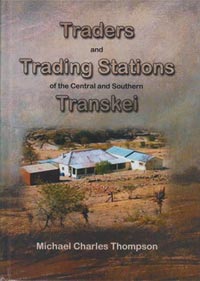
Travelling the gravel roads of the old Transkei in a Volkswagen Beetle, visiting the various trading stations to take orders and supply goods, was Michael Thompson, who has just released a new book on the traders and their stations of this region.
Traders and Trading Stations of the Central and Southern Transkei is a comprehensive work with anecdotes, maps, history, gravel paths, missionaries and communities and all that makes up this area where time stood still when the rest of South Africa developed at a rapid pace.
Thompson has deep family roots in the Transkei. His great-grandfather, Richard Calverley, is recorded as the first citizen of Umtata, having been granted land by Chief Gangalizwe on the Umtata River. Born and school in Umtata and working for Dyker and Dyer Wholesalers, Spargs Wholesale and a representative of Lever Brothers, Thompson travelled from Umtata, through to Butterworth and far-off places such as Tsolo, Cala, Mlengana and Engcobo, crossing the Umzimvubu and Tina Rivers in the east and the Great Kei River in the west.
Celebrating a 100-year period in South African history which ended between 1965 and 1980, Traders and Trading Stations tells of European traders who came and set up trading stations amongst the Xhosa-speaking residents. It’s a social history of those traders, concerned with details of their trading activities, families and social life.
It was recorded that in 1932 there were approximately 600 trading stations owned by Europeans. Licenses to trade were obtained from the chiefs, then, after annexation, from the government. Trading sites were five morgen and no new site or license to trade in a location was granted within five miles of an existing station.
Blankets and beads
With them the traders brought, besides beads and blankets, medicine, agricultural tools, and clothing. As they worked together with the missionaries, many a school was erected throughout the region, and missionary work was done in all earnest.
Trading was at first done by ox wagons, crossing deep and dark rivers on gravel roads leading into a mostly unknown hinterland. The oxen had to swim and the wagons floated, but crossings were mostly safely accomplished. Two teams of sixteen oxen each were often used for one wagon, and many rivers had to be negotiated while they were in full flood, or parties had to camp for days on end before able to cross.
Thompson, tracing the footsteps of the old traders in his Beetle, walked back on his roads once travelled, and talks about old families, such as the Buchans, Misselhorns, McDonalds, Turners Clarkes. On his travels he often met with the descendants of these old traders, such as Ivor Daniels. “Isinuka (the place that smells) near Port St Johns was one of the earliest trading sites in Port St Johns, where the route from Umtata to Pondoland crossed the drift at Fort Harrison. My uncle, Frank Daniel, bought the station in the mid 1930’s, as a home for my grandparents Samuel and Magdalene Daniel,” related Daniels.
Homes and trading stations were first built mostly from sods, and traders and their families were forced to live in tent wagons. Shops were first erected, and buildings were later replaced by brick buildings.
One of the more remote trading sites was way down on the Tina River, at Mjilana. “Beautiful, rugged country, where the boerboon flowers – making it worth the trip just to see them flower,” says Thompson.
An interesting section of the book deals with "Kreb’s tokens", a method of payment used by a Mr Krebs, who had a trading store in the Mqanduli district. An extract from a document by Milner Snell, Tokens of the Transkei, tells of the tokens that were known as "barber shop" tokens. “There were several manufacturers in England, but these particular ones, with the brand name Ogee on them, were manufactured by Osborne Garrell & Co in London, who were suppliers of implements and other accessories for barbershops.”
Tokens
“The tokens were distributed worldwide, and ranged from 1d to 3/6d [from 1 penny to three shillings and sixpence]. Mr Krebs holed and numbered the tokens. The tokens were used as ‘good fors’. The customer being handed the appropriate token, which in turn was given to the man who ground the mealies.”
The Coinage Act of 1922 put a sudden end to the use of tokens.
Trading stations and the travelling back and forth later resulted in the need for blacksmith shops and overnight inns. The Prince of Wales Hotel near Umngazi was one such inn, where the proprietor, a fellow of many shifting moods, had “striking powers … with a revolver”. In spite of the distinguished-sounding name, no stop was made here because of its owner, and people hurried by hoping to be out of firing range before the owner was aware of their presence.
Today, most of these roads are tarred, and bridges cross the muddy waters of rivers such as the Umzimvubu at Port St Johns. The old traders are no more, and the trading stations were handed down to a number of owners, with many no more in existence. The scenery, however, has changed very little, and nostalgia hangs over the old farms where fruit and vegetables used to blanket the valleys and hills. “The roads had tremendous scenery. I once rounded a bend and was confronted by a field of yellow irises, fringing a valley of green. Such were the perks of travelling the Transkei roads – the natural beauty made up for the poor road conditions. In fact, the bad roads gave one time to look and see,” says Thompson.
Traders and Trading Stations is a series of personal reminiscences about events, people and places that Thompson was fortunate to know, and a system which now sadly has passed. His book is a tribute to those people and times.
For more information about the book, or to order, contact ECToday on (046) 624 1207 or e-mail dennison2@telkomsa.net.
Kommentaar
Interesting read.
Belinda, I would like to know if you are related to Wilshire and Joan Calverley who farmed in the Melmoth / Babanango area. I believe their son Gavin now runs the farm.
My grandfather, Joseph Llewellyn Jones, owned the farm Vidaburg which he sold to Wilshire's father Fred Calverley and my parents maintained a friendship with Wilshire and Joan. I'm the best next generation and would like to maintain contact.
Greg Jones
Hi Greg, have u any info of:
SMALE
SHARPLEY
CALVERLEY
WHITE
My great grandmother was Mary-Ann SHARPLEY who married Richard CALVERLEY. Mary-Ann’s father was Patrick SHARPLEY and her mother was Mary-Ann GOSS. Mary-Ann CALVERLEY had a brother, John Patrick SHARPLEY, who traded at Coffee Bay. He died in April 1878 during Pirie Bush Campaign during the 9th Frontier War (Captain J P SHARPLEY of the Tsomo Fingo Levies). He had one daughter (name of mother unknown but she might have been a Xhosa) named Caroline. Caroline was approximately 10 years old when her father died in 1978. Somewhere (I cannot recall where and I might be wrong), I have it that Caroline married John SMALE who was a son of Frederick SMALE and they had one or two children and divorced. This is what I’m trying to establish? John traded at Ngqeleni …
Kindly relay more information if you might have about Mary - Anne Goss.
I am Charlene Goss - second name Mary - Anne Goss. My father Dudley Goss born in 1938 from a Xhosa woman with father unknown. Trying to locate our family history.
My dad lived in Bizana - Nomlagcu with his Xhosa Family, I just know my grandad was a white man, no further information.
I know Grimmet Dudley Goss who's mother was a Mpondo lady from Lusikisiki. He was born in 1935.
I have been doing extensive research into my husband's side of the family as his father who is 88 has no records of his mother (Cora Selena Finley nee Calverley). My husband's name is Owen CF Calverley. I have gathered quite a lot of information and am still looking for more.
I'm trying to find any information regarding my great grandfather and grandmother. Their names were Gerald & Violet Ashington.
They apparently owned a hotel and a trading store , interested in the history of their arrival and existence. Their surname was Washington but for some reason it was changed to Ashington. My grandmother spoke every native language in existence and ended up being brought up by her aunt in Florida, Jhb.
There were two daughters , Eileen Alanna & Jennifer.
Your input would be much appreciated.
My great grandfather was a trader in the Bizana area between 1882 and 1906. His name was William John Fuller.
This is interesting. I'm from Bizana even though I work and live in Gauteng. Maybe if you travel to Bizana, you might get more information.
Hi there Mfundo,
Did you perhaps know of the Bircher family in Bizana. AA Bircher was a trader there and his son Ted, nicknamed 'Mazimba' lived at Gun Drift. He was my late father-in-law.
Hi I am Pauline, maiden name Ellis and knew the Butcher family in Bizana. I attended the school with the daughters, Belinda and Jackie Butcher; their parents were Don and Barbara Bircher.
The Snodgrass family owned a trading station in Tsojane, in the early 1900s. A daughter, Ruth "Sally" Snodgrass was born in 1913, and was a dear friend of mine. I wrote down her memoirs growing up in the "bush" in Transkei, later going to boarding school at Kaffrarian Girls. She passed away in 2009, aged almost 96 years old. Does anyone have any details of the Snodgrass family - Sally had many siblings?
I am trying to trace my father’s side of the family. He was born in Calla in 1917. Name: William Hutton Dicks. Anyone, help will be appreciated.
Thanks in advance.
Christina Archer
Hi Pauline, Don Bircher was my brother in law, his wife is Joan. They had 2 more children, Lorraine and Gary.
With regards to Clinton who asked about the Smale fam of Ngqeleni, Fred was my late moms' father. She was Mary Agnes. Her mother died when she was 9 and went to live with an aunt. Her father remarried. Her mother was a Bouchier.
I am looking for the ancestors of Jessie Christina Florence Mc Kay Born 10.10.1881. Who grew up at Tina Bridge Trading Station Transkei South Africa.
I would like to get in touch with anyone from the Bizana district, especially from the Bircher family, as I am working on the diaries of Dr George Batchin Thompson, district surgeon of Bizana in which "Bircher" is mentioned.
Cherry Howall, my family comes from Sally Snodgrass. My mother and her siblings are still alive all live in Pretoria. Would love to hear about the stories Sally told you.
Noleen Mathews, my uncle Ruben Ashington owned that hotel. I think he inherited it from Gerald, his father. I have the family tree if you’re interested. Thelma was his wife’s name. I spent many school holidays there as a small boy. Feel free to message me. Michael Ashington.
Maybe try to locate and contact members of the Stobart family who were among the last 'white' business people in Bizana following the Transkeian 'independence' in the early 1970's when most white-owned businesses were bought out by the SA Nat Government and handed to the XDC (Xhosa Development Corporation, which later became the TDC - Transkei development Corporation) for handover to Transkeians under the Nat governments separate development policy, which had many unintended consequences for harmonious race relations (the mission schools and hospitals were also taken over by the government).
Hi Veronica, Pat Bircher here. My late husband's (Deryck Bircher) grandfather, AA Bircher, owned 2 trading stores in Bizana for a number of years starting , I think, from around 1906. The one was managed by Percy and Queenie Fisher. She was AA Bircher's wife's sister. AA Bircher and his wife Martha lived at Winterskloof near Pietermaritzburg.
Many years later their eldest son, Ted, my late father-in-law, married and settled at the farm (he had been given by his father) at Gundrift, halfway between Bizana and Harding.
Ted and two sons, Deryck, and Neville, bought the Bizana Butchery and gave it to the youngest son, Donal, and his wife Joan when they married in 1966.
Hope I haven't overloaded with too much detail. Is this Dr Thompson related to the Methodist minister, also a Thompson?
Regards, Pat
Rev Ronald Thomson was a family friend known to my mother, Charlotte (nee) Wyatt from Bizana. My grandfather Harry Wyatt was a transporter. Ronald visited us at Ngqungqu trading station, Mqanduli district when I was in primary school, sometime in the 1950's.
Hi Greg, have u any info of:
SMALE
SHARPLEY
CALVERLEY
WHITE
My great grandmother was Mary-Ann SHARPLEY who married Richard CALVERLEY. Mary-Ann’s father was Patrick SHARPLEY and her mother was Mary-Ann GOSS. Mary-Ann CALVERLEY had a brother, John Patrick SHARPLEY, who traded at Coffee Bay. He died in April 1878 during Pirie Bush Campaign during the 9th Frontier War (Captain J P SHARPLEY of the Tsomo Fingo Levies). He had one daughter (name of mother unknown but she might have been a Xhosa) named Caroline. Caroline was approximately 10 years old when her father died in 1978. Somewhere (I cannot recall where and I might be wrong), I have it that Caroline married John SMALE who was a son of Frederick SMALE and they had one or two children and divorced. This is what I’m trying to establish? John traded at Ngqeleni …
I would Like to reply to this. My ancestor is John Patrick Sharpley
Reply
Charlene Goss
2017-04-24 at 14:54
Kindly relay more information if you might have about Mary - Anne Goss.
I am Charlene Goss - second name Mary - Anne Goss. My father Dudley Goss born in 1938 from a Xhosa woman with father unknown. Trying to locate our family history.
My dad lived in Bizana - Nomlagcu with his Xhosa Family, I just know my grandad was a white man, no further information.
Reply
Lerhona
2017-12-22 at 00:56
I know Grimmet Dudley Goss who's mother was a Mpondo lady from Lusikisiki. He was born in 1935.
Sharon Calverley
2018-05-18 at 13:53
I have been doing extensive research into my husband's side of the family as his father who is 88 has no records of his mother (Cora Selena Finley nee Calverley). My husband's name is Owen CF Calverley. I have gathered quite a lot of information and am still
My name is Miranda, maiden surname Vogt. My late grandfather was John Ernest Henry Vogt. He was born in Stutterheim and had a trading store in the Lady Frere area. He never married, but had two kids with an African lady. We know nothing about her. My late father was Gerald Vogt. Would appreciate it if anyone could share some info regarding his farther or mother.