

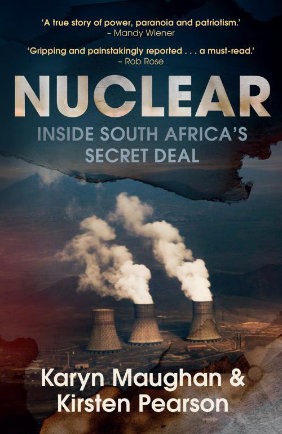
 Title: Nuclear: Inside South Africa’s secret deal
Authors: Karyn Maughan and Kirsten Pearson
ISBN: 9780624087144
Publisher: Tafelberg
Any book that opens with an alleged poisoning by an averred unfaithful wife, bends more towards Shakespearean drama than it does to exploring the mundane question of how it is that South Africa has failed to keep the country’s lights on. The space between these polar opposites is suggested by the cover of this new book from Tafelberg: here, the word nuclear shouts out, while the subtitle promises that the contents reveal what is “inside South Africa’s secret deal”.
The book falls into the category of “state capture literature” that has been generated by the calamitous Zuma presidency. Much of this work has been written by a committed cohort of journalists and/or activists for whom this country has a deserved reputation. This particular book was written by award-winning journalist Karyn Maughan and Kristen Pearson, who is described as “a development practitioner and activist” and is a one-time staffer in the National Treasury.
They write with verve and passion, taking the proverbial “no prisoners”: at times, the pace is breathless, but the attention to detail is as impressive, as is their determination to follow, with forensic precision, the many twisting tributaries of an epic drama.
What is the story?
...
The danger of this story is that the country’s international relations were out of kilter with the views of its people, but – far more importantly – that the Zuma presidency came within a whisker of bankrupting several generations of South African tax payers. But the message of this book is that South Africa’s democratic institutions – in the form of bureaucrats, courageous citizens and courts – checked naked opportunism and criminality which was disguised as liberation politics.
...
As president of the country, they allege Jacob Zuma broke both protocol and the law to strike a deal on nuclear power with the Russian state. The early chapters are interested in explaining why Russia was preferred over this country’s more established (read Western) trading partners. It seems that Zuma had both personal and political reasons.
Not only was his choice shaped by the legacy of “the Struggle”, as Russia (then in the guise of the Soviet Union) had supported the liberation movement, but Russia also “saved his life” after he was allegedly poisoned by his fourth wife. Moreover, he called the Russian leader his “friend” and saw that country – together with the multilateral organisation, BRICS – as a counterweight to Western hegemony of the global system.
That there is a lot of stuff bundled together in these claims is plain, but laying them out, weighing them up or placing them into a comparative framing is not the task of this book, which hurries on to explaining various ways in which Zuma tried to stitch up the nuclear deal between this country and the Russians.
Using – and certainly misusing – policy instruments and state institutions, Zuma’s actions have helped to finger a now notorious cast of characters who featured in the seemingly endless changes in his successive cabinets.
Evidence of the claims that are made at this point (and elsewhere in the book) is supported by extensive footnotes – over 130 in all. But – and this is a spoiler alert – some of these are self-referential, and, official statements aside, only one non-South African source is cited – this was a study issued by the Carnegie Endowment for International Peace but penned by authors who seemingly have no knowledge of South Africa.
In the story’s telling, a Manichean world of good versus evil emerges. Those who tried to fake, fascinate, flatter or force South Africa – or Eskom – into signing a deal with the Russians (or Rosatom, that country’s nuclear energy agency) are “bad guys”; those who resisted this capture are “good guys”.
This is a weakness in the book: so determined are Maughan and Pearson to draw the divide between virtuous and the sinners that they sometimes slip into sappiness. So, on page 78, “the deeply religious and introverted” Nhlanhla Nene, one-time minister of finance, is reported to have appeared before the Zondo Commission “quietly and without ceremony ... [w]earing a South African flag lapel pin”.
Amen to that, one might add!
Do such reservations mean that Maughan and Pearson have not been even-handed in writing this book? Not at all. For instance, Tina Joemat-Pettersson (one-time minister of energy and said to be a Zuma acolyte) emerges on this side of virtue because she resisted pressure – from Zuma, her own bureaucrats and the Russians – to sign a two-faced nuclear deal which would have bypassed the necessity that the Treasury – and it alone – had the constitutional authority to sign off on any deal of this kind.
Does the book mislead? No. However, what this account neglects to do is ask second-order questions like, what was the role of the presidency – and its officials – as this tawdry tale unfolded? Why is it that in South Africa, strategic ministries – like Energy – have become political dumping grounds? Why is it that in South Africa, strategic ministries – like energy – have become dumping grounds? And why is it that every knot in our national life signals the presence of the State Security Agency?
Does this mean that Maughan and Pearson got the story wrong? Again, the answer is no – they have told it as far as they can! Based on what they had before them and the interviews they conducted, this is a plausible account of the malfeasance – (defined as) the fact of someone in a position of authority intentionally doing something dishonest or illegal – which has marked politics since the Arms Deal.
If, as is often said, “journalism is the first rough draft of history”, then this book is a second – and very rough – draft of how the global complexity of securing nuclear-generated energy was caught up less in geopolitics than in the many tangled webs which Jacob Zuma spun.
Like all confounding stories, it reveals several truths. One is that communist Russia – more, perhaps, than the capitalist West – is recognised as a force which liberated South Africa from apartheid. If this is not quite the understanding of the think tankers, it seems to be the view on the street. But the paradox, of course, is that this has drawn successive South African governments closer to Moscow and Putin’s brand of authoritarianism.
The danger of this story is that the country’s international relations were out of kilter with the views of its people, but – far more importantly – that the Zuma presidency came within a whisker of bankrupting several generations of South African tax payers. But the message of this book is that South Africa’s democratic institutions – in the form of bureaucrats, courageous citizens and courts – checked naked opportunism and criminality which was disguised as liberation politics.