

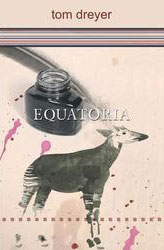
Title: Equatoria
Author: Tom Dreyer
Translated by: Michiel Heyns
Publisher: Aflame Books
ISBN: 9781906300012
Publication date: October 2008
Pages: 164
Tom Dreyer's Afrikaans novel Equatoria, which debuted in 2006 to great critical acclaim, has recently been translated into English by Michiel Heyns and published by Aflame Books. The novel is set in the year 1912 and is the fictitious account of two Englishmen, Willis Reed and Guy Nichols, who have been commissioned by the Antwerp Zoo to bring a live specimen of the okapi back from the Belgian Congo. In Europe of the early twentieth century the okapi was known only from descriptions and was considered to be almost as mythical as the unicorn. Consequently, the search for the okapi is as much a search for truth itself.
Equatoria's narrative is predominantly focused on Willis Reed and his obsession with the okapi. In the early stages of the novel, as the quest begins in the jungles of the Congo, Willis notes that "the forest [was] opening up like a book before him." This phrase is revisited in different forms several times in the text, and becomes increasingly significant as the narrative progresses. It puts me in mind of the view held by the French philosopher Paul Ricouer that one should understand reading as an appropriation of the text. This is, in part, due to the fact that reading allows one to gain an understanding of the self through the mediating factor of understanding the text one is reading. For Willis the forest is that text, the pages of a book; and the experiences he undergoes, the people he encounters (notably the love interest, Alice), and his dealings with animals (specifically the okapi he captures and names Lizzie) are all means of bringing to Willis a deeper understanding of his self.
From the initial pages of the novel it is evident to the reader that Willis feels "as if there were some membrane between himself and the world ... that he was different from other people, that he lacked some faculty of human intercourse, which would forever exclude him from the circle of their smiles". It is due to this feeling of separateness that he came to Africa in search of the okapi; for he believed that it would "lend more substance to the tenuous metaphysic of his existence" and "fill in the voids in [his] life".
At the Metropole Hotel, before embarking on the expedition into the jungle, Willis meets Alice De Quincy, the young wife of the drunken General De Quincy. De Quincy is a cruel and tyrannical master to his workers; something which disgusts Willis. After barely more than one sexual encounter, Willis is in love, if not obsessed, with Alice. Through his mania to find the okapi, Willis manages to conflate Alice in his mind with the pure woman who according to mythology is the only one able to capture a unicorn. He believes that "without [Alice] the okapi could elude me forever." Trusting that despite her absence from the expedition, Alice will direct him to the okapi, he goes so far as to keep the letters he writes to her during the mission alongside his compass and maps. However, Alice, who does not share Willis's romantic feelings, is careful to warn him, "Nothing wants to be caught."
I must return, here, to my earlier use of the word appropriation, for it is only through the actual act of capturing, of taking for himself, that Willis will be able to come to that sense of self for which he yearns. But for Willis the act of appropriation is not the euphoric event he had expected. After weeks of fruitless searching, the explorers eventually manage to capture a young okapi calf, removing it from its parents. Stunned by the event, he wonders, "Is there nothing more, then? Does everything amount to no more than this: the cold embrace of a snare, a cartridge dropping on the forest floor?" And, worse still, he asks, "But what do we do with the guilt?" Willis suddenly realises that there is no difference between General De Quincy's abuse of his workers and his own capturing of the okapi - they share a communal guilt. The self he has come to know is not the self he had hoped for, and this is reflected in the jungle which has now lost it beauty: "Flowers turned into bloody mouths, an eye peered out of every knot, and branches contorted into hideous limbs." He is repelled by the reality of himself.
Despite Willis's best efforts, the okapi calf dies without its mother's milk. Wracked with guilt, in an act of contrition, Willis builds a pyre on which he burns the calf. The calf becomes a scapegoat for him, and as the body burns, "his own illusions were burnt with her." The appropriation is complete, the understanding of the self realised.
To translate well is not an easy task; for the very act of translating requires a reading of the text, and consequently, a rewriting and appropriation, that is unavoidable. The translator's aim is to re-present the text to the reader so that, while the words are different, the essence is not. This cannot be achieved by simply translating word for word ad nauseam. The translator must have a special ear for language, for nuance, and most of all, a respect for the original text. All of these qualities Michiel Heyns possesses in abundance. A remarkable prose writer in his own right, Heyns has not disappointed in his role as translator. The writing is as well-crafted as the original's and has not lost its sense of passion and obsession. Dreyer's novel could not have had a better translator.
Equatoria is a finely crafted narrative. With its good prose and the author's patent zeal for researching and writing, this novel is a captivating and intelligent read in both Afrikaans and English.