

There is a war being waged against corruption in South African universities’ lecture halls, libraries, boardrooms and offices. Sandile Ntuli attended the Johannesburg launch of Jonathan Jansen’s book, Corrupted: A study of chronic dysfunction in South African universities, and shares his “crib notes” with LitNet’s readers.

Professor Jonathan Jansen emphasises a point to Stephen Grootes during the book discussion on his latest book at Exclusive Books in Rosebank, Johannesburg.
There is a war being waged in South Africa’s universities. The casualties are great in number; ignoring them would be a massive blunder. You will not, however, see the bad guys and gals in this war wearing combat uniforms, but rather expensive, exclusive brands. The war machines that the aggressors drive in this conflict are not military tanks; the best German sedans and SUVs will do. This is no ordinary war; it is a war against corruption in higher education.
To learn more about it, I headed to Exclusive Books at Rosebank Mall in the City of Joburg on Thursday night. Professor Jonathan Jansen, former vice-chancellor and rector of the University of the Free State (UFS), is our war correspondent for this battle. He has interviewed over 100 academic managers and others, and seen stuff in higher education that he says he fears. What better way to take us to the front line of a war than to document its beginnings, humanise and name its victims, and then expose its biggest profiteers?

Our correspondent has done so with his latest book, Corrupted: A study of chronic dysfunction in South African universities. We attendees had to leave our labels of teacher, writer and, in my case, salesman at the door, for Jansen would be doing the selling and teaching that night. He’d already done the writing. Stephen Grootes of the SAfm Sunrise radio show acted as the moderator.
Corrupted looks at corruption in South African universities since the 1990s. Stephen Grootes kicked off by noting how he didn’t believe his jaw would drop any lower following former Eskom CEO André de Ruyter’s recent revelations about corruption at the power utility. In his latest book, Jansen writes about the many flavours of higher education corruption, be it “Fort Hare flavour” or “UJ flavour”.
He says that at one university, so bad is the level of corruption that the vice-chancellor is the only one who has access to a key that opens a safe which comes in handy when degrees must be authenticated. In another institution, the vice-chancellor received a phone call from a bank, as an individual had forged documentation in an effort to use the university as security for some kind of loan. Then there’s the power that trade unions exercise, which can lead to the closure of an entire university when its students and staff get caught in the crossfire of unhappy members’ frustrations.

Professor Jonathan Jansen commends moderator Stephen Grootes on how well he prepared for the book discussion on Professor Jansen’s new book.
Jansen claims that in some institutions, it seems “there’s place for everyone and their cousin” in appointments of various posts, despite some of the appointees being unqualified for a position. Our correspondent says in his book, that a whistle-blower at one dysfunctional university gave the new administrator “a list of all the family members appointed by the vice-chancellor”, but no action was taken against the bad apple. Praat van “baantjies vir boeties”. Talk about nepotism.
What could be the root of this problem? Jansen says that to some extent it has to do with what comes to mind when people think of a university. He says that for him a university is “a place of higher learning, a place to do research [and to advance] the academic project”. However, people in a township may see a university as a place to compete for a job or to get passengers for their taxis.
Surely, though, as with every war, there are allies to be found. The allies for Ukraine in its war with Russia are the United States and the United Kingdom; the ally for universities in its war against graft should be the minister of higher education. The truth of the matter, though, according to Jansen, is that the minister can make things much easier or much harder for a university.
Considering that government remains a big funder of these institutions, some ministers of higher education may even increase pressure for councils. If you have a strong university council like that of the University of the Witwatersrand (Wits) or that of UFS, the minister eventually gives up. Jansen is exasperated by how “institutional rules are deliberately undermined by people who made them, to gain access to resources”. Whether it’s with overpriced goods and services, bribery for tenders or siphoning off money from the National Student Financial Aid Scheme (NSFAS) that is meant for poor students, beneficiaries of higher education corruption take no prisoners, and they, too, are not taken prisoner for their crimes against humanity.
Yet some universities, it appears, are winning this war against corruption. A few notable examples of universities where you could smell the corruption at the university gates already, are the Universities of Venda, Limpopo and the Western Cape. With good administrators and values in place, these institutions are turning things around and closing the taps to keep out the thieves who come in by way of tenders and NSFAS.
..........
We push back by blowing the whistle when we see that someone has been doing their shopping in the university cash register.
..........
Despite all the negativity is a promise of our enduring human spirit. Jansen sums it up in this way: “I think all is not lost,” adding: “We need to push back.” How? We push back by blowing the whistle when we see that someone has been doing their shopping in the university cash register. The homeless people directing traffic when robots don’t feel like working – they’re pushing back. Strong universities like the University of Cape Town have what Jansen calls “institutional integrity”; this kind of institution he describes in his book as “an organisation that defines and acts within a strong code of ethical conduct and positive values [and] doesn’t tolerate deviance from the code by its employees or partners”. This is an example of a university pushing back.
Among those pushing back the hardest are the likes of the University of Fort Hare’s vice-chancellor, Professor Sakhela Buhlungu, whose bodyguard was shot dead in what appears to have been an assassination attempt. The professor has been exposing graft at the embattled university. Sadly, those who are ethical in running a university, such as Professor Buhlungu, pay a physical price, as it takes a toll on them to keep the thieves away from the kitty.
Corrupted also offers solutions to this problem worth sharing. Professor Jansen says we first need to change the language and conditions of our universities. It took him two years to get his university council at UFS to debate. While Wits University is an exciting place, Jansen believes it should be wiser and allow for people to ask questions. “You must create conditions for people to be intellectually engaged.”
Another solution being proposed by our war correspondent is the appointment of smaller, professional university councils without the interference of politicians. Those selected for such councils should be competent leaders who are not blindly loyal to political parties or factions. Essentially, we need three types of leaders: ethical leaders (who do not have their bread buttered on both sides: the side of integrity and that of dishonesty); capable leaders (who can administer big budgets); and then scholars (who appreciate that “everything revolves around the academic project”).
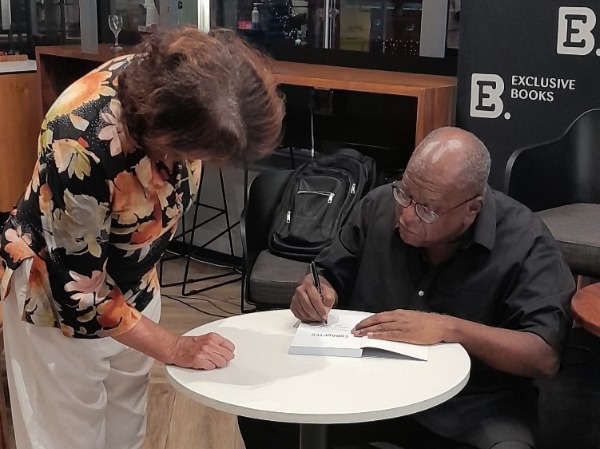
Professor Jonathan Jansen signs a copy of his book for an attendee
An audience member at the Corrupted book discussion from Oxford University likened the book to How to steal a city: The battle for Nelson Mandela Bay – An inside account by Crispian Olver. That book is regarded by some as the most important book on state capture.
The BBC and CNN tell us that a devastating war is cutting lives short in Ukraine, but the ethical war is being fought in the lecture halls, libraries, boardrooms and offices of the Witses and Fort Hares of our South Africa. Which vice-chancellors will rise to the occasion and be the President Volodymyr Zelenskyy of the academic war?
Kommentaar
What a pity! Our country has become a disgrace! There is no integrity on any level. We are in the claws of ruthless mafia groups. Cry our beloved country!
Congratulations on getting this piece published, Sandile! Thank you for raising awareness on such an important topic!