

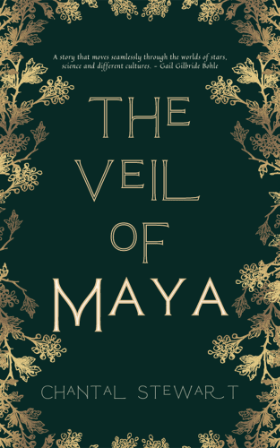
 The veil of Maya
Chantal Stewart
Minimal Press
The theme of the book, which is explored through six sections, is given in the title. The veil of Maya is a Buddhist/Hindu concept that we identify with thoughts, feelings, beliefs, opinions and so on, which distort actual reality.
The author explores this theme in the life of Lena, a geneticist who has been asked to investigate whether there is a genetic basis for an unusual cluster of symptoms in men from a village in Eswatini.
At a lecture on solar eclipses before she leaves, she meets the enigmatic Gabriel, an astronomer. The author introduces the theme of competing realities with questions from a group of astrologers at the lecture.
The two stories interweave throughout the book: the mystery of the men’s symptoms and the love affair with a man who is reticent about his past.
The author takes us from academia in Cape Town to the traditional areas of Lubombo in Eswatini. She mirrors the theme of different realities in pitting Lena’s Western methods of investigative medicine against the traditional stories and beliefs of the Swati.
...
The author takes us from academia in Cape Town to the traditional areas of Lubombo in Eswatini. She mirrors the theme of different realities in pitting Lena’s Western methods of investigative medicine against the traditional stories and beliefs of the Swati.
...
Kingston, the chief of the area, epitomises this, as he did three years of medicine in England and abandoned that for the traditions of his people. He argues against the loss of humanity in Western traditions. Lena watches an eclipse of the moon with him at the river near his house. Stories and myths give life to the experience.
Whether the group of men has a genetic disorder or not forms a large part of the novel. They present with strange behaviour called madness or psychosis, epilepsy and skin lesions. It starts with one poor soul who is in prison after committing a murder and appears to have a definite illness, probably schizophrenia. Some of the apparent psychotic symptoms we hear about in the other sufferers are that they laugh uncontrollably, become aggressive and speak with different voices. The one man explains that his ancestors are angry with him, and he hears voices from his stomach telling him what to do. The term in the community used to describe what he is experiencing is amafunfunyana, which is translated as “bewitchment”. Is this not a description of a mass psychogenic illness (mass hysteria)? In mass psychogenic illness, there is no biological basis for the symptoms. This can be true, both for the psychotic symptoms and for the apparent epilepsy. Convulsions without a biological basis are fairly common in clinical populations, and are currently called functional neurological disorder.
I think the question of whether this is a case of mass psychogenic disorder plays into the assumption that the Western nosology encompasses all diseases, including mental illnesses. However, we express mental illness from within our cultures. Forcing a Western diagnosis is not necessarily useful and can lose much of the significance of the experience. I’ll tell a fascinating story about post-traumatic stress disorder (PTSD) which illustrates the importance of culture in expressing our experiences.
A symptom which is found only in PTSD is that of flashbacks (reliving a traumatic event as though it is currently occurring). Edgar Jones and his fellow researchers published a few studies around 2002. They examined records for apparent mental illnesses that led to medical pensioning in wars in which Britain was involved, from the Victorian campaigns to the Gulf War. If you have read the war poets’ work on the First World War, you hear PTSD. We would expect flashbacks to be described as a reason for medical pensioning. However, this is not the case. Until the Gulf War, various somatic complaints showed emotional distress, including dyspepsia and disorganised action of the heart. The physical symptoms had cultural significance at the time. Flashbacks start appearing as a reason for medical pensioning only from the 1991 Persian Gulf War. The authors conclude that cultural expectations had changed; movies had sensitised the soldiers to the need for flashbacks to demonstrate their distress.
Amafunfunyana is the villagers’ attempt to create meaning for stressful events from within their cultural dictates. We learn that many of the men are infertile, a problem that is very distressing and not spoken about. This explains why only men are affected. With mass psychogenic illness, women, adolescents and children are more commonly affected.
Do we need to fit the symptoms into a Western paradigm? I agree with Kingston, the chief, that there is little value in the exercise. There may be elements of mass psychogenic illness, but so what? The cultural expression and solution fix the problem in the village. The infertility is dealt with and babies are born.
Lena’s love interest, Gabriel, is very reticent about his past. He is a brilliant scientist, about to publish in a prestigious journal. However, there are questions about himself which he evades. A colleague is distrustful of his data and Lena is confronted with information about his past relationships, which leaves her very unsure of him and her place in his life.
The author highlights the fluidity of reality throughout the book. The events, investigations and relationships she experiences eventually lead Lena to recognise the essence of life.
I dislike similes, and the author’s use of them in the initial chapters made it difficult to get absorbed into the story. Her writing became more natural and fluid later in the book, and I could then enjoy the themes she was exploring.
***
Chantal Stewart’s The veil of Maya has won the Humanities and Social Sciences Award for Best Fiction Novel 2023.
Kommentaar
In The Veil of Maya, Chantal Stewart’s main protagonist, Lena Brown is led to re-examine her beliefs and attitudes towards Science represented in this story by Medicine and Astronomy, and Myth/Art represented by African Astrology and Cosmology, in her quest to solve a mystery. As Lena’s story unfolds, we, the readers, are also led to examine our beliefs between these two very different approaches to our lives and their meaning on this planet. Where does the truth lie for Lena and for us? Is there a balance, a comfortable meeting place between Science and Art? Or is there only ever the dichotomy?
These crucial questions are delicately explored in Chantal Stewart’s beautifully nuanced prose. We are not told what to think. We travel alongside the living, breathing Lena who hopes, desires and suffers as we do as she searches for the truth about love and her world. The questions this book raised and Chantal Stewart’s evocative portrayal of different localities stayed with me long after I had turned the last page. A visit to Sutherland with its night skies of brilliant stars, is a must for me!