

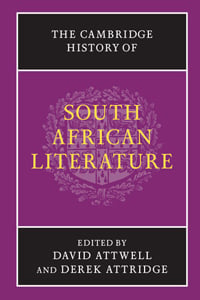
 Titel: The Cambridge History of South African Literature
Edited by: David Attwell and Derek Attridge
Publisher: Cambridge University Press
ISBN: 9781107681873
Click here to buy The Cambridge History of South African Literature from kalahari.com.
1
Literary histories produced in South Africa since the early 20th century, starting with the work of Besselaar (1914) and Nathan (1925), as well as everything in between, right up to Kannemeyer’s Geskiedenis van die Afrikaanse Literatuur (1978–1983) and Chapman’s South African Literatures (1996), are mangled by linguistic blinkers and conceptual shortcomings. As a result they have attracted withering critical attacks, fierce contestations and open rejection.
Besselaar and Nathan, writing in unabashed complicity with the rise of white supremacist rule following the formation of the Union in 1910, conceived of South African literature as English and Cape Dutch, as early Afrikaans was then known. For both, literature in the African languages did not exist at all, neither in oral nor in written form. This literary ethnocentrism was to continue until late in the 20th century, especially among Afrikaans and English literary scholars and historians in South Africa, as is evident in Malvern van Wyk Smith’s Grounds of Contest (1990).
 |
|
John Kannemeyer |
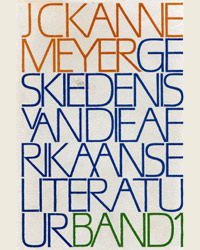 |
In the case of Kannemeyer a conservative ethnic nationalist approach and an over-dependence on established literary criticism was seen as problematic by many Afrikaans scholars. Chapman, in turn, was assailed for privileging South African writing in English at the expense of literatures in the African languages, Afrikaans literature and the literatures of other counties in the southern African region.
As a result, literary scholars came to develop a hermeneutics of suspicion towards literary historiography in general, and specifically towards all efforts aimed at accounting for all South Africa’s literatures in a single publication. This congealed into rigid convictions that a comprehensive literary history of all the literatures in South Africa was theoretically and practically impossible and should therefore be permanently abandoned.
However, such a history is not only possible, it is also necessary.
2
It is possible, since the abstract, thoughtless and uninformed claims concerning the radical diversity and putative incommensurate differences between the various literatures are rooted in a number of factors. Firstly, with some exceptions, most literary scholars in South Africa work in monolingual modes (even when they are bilingual or multilingual) as well as in the segregationist cultural paradigms of a divisive past. Secondly, contemporary literary and culture theory is averse to inclusive and comprehensive histories which are considered to be discursive totalisations tainted with authoritarian practices and the epistemic delusions of grand narratives. Thirdly, the scope of a comprehensive history and the resources it will require are seen as a prohibitive.
An inclusive history is also necessary, since the multilingual nature of South Africa’s literary cultures necessitates such a project to bring down the real and imaginary boundaries erected between the languages and literatures of the country for crude and nefarious ideological and cultural purposes. The insistence on the radical distinctiveness of the various literatures of South Africa is so persistent that it is sometimes even claimed that literatures in the African languages have nothing in common and that white and black writers in English and Afrikaans belong to completely different and unconnected traditions. In this unashamed parochial thinking, Afrikaans literature and English literature written by whites are said to constitute parallel universes, when even a cursory knowledge of these literatures indicate the opposite.
Furthermore, from a sheer literary perspective the construction of multilingual literary histories will facilitate contact zones between literatures and open prospects for new developments and trends. It is a fact that literatures develop exponentially and unpredictably when they are open to one another and to the diverse cultural currents related to them. The modernisation of Afrikaans literature through modern European literature, beginning in the 1930s and accelerating in the 1960s, is a case in point. The extraordinary range and diversity of global English and its literary productiveness are largely due to the contact of the language with other languages and cultures in various regions of the world.
3
David Attwell and Derek Attridge have waded into these troubled waters as editors of the Cambridge History of South African Literature. Fully aware of the pitfalls lurking below the surface, they jettisoned the monological or monofocal approach used in the histories of Kannemeyer and Chapman to opt for a multi-authored dialogical approach. Forty-three researchers from all literatures in South Africa contributed to the publication. In this approach the editors heeded the Belgian comparative literary scholar Albert Gérard, who as early as 1975, in a paper read at the University of South Africa, advised that a comprehensive history of South African literatures should be undertaken by means of a multilingual team approach.
 |
| Derek Attridge and David Attwell |
This new history consists of 39 chapters grouped into in six parts and arranged in a rough genealogical order, but not chronological in the form of a year by year narrative. It does not impose a single perspective or theory on the various chapters, but leaves room for approaches ”specific to each of the literatures” in relation to aesthetic, historical, cultural and political factors prevalent at a given time. This allows for some chapters and sections to range across periods both prospectively and retrospectively. This results in multi-stranded constellations of “continuities and contrasts” between periods and literatures which do not foreclose or impose comparative readings or elide contradictions. Each of the six parts is provided with an introductory overview outlining the social and historical factors of a particular period and their creative textualisations in the various literatures.
4
 |
|
Hedley Twidle |
Part I deals with the oral traditions and practices of the African language literatures. It opens with an excellent chapter by Hedley Twidle dealing with the Bleek and Lloyd Collection housed at the University of Cape Town. In a lucid manner he provides access to the vast collection consisting of “some 13 000 pages” of transcriptions and translations of |Xam narratives, lyrics, folklore, customs, and accounts of daily life and natural phenomena compiled between 1870 and 1884. It focuses on the complex process of the transposition of verbal narrations of a variety of kukummi into script and the translation of what in the verbal narrations of the |Xam informants were already translations from |Xam into polyglot versions of Cape Dutch en route to Afrikaans.
Where material from the archive was previously treated a-historically, romanticised and appropriated by English and Afrikaans writers, this chapter sheds light on the compromised transactions between the colonial ethnographers and their prison informants. The violence and trauma which suffuses the collection cast a long shadow over every phase of the literary and cultural histories of South Africa to follow.
Other chapters in Part I discuss the isiXhosa praise poem, the Imbongi, the Sesotho lifela (migrant poem), the isiZulu izibongo (praise poem), isiNdebele, Siswati, Northern Sotho, Tshivenda and Xitsonga literary traditions. The adaptations and transformations of oral performance literatures from the past to the present are highlighted, and connections between verbal and written textualisations, as well as migrations into audiovisual and digital media, are delineated. These chapters give an account of the rich and constantly changing African language literatures which earlier literary historians routinely overlooked and dismissed as preliterate folklore.
Part II deals with the writings produced in the early phases of Europe’s mercantile expansion initiated by the rounding of the Cape by the Portuguese in 1488 and the later permanent occupation of the Cape, first by the Dutch in 1652, and later by the British in 1806. In three chapters, the introduction of the myths of African barbarism, commercial documentation, travel writing and colonial natural history into South African letters, stained as they were with the physical, cultural and epistemic brutality of imperialist globalisation, are traced.
Part III begins with the emergence of South African English writing after 1820 in the wake of the arrival of some 4 000 British settlers in the Eastern Cape. This is followed by the establishment of mission presses and the emergence of black journalism and creative writing. The movements for the recognition of Afrikaans as a distinct language also receive attention.
5
It is in the four parts which follow, covering the 20th century, that a clear picture begins to emerge of the extraordinary scope of the literatures of South Africa. The irreducible diversity inscribed in the poetry, narrative, dramatic, autobiographical and meta-literary writings is given multifocal attention to tease out a heterogeneous field of entanglements, contrasts, convergences and differences pertinent to the literatures.
While imbalances, particularly with regard to 20th-century and current writing in the African languages, persist, this publication emphatically refutes the inanities written about the impossibility of producing an inclusive history of South African literatures. The editors must be commended for their deft conceptualisation of a complex and tricky field, and the contributing authors for their fine historiographical and critical labour.
- Read a review by Helize van Vuuren
- Read a review by Linda Kwatsha
- Click here to return to the contents page
- Click here to view photographs of the UK launch of The Cambridge History of South African Literature.
- Click here to view photographs of the Cape Town launch of The Cambridge History of South African Literature.