

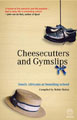
 Title: Cheesecutters and Gymslips
Author: Compiled by Robin Malan, with a foreword by John van de Ruit
Publisher: Umuzi
ISBN: 9781415200605
Pages: 208
Publication date: June 2008
Boarding school can mean different things to different people. Some cherish the memories, while for others it was hell on earth. Yet there are very many stories to be told from the experience of boarding school, where just the thought of leaving home at an early age becomes the teller's tale of adventure. A close friend to this day still cannot handle having to decide on when to leave a place and when to return. His mother would start getting him ready for boarding school days before he actually physically needed to go, leaving the family's Karoo farm for the drab inside of a boarding establishment. The same person recounts the marvellous times when he learnt the game of cricket (he later became a provincial player), or reminisces about the fun times and tells of his school chums he met when he was at boarding school in Bloemfontein.
As a teacher having lived in a boarding house for nigh on thirty years I have many stories about life and experiences in the boarding house ... enough to fill a volume like Cheesecutters and Gymslips many times over. There have been moments of joy, and moments of sadness; there have been moments of seriousness and then also moments of immense fun. Most rewarding of all, however, have been the experiences of seeing young people grow from boyhood into adolescence and approach adulthood, within the boarding house environment, as they grow close to others and get to know themselves so much better in the process.
The stories in Cheesecutters and Gymslips are such stories, told by eminent and well-known authors. Each has a particular story to tell. Thirty-seven southern African writers share their experiences of their boarding school days in this very engaging book. One of them was born in 1980, five in the '70s, three in the '60s, seven in the '50s, seven in the '40s, seven in the '30s, three in the '20s, six between 1911 and 1919, and two in the first decade of the twentieth century. Thus, 23 of the 37, that is almost two-thirds, were born in the first half of the previous century. Needless to say, boarding schools were places of old-fashioned values and sometimes mostly draconian institutions.
The book has been expertly compiled by Robin Malan who has spent his whole working career in teaching and theatre and making books, including a number of novels for young people, as well as anthologies, the most renowned of which is Inscapes. He is thus well qualified to judge what makes for good reading in his new book, Cheesecutters and Gymslips.
Reading through the descriptions and accounts of men and women of their experiences away from home brings different reactions. There is the theory that going to boarding school is good for you. Then there is the side of boarding school that says that leaving home at too young an age can be sorely damaging. Yet, some are adamant it's the right thing, like the Jesuits, whose renowned saying might well sound appealing to some, odious to others:
Give me the child for seven years,
and I will give you the man.
Reading through the essays in the book might well remind one of Spud, although they are different, appealing more to a specific mentality. For a schoolteacher who has being doing duties in the boarding house for near thirty years I must confess Spud is not the most exciting of books. Cheesecutters and Gymslips provides a rich historiography of life in South Africa over a wide spectrum, where you read of the schooling period of Nelson Mandela, Professor ZK Matthews, Ellen Kuzwayo and Phyllis Ntantala (Pallo Jordan's mother), and the histories that accompany their experiences. In these essays one gets a real idea of the importance of the early influences on the lives of wonderful people like Mandela, Chris Barnard, Doris Lessing, Stephen Gray, Guy Butler, Patrick Cullinan, EKM Dido and Mamphela Ramphele.
Doris Lessing recalls the petty rules about washing oneself - or the contrary: that washing too much was sinful. She attended the Dominican Convent School in Harare, Zimbabwe in the 1920s. Cleanliness for the Catholic nuns, who oversaw them at school, was an invitation for the devil. Hands were washed as far as the wrists, faces could be washed and if soap got into the eyes, you were to grit your teeth and offer the pain to God. Girls were exhorted not to look at their bodies when washing. A special board was used on which the head was rested as the girls washed themselves, looking away from their beautiful, soft, naked bodies. Underclothes were changed once a week. It was fine to smell. Wearing smelly knickers and dirty socks offered a far better chance of acknowledgement from God than washing too often. "All is vanity. You should not think about your body," reminded Sister Amelia.
Ivan Flint recalls his days at Paul Roos Gymnasium in the 1960s. Ivan is a well-known architect in Cape Town. He learnt the difference between English and Afrikaans boys: the former self-conscious, and the Boereseuns those who "just played hard rugby and generally seemed more capable of passionate abandon". This might well account for why Paul Roos gives the English-speaking Cape Town schools a hammering at rugby still today! Flint's experiences, as any boy attending a South African boarding school during this era would certainly agree, are not void of the painful accounts of severe caning. Mr van der Mesch's "artful and theatrical handling of the cane" comes across graphically in the Flint prose.
One of the boarding school attendees included by Malan in his book is Nelson Mandela, who gives an account of his schoolboy days in the 1930s at Healdtown Methodist Boarding School near Fort Beaufort in the Eastern Cape. Mandela's formative years, from his time at Healdtown, made him see himself "as a Xhosa first and an African second". This came as an inspiration from the poet Mqhayi, who attributed the Morning Star, the star for continuing the years, the years of manhood, to the Xhosa, granting it pride of place above all others. While Mandela confesses the confusion this philosophy carried with it, it once and for all galvanised in his mind that "seeking benefits from whites [...] often required subservience". Is this the catalyst, the influence from the song of a soothsayer, the poet Mqhayi, of the political actions of one of the greatest national leaders of all times?
Murray La Vita's column in Die Burger is as vivid and graphic in its descriptions as his abounding energy describes his early days at boarding school, drab and grey: "The phone box was made out of metal that was painted gray. The black rubber receiver had a very specific smell (you may know that smell)." It was the time of the Soweto uprisings, not far away from Krugersdorp where Murray was at school, in the hostel of Monument, the Afrikaans High School in the town. Soweto was down the road, as it were, and one of Murray's colleagues was speaking on the telephone pleading with his mother to fetch him in case the "blacks" came to attack the hostel. A strange irony lies in the very nationalism that Mandela describes as the same nationalism that scared Murray and his friends when they were young thirteen-year-olds, residing in a boarding house, away from home!
I remember well the days I spent as a teacher in the 1980s at St John's College (SJC) in Johannesburg. It was thus with a great deal of interest that I read William Plomer's account of his days at school there in the decade starting in 1910. SJC was founded by the fathers of the Community of the Resurrection, from Mirfield in Yorkshire. In fact, in Pelican Quad there is a magnificent memorial to these great men (a pelican with its chickens feeding from the beak, a symbol of sacrifice). Plomer certainly jogged the memory by recalling the most amazing Shakespearean productions for which SJC is renowned. The open Clarke Quad to this day remains a suitable stage for such productions and the beautiful Johannesburg summer evenings a fitting time to be part of the audience and marvel at the costumes, acting and sets. Plomer remembers with great interest his part as Lady Macduff's son, and later as Titania in A Midsummer Night's Dream. It was nothing for the staff, one afternoon a year and each assigned a part, to read the Shakespearean set work to the senior English class in Big School (the school hall). It was there that the boys learnt how to read, properly, in meter. Needless to say, judging by Plomer's experiences, he derived a great love for writing at SJC. It is not hard to see why!
One of the great British headmasters and a writer in his own right, Jonty Driver, recalls his days at St Andrew's College in the 1950s. I met Jonty several times when he visited Bishops where I teach. In his essay, Jonty describes his very miserable time at school, the bullying, and how he, too, could easily have become a bully but chose to rise above it all. He followed the career of the Thespian at school, and when looking back, fifty years later, at a photograph of himself cast as the king in the play, "[i]t didn't fit at all with my memory of my time in that school." Such are the cruelties of boarding school of those times.
Reading these and other accounts in Cheesecutters and Gymslips conjures up different emotions about one's life at boarding school. One thing is certain, though: learning to live alongside, next to, with other people from an early age makes you appreciate the space that is not as free as you might want as a boarder. But looking back on it all you learn to appreciate it.