

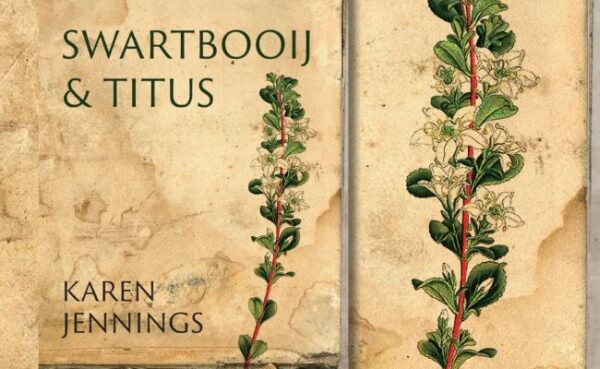
Book cover: https://karavanpress.com/2025/11/09/karavan-press-title-swartbooij-titus-by-karen-jennings/
Swartbooij and Titus
Karen Jennings
Publisher: Karavan Press, 2025
ISBN: 9780639862668
........
History likes its villains tidy and its violence abstract. Karen Jennings refuses both. Swaartbooij and Titus opens a wound in the Cape’s colonial past and rubs salt into it, asking not who was right, but who was wronged, who was left to carry the memory when the smoke cleared. With the northern frontier of the eighteenth-century Cape as its backdrop, this is not a historical novella in the typical sense, but an act of reanimation: a novella that speaks back to the record, breaking its silence with breathtaking force.
........
History likes its villains tidy and its violence abstract. Karen Jennings refuses both. Swaartbooij and Titus opens a wound in the Cape’s colonial past and rubs salt into it, asking not who was right, but who was wronged, who was left to carry the memory when the smoke cleared. With the northern frontier of the eighteenth-century Cape as its backdrop, this is not a historical novella in the typical sense, but an act of reanimation: a novella that speaks back to the record, breaking its silence with breathtaking force.
Jennings takes two men consigned to the margins, a Khoisan father and son, and restores to them the dignity of motive, grief and consequence. Written in a beautiful slip between prose and poetry, Swaartbooij and Titus reads like a chant against forgetting, a reminder that colonial violence did not begin as myth, nor does it end as metaphor.
Jennings doesn’t shy away from difficult material. In An island, her Booker-nominated novel, she unpacks issues of place and belonging through isolation and moral reckoning. She discusses just how far we would go to protect what we deem to be ours. Meanwhile, Crooked seeds, which was longlisted for the Women’s Prize last year, deftly assesses the belonging of someone whom society has long since shunned within a stark climate-ravaged future. Swaartbooij and Titus deepens these preoccupations by turning backward, revealing how such questions have always structured violence, power and exclusion.
........
The book, in and of itself, is a narrative mystery. Jennings blends prose and poetry masterfully, using the lyric rhythm of poetry to accentuate the deep and meaningful lived experience of Titus and his father Swartbooij. There are things that simple prose cannot say, and leaning into the poetry feels earned. It doesn’t feel self-indulgent or like an artistic flex. Instead, it provides the reader with a steady flow of trance-like reading – never sure what is coming next, but knowing that the vessel will inevitably serve the message.
........
The book, in and of itself, is a narrative mystery. Jennings blends prose and poetry masterfully, using the lyric rhythm of poetry to accentuate the deep and meaningful lived experience of Titus and his father Swartbooij. There are things that simple prose cannot say, and leaning into the poetry feels earned. It doesn’t feel self-indulgent or like an artistic flex. Instead, it provides the reader with a steady flow of trance-like reading – never sure what is coming next, but knowing that the vessel will inevitably serve the message.
Building on this trance-like momentum, Swaartbooij and Titus resists the familiar comforts of narrative resolution. Jennings rejects the idea of redemption or moral neatness. Instead, she shows us – painfully, even slowly – how the build-up of rage can lead to inevitable violence. How the hurt and anguish we experience compounds and leaves us hardened to the world. She shows us how the accumulation of all our feelings can sometimes lead us against logic and steer us towards action, consequences be damned.
The novella does not focus on a single massacre, but instead unpacks the conditions that made such events possible in the first place. The colonialists made promises they never kept; loyalty was demanded, but not returned; and the boundary between survival and complicity is necessarily left unresolved. Jennings’s restraint here is striking. Violence is rarely staged head-on; it surfaces obliquely, often in aftermath or implication, and is more unsettling for that refusal to perform itself for the reader.
One of the book’s most compelling achievements lies in its handling of anger. Colonial narratives have tended either to demonise indigenous rage or to smooth it into something more acceptable. Jennings does neither. Rage is allowed to appear as cumulative and intelligible, shaped by dispossession and deceit, without being romanticised or excused.
By the end, you don’t close Swaartbooij and Titus with answers. You close it with a weight in your chest. Jennings doesn’t give you someone you can get behind; she gives you people who are shaped by their hurt and grief. She shows you what led them to that slow, accumulated violence. She makes no excuse for them, but she shows you why you should care. Why it mattered then as much as it matters now. That’s the message. Sometimes, the prose builds the tension, and the poetry further elaborates on it. Other times, the poetry makes you dead-brake. It makes you take a step back and reconsider what you’ve just read. It asks you to clarify with yourself whether you have truly understood what the prose has told you.
With its intentionally untidy resolution, Jennings makes you a witness to something difficult. Something that we, as humans, need to understand in order to build ourselves into more deeply empathic people. This novella is as much about grief as it is about understanding. Understanding in a way that says, never will this happen to anyone ever again. Not as long as we have something to say about it.
Also read:
Kommentaar
Baie keer verstaan ons nie hoekom mense doen wat hulle nou doen nie, want ons ken nie die verre verlede, die agtergrond nie. Die boek sal ook my insig oor my agtergrond kan verlig. Dit is deurdrenk met diepe insig en antwoorde.