

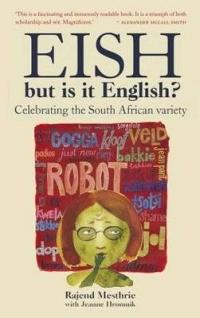
 Title: Eish but is it English: Celebrating the South African variety
Author: Rajend Mesthrie with Jeanne Hromnik
Publisher: ZEBRA PRESS
ISBN: 9781770221529
Price: R162.95
Click here to buy Eish but is it English: Celebrating the South African variety on Kalahari.com.
The sun may have set on the English Empire, but the English language continues to spread and proliferate across the globe. This avowedly popular book examines its local, South African variety – or varieties, for it soon become apparent that there are in fact a number of South African Englishes. The book is in part a spin-off of John Orr’s well-known radio programme Word of Mouth, on which Rajend Mesthrie was a frequent guest, giving his expert opinions (he is a professor of linguistics at UCT) in a relaxed and informal way.
This book is the product of an unusual arrangement between the two co-authors: it is based on interviews with Mesthrie, conducted and recorded by Cape Town freelance editor and writer Jeanne Hromnik. One of her aims was to produce a book that retains some of the spontaneity and informality of the spoken word, and in this she has largely succeeded. Language impinges on our lives in a particularly intimate way, and few people will be indifferent to the controversies that swirl around the issues of language choice and language use in our country.
If there is a standard variety of South African English (although this book does not seek to privilege any particular variety) it is probably that spoken by ESSAs (English-speaking South Africans), many of whom trace their familial roots back to England. Although they constitute a minority of English speakers in this country, they often seem to feel that their English has normative value! Given our complex history and our multilingual, multi-ethnic society, English-language variation increases as one moves across or down the social spectrum. In this book particular attention is paid to the English spoken by South Africans of Indian descent and by black South Africans – although here again there are significant differences between the English spoken by an older generation and that spoken by streetwise urban insiders and sophisticates. “Tsotsitaal” has, of course, had a massive influence on the language spoken in the townships. Many black urban dwellers are fluent in several languages, hence their frequent code-switching – as is also evidenced by a number of local TV soaps.
The authors comment succinctly on such well-known features of South African English as our use of “robot” (for “traffic lights”), on expressions such as “Ï’m coming now now”, on constructions such as “He threw me over the hedge with a stone”, and on sentences like “The people, they are tired of waiting for change.” I recall my perplexity at being told by a township friend that so-and-so “is late” – when I knew very well that the person in question had been dead and buried for some time!
Occasionally one is reminded that a word one had taken for granted – like “bottle-store” – is, in fact, peculiar to South African English. I was interested to see that the jury is still out on the origin of some well-known words like “tsotsi” and “larney”, and was intrigued to discover the rather obscure origins of “mealie” (or “mielie”) and “bunny chow”. There was no mention of the widely used word “shebeen”. One supposes that words from our apartheid past (like “kwela kwela” and “dompas”) will gradually fall into disuse. I am still puzzled by the derivation of “velskoen” – or is it “veldskoen”?
The authors pay handsome tribute to the pioneering efforts of the Branfords at Rhodes University, who started the Dictionary Unit that produced four editions of A Dictionary of South African English. They also acknowledge the magisterial A Dictionary of English on Historical Principles (“a greatly under-appreciated work of scholarship”), whose managing editor was Penny Silva. They make honourable mention the work done by lexicographers at Stellenbosch University on the Woordeboek van die Afrikaanse Taal (or WAT for short.)
This modest and accessible book will appeal to those with some interest in the way we express ourselves. In spite of the indignation captured in the title, it won’t give much comfort to the sticklers for “correctness”. Like David Crystal (and other linguists) the authors prefer to use the notion of “appropriateness” rather than “correctness”, and they avoid anything that sounds prescriptive.
Two minor suggestions: an index would have made the book even more user-friendly. And although this is a non-scholarly book, a glossary of selected terms, or a list of suggested readings, may have been helpful. After all, the book may actually quicken an interest in sociolinguistics in some readers.