

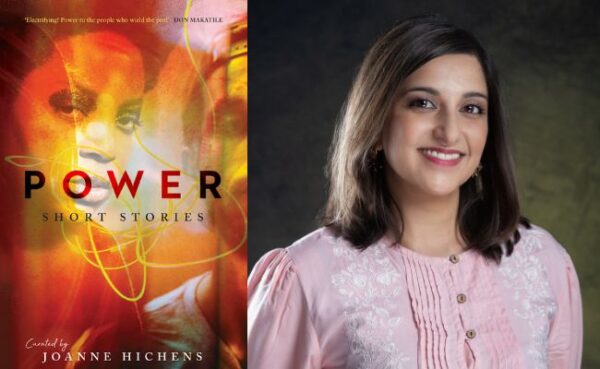
Picture of Nadia Cassim: provided
Short.Sharp.Stories is a platform showcasing established and emerging South African short story writers. For the 2025 anthology, Power: Short stories that light the dark, writers imagined “power” in fictional terms – how it influences and affects us, including political and personal power, and the ever-present issues of loadshedding.
In this Short.Sharp.Stories interview, Consuelo Roland chats with Nadia Cassim, author of the short story “The stairs she climbed”, about a mother’s attempt to secure maintenance for her child in the Roodepoort courts.
Nadia Cassim is a writer, artist and financial advisor. She graduated with honours from the School of Architecture and Planning at the University of the Witwatersrand before pursuing fine art. Her paintings have been exhibited in two solo shows and showcased at the Women’s Jail at Constitution Hill. In 2023, her artwork When blood ties become blood chains was featured in the Ake Review.
In 2012, she founded IRTIQA, a modern Muslim women’s magazine, which she led for eight years before focusing on writing. In 2023, she was selected for the Bosberg Books Writing Residency. Her short fiction has appeared in anthologies published by Modjaji Books, Brittle Paper and the Umuofia Arts and Books Festival. Forthcoming publications include short fiction by Mirari Press and her debut novel, Not another samoosa run!, by Kwela Books.
Firstly, what draws you to writing short stories, and are you drawn to a specific form/genre?
To be honest, in my early years, I didn’t give much thought to short stories – at least not until I decided to write one myself. That’s when I realised that short fiction can be a powerful conveyor of meaning. Like drinking an energy drink on the way to a meeting, it can tackle themes that may seem tired in a refreshing and energising way, leaving readers contemplating the author’s words long after they’ve left the page.
When it comes to genre, I don’t restrict myself. I’ve written stories that are dramatic and fantastical, as well as romantic. What matters more to me is that the story is relatable.
........
When it comes to genre, I don’t restrict myself. I’ve written stories that are dramatic and fantastical, as well as romantic. What matters more to me is that the story is relatable.
.........
In terms of form, I like to alternate between past and present to give my characters greater depth and context. This allows readers to better understand the motivations behind certain actions and the significance of particular settings.
Amaani is a compelling three-dimensional protagonist with a strong personal motivation. How did you come to place her in that setting and in that situation?
Amaani’s character is loosely based on my experience as a mother. When reflecting on some of the most intense power struggles in my life, maintenance court stood out as a space where conflict between parents is laid bare. The fight for justice, and for what you love, can be a powerful motivator, often compelling people either to step up or to step away. That’s the emotional truth I wanted to capture.
........
The fight for justice, and for what you love, can be a powerful motivator, often compelling people either to step up or to step away. That’s the emotional truth I wanted to capture.
........
Talking more of setting, your story – set in the Roodepoort Magistrate Court (with a staircase) – has a visceral sense of place. Is place, or setting, important to you, and are certain places more evocative than others?
I believe that place, or setting, is very important. As readers (which we all are before we become writers), a strong sense of place can either draw us into a narrative or leave us feeling disconnected from it. I need to feel grounded through the five senses – atmosphere, smells and aesthetics. That’s what I try to achieve in my writing: to root the reader in the immediate environment of my characters. I often write stories set in places I’ve visited or lived in, even briefly, so that the portrayal feels more authentic.
The writing is packed with details, perfectly conveying grief and anger and frustration, giving the story a melancholic quality. Ultimately, Amaani’s hope for a better future and her empowerment lie in her determination to move on and leave the conniving Ahmed behind, even if this means that her baby daughter will have no relationship with her father. Did you experience any challenges in writing the ending for this story?
Oh, yes, many times! I rewrote the ending three times and eventually circled back to something close to the original. Endings are so important, and I’m grateful to have had keen, expert eyes on my work to help me shape the best one possible.
Do you see short story fiction as having the ability to shift perspectives about prevailing societal problems on an intellectual and/or emotional level in a way that memoir and nonfiction cannot, and do you feel that you achieved your aim?
This is a difficult question. I believe that all forms of writing have value, and, depending on the reader, a message can be effectively conveyed in any of them. Perhaps one advantage short fiction has over memoir and nonfiction is that it can deliver truth in a more palatable way. By altering one or two elements in a narrative, it can soften the blow, so to speak, while still delivering the message with impact and greater compassion. I can only hope that my story has highlighted the plight of single mothers in South Africa.
........
By altering one or two elements in a narrative, it can soften the blow, so to speak, while still delivering the message with impact and greater compassion. I can only hope that my story has highlighted the plight of single mothers in South Africa.
........
Getting back to the more general, do you have a favourite short story or a collection you turn to for inspiration? Why does this particular story/collection stand out for you?
While I value all stories and collections, I must admit to being deeply inspired by an older piece: Out of the blue by Saaleha Idrees Bamjee, the winner of the 2014 Writivism Short Story Prize. The story tackles infertility in such an honest and haunting way, cutting through all illusions with beautifully crafted prose.
As a writer chosen for inclusion in this latest Short.Sharp.Stories Power collection, could you share what value you see this competition adding to the South African literary scene?
Short.Sharp.Stories is a long-standing competition that offers both emerging and established authors the opportunity to showcase their storytelling. Its role cannot be underestimated – especially in South Africa, where opportunities for new and diverse voices are often limited. I’m deeply grateful to have been included in this year’s collection, and I look forward to future editions and the fresh voices they will bring to light.
What “writing tip” can you offer to aspiring writers, and particularly to those who would like to see their stories included in future SSS collections?
I’ve found that writing every day helps keep the creative muscle alive. Every voice is important and deserves to be heard, but only with consistent practice and perseverance can you ensure that your writing becomes publishable.
You have worn different hats – as an artist, a financial advisor and a fiction writer. Do you find these activities compatible, and why?
I believe that everything we do in life depends on where we are in our evolution. We can have more than one purpose in a lifetime, and the different hats I wear reflect that. The most important thing for me is to serve humanity and contribute my skills in a meaningful way. My work as a financial advisor is more practical and allows me to engage with various personalities, which helps me when writing different characters into my stories. However, I believe that at some point, I will leave this vocation behind.
Being an artist has always come naturally to me. I rebelled after completing my town planning degree (much to my lecturers' disappointment) and chose to pursue this path instead. I see art and writing as the same thing, simply expressed in different ways: one conveys a message or feeling through pictures, while the other does so with words.
“The stairs she climbed” is a compelling story about a single mother’s struggle that leaves a lasting impression. Thank you. We are looking forward to more of your stories. Would you like to share a little of what we can expect in the future?
My debut novel, Not another samoosa run!, has just been released by Kwela Books, and I’ll have another short story featured in the anthology The seven wonders by Mirari Press. Beyond that, I can’t say much. I’m a firm believer in planting seeds for the future privately, as I think oversharing tends to leak energy.
Congratulations on the release of your novel. A lovely title, by the way. In a nutshell, how would you sum up the differences for you between the long form and short story writing?
The novel was written over several years, with many redrafts focusing on character and plot development. This is a natural process familiar to many authors, and it requires both dedication and patience. When it comes to short fiction, however, the process is stricter and more demanding. Writing a short story is an art that calls for far greater precision and creativity to get it “just right” for publication. I still have much work to do in honing both my novel writing and short story skills.
This has been a good year for you in the literary world. We wish you more success!
Thank you, and yes, I’d say it has been a surprisingly good year. While my novel was scheduled over a year ago for release this July, the news of my acceptance into anthologies such as Power and The seven wonders reached me only at the beginning of 2025. It has been a beautiful journey, and I am immensely grateful.
Consuelo Roland is a writer, editor and writing coach. She holds an MA in creative writing from the University of Cape Town. The new edition of her acclaimed debut, The good cemetery guide, is now available from Karavan Press. With her subsequent novels in the Limbo series, Lady Limbo and Wolf trap, she continues her exploration of human relationships and the power of possibility. Her poetry, essays and short stories appear in various journals and anthologies. She lives with her husband and animal family in Hout Bay, a coastal town on the Cape Peninsula.
Power is available at good bookstores and directly from Tattoo Press: joanne.hichens@gmail.com.
Tattoo Press is an independent small publisher, specialising in contemporary South African short fiction.
Also read: