

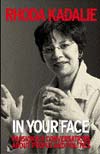
 Titel: In Your Face - Passionate Conversations about People and Politics
Author: Rhoda Kadalie
Publisher: Tafelberg
ISBN: 9780624047308
Pages: 262
Click on the cover of In Your Face to order your copy from kalahari.net now.
Rhoda Kadalie’s detractors may want to dismiss her as sanctimonious and impertinent, but there really is no mistaking the regular rantings of this committed South African for anything but pure passion. In that sense, her collection of columns entitled In Your Face - Passionate Conversations about People and Politics reflects exactly what the back cover blurb bills it as: “A fearless take on the state of our nation from one of South Africa’s most outspoken commentators”.
Far from being the bergie of South African social commentators, Rhoda has carved a place for herself with a pragmatic fluidity that one can hardly imagine to have flourished anywhere else but in the working class neighbourhoods of the Mother City. Not even her genealogical forebears have escaped her criticism – she disapproves publicly of her trail-blazing trade unionist grandfather Clements Kadalie’s hard-drinking, womanising ways. Yet she clearly owes them, including her pastor father Fenner, much for the civil zeal that courses through her veins. Anybody who has seen her in front of an audience will recognise this instantly.
Rhoda cut her teeth as an academic at the University of the Western Cape during the politically heady 70s and 80s. She also served as an activist in probably the only civil consciousness movement that can lay claim to have proved that social cohesion across political and racial boundaries in South Africa is possible: the United Democratic Front (UDF). Her columns, which she writes for Business Day, Die Burger and Beeld, reflects the turn her interests took after spells as a Human Rights Commissioner and a Land Claims Commission employee in the 90s.
With her having headed up the Impumelelo Awards Trust since just before the turn of the millennium, the majority of her writing is focused on cutting through the political noise that so easily distracts the public ear from essential service delivery and poverty eradication issues. She does so unashamedly and from a fairly liberal standpoint, often to the chagrin of the ruling party, of which she ironically remained a card-carrying member until at least 2005.
Tafelberg’s publication of Kadalie’s collected work is as devoid of fripperies as her writing and is none the worse for that. Altogether it contains 105 of her missives, each as pointed as the next, with substance and quality quite consistent throughout. In relating the experience of her younger colleague, Candice Jansen, who ably sorted and classified the work into nine coherently themed sections, Kadalie correctly concludes that much of the value of this publication would lie in the chronology of important political events that it constitutes.
But South Africa is a very complex society and any public opinion-maker would be hard pressed to have all the bases covered all of the time without sacrificing some of their unique identity. In Kadalie’s case it certainly is no different and in terms of what gives in this book, one of her many quotable quotes is turned right on its head.
See, public commentators operate in that grey space between government and civil society that allows them to influence opinion on both sides on how politics should be gluing society together, rather than tearing it apart. In South Africa this is of critical importance, for bar a post-Polokwane blip, our politics has on all sides and to a large extent kept feeding off the sharp divisions that remain in our civil make-up. Given Kadalie’s ideological bent, one would expect the aim to be to encourage a civil society that is united in seeking the protection of their freedoms and rights as individual South Africans, as well as their individual ability to make informed political choices.
This she gets half right. She rightly pokes holes in the dominant narrative propagated by the ANC. She also sticks to her guns as far as her principles are concerned (unlike some of her fellow columnists at Business Day, such as Xolela Mancgu and Aubrey Matshiqi, who often impress, but regularly miss the beat when issues of race and opportunity rear their heads). Where Kadalie falters is when she forgets that there is a politically powerful, but historically disadvantaged, majority that will not be appealed to in a language that shows no acknowledgement of their sociological sensitivities and that regularly trashes their sentimental proclivities. This is somewhat exacerbated by the fact that she is neither even-handed when it comes to assessing the different actors on South Africa’s political stage, nor does she promote her politics of choice in a voice that is sufficiently distinct from the party she admires most – the Democratic Alliance.
Her writing bolsters those who think like her anyway. It may even swing those who are already disenchanted with the ruling party. But it will not penetrate the thinking of the ANC’s bedrock for whom the reality that she addresses in her weekly column appears so very different. And that is where the crunch lies. It is that division in our society that is given oxygen through Rhoda’s work because, like many other South Africans, she appears to have internalised our divided society to such an extent that she seems unable to approximate the vision of civil unity in the language of her opinion.
Should you be one who is open to Rhoda’s way of thinking, In Your Face will make your lip quiver and even have you in stitches in places. It is a substantial, satisfying and consistent read. For these reasons and for the many interesting turns that her writing may take, let us hope that she will never stop giving us her take on the state of our nation.