

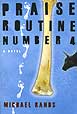
 Title: Praise Routine Number 4
Author: Mike Rands
Publisher: Human & Rousseau (Pty) Ltd
ISBN: 9780798150033
Publication date: August 2008
Pages: 296
Another reviewer of Michael Rands's debut novel, Praise Routine Number 4, called it "angry". I didn't find it so much angry as gleefully, savagely satiric. Rands is out to attack everything and everyone he can - there are no holy cows, especially not those belonging to the ancestors. One by one he sets up his targets: white male patriarchy, young white male slackers, obsessive white girls, ridiculous cultural norms, the bandwagon of exploitation, whether it is riding on apartheid guilt or colonial shame or both.
All this is layered on to a story that never lets up and is as compulsive as a thriller. (To use the image of one of the much-eaten foodstuffs referred to in the book, metaphorically speaking you're getting a pizza with many toppings.) The narrator, Byron Winterleaf, a dagga-smoking, young white guy who prances around in skins in a Xhosa-themed restaurant, translating the praise singer's sycophantic babble, is fired from this job. At about the same time he gets involved with a rich young woman photographer whose father is a hunting-fishing-screwing type, sets up a project to grow dagga in his bedroom with a very dubious sort, and finds a leg bone in his back yard after the area is flooded during a storm. The bone ends up in the hands of one Susan Ridge, one of those extraordinary bleeding-heart NGO types we've all encountered. The NGO she represents is called Restoring Dignity to Forgotten Minorities and she, in the manner of her entrepreneurial kind, has seen an opportunity. Surely this bone belonged to one of the Khoi victims of the disastrous smallpox epidemic that wiped out their presence in the Cape peninsula in 1713? She promptly turns Byron's Observatory house into a cultural live action museum by day and trance club at night. Systematically Byron is dispossessed of his livelihood, his house, his dignity (although, as he's a slacker, this is not difficult), his girlfriend - in fact, virtually everything that defines him. At the end of the novel he admits: "I'm an idiot. And I'll always be an idiot." He's last seen driving off into the darkness.
Rands is relentless. He gives Byron, and hence the reader, no quarter. There is no saving grace for Byron at the end: he is humiliated, he's a loser. And if there is no redemption for the main character, nor is there any for the reader. If this novel were not so funny it would be difficult, indeed painful, to read. There were times when I felt that if Byron cradled his balls once more and then smelt their mustiness on his fingers, I would wear gloves to read the book. But this is where Rands is so accurate. He wants his characters to wallow in their humanness: the smells, the body ooze, the wax, the mucus, the semen, the blood, piss, the grey dust of shed skin. Byron has few peers in literature who are as disgusting. There is certainly no one like him in our literature. He is obnoxious, he is weak, he is, in the current idiom, a waste of space. And yet, because of all this, he has our measure. Rands's prose is sharp as needles, his dialogue sounds as if he'd recorded it.
So flounder about with Bryon in this toxic environment: it's great fun and not a little uncomfortable. What more can you ask of a novel?