

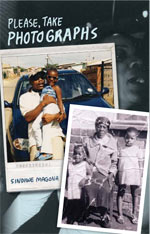
 Title: Please, Take Photographs
Author: Sindiwe Magona
ISBN: 9780980272956
Publisher: Modjaji Books
Publication date: 2009
In the title poem of her debut collection, Please, Take Photographs, multi-award-winning author Sindiwe Magona urges her readers to
Please, hurry! Take photographs of all the children, now!
Take photos, for tomorrow they will be gone.
Take photos! Take photos of the children …
Children who will not see thirty.
Children who will never … grow … old. (46)
Anyone who has read Magona’s Beauty’s Gift (Kwela 2008) will immediately recognise the urgent, crucial themes of Please, Take Photographs, now made even more poignant by Magona’s simple, direct poetic voice. In this powerful and highly political collection of poetry, Magona once again writes about the tragic consequences of the AIDS pandemic on human lives, as well as the debilitating effects of violence against women and children. In an eloquently metafictional poem titled “Writing”, the speaker in the poem claims that writing must “say something/ Original and provocative/ About the larger condition of/ Frail humanity” (16), and this is, without doubt, exactly what this volume of poetry does. Innovative and immensely provocative, Please, Take Photographs is a defiant protest against the violence women and children suffer at the hands of men who profess to love them.
The tone of the collection is brutally honest and, at times, rather confrontational. As in Beauty’s Gift, Magona is especially harsh in her treatment of men described as “reckless sperm-spewer(s)” or “brainless breeders” (48), men with “brains residing below the navel” (36), men who “call sex with condoms/ Eating candy with the wrapper on” (45). Most of the poems in the collection speak out against the “plague that comes with love” (46), voicing the terrible grief of the children “who will not believe their/ Dying” (46), the women dying “at the hands of/ Princes professing undying love” (33), both challenging and mobilising the reader to battle the AIDS pandemic and its accompanying tragic loss of human lives. “The revolution,” her poems urge, “[i]s far from over./ You still have a role to play/ Not on the battlefield but in your/ Home and in your community” (70).
Magona’s defiant style has a tender, touching undertone, though, since many of her poems are grounded in the philosophy of ubuntu. Accordingly, she locates the solution to the problem of human misery in “love among ourselves” (70), insisting that “the greatest contribution/ You can make” is the “Love of self/ In total community!” (70).
While most of the poems in Please, Take Photographs are hard-hitting and highly political, the collection is also marked by gentle and affectionate snapshots of rural village life, painting a tender picture of an “early sun/ Buttering morning clouds” (9), the “easy sameness” in the “symmetry of round huts” (77), the “... soft rounded hills/ Green-gray-brown mountains/ All exuding an air of/ Profound serenity” (77).
While Magona’s “village” poems are beautiful and, without doubt, the most lyrical of the entire collection, there is an underlying nostalgia, a certain homesick longing for an unspoilt village life, which is rather troubling. Especially when set against the cruel reality and starkly political message of the rest of the poems in the collection, Magona’s village poems seem to yearn for a pre-lapsarian, rural utopia not associated with the death and violence found in the other poems. The one poem which seems to overcome this dichotomy of a “rural ideal” vs a “pestilent modernity” is the poem “A Wish”, in which the speaker urges all “good things” to “(g)row and fill the land” (75), to
Drive out all the evil which abounds
Grow here and there and everywhere
Sprout and spread; thicken and quicken
Spread far and wide like the plague. (75)
In this way, “A Wish” utilises the imagery of rural renewal and growth for a political message of hope that does not rely on the more nostalgic and homesick undertone of the other village poems.
The final poem in the collection, another village poem, leaves the reader with “soft-spoken/ Words; sustained tenderness shrouded/ In lingering shy smiles that reach deep into eye” (79), an excellent image with which to conclude Magona’s collection. While her words are not always soft-spoken or lyrical, often being hard-hitting, brutally honest, direct, rebellious and challenging, Please, Take Photographs is a powerful and outspoken collection of poems that are all marked by a sustained tenderness which will not only reach deep into eye, but also deep into mind and heart.