

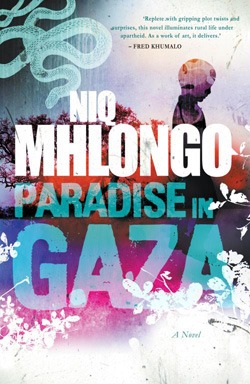
 Paradise in Gaza
Niq Mhlongo
NB Publishers
ISBN: 9780795709722
I used to like the smell of freshly cut grass until I read that what caused the smell was "green leaf volatiles, or GLVs, and that plants often released these molecules when damaged by insects, infections or mechanical forces – like a lawn mower".[i] It was also said that these were the plants’ "cries" and "warning" to other plants about the anguish they were suffering. I never thought of the sweet smell of freshly cut grass the same way ever again. Similarly, whatever your views of black South African traditional beliefs and practices, Paradise in Gaza is bound to affect your conventional views of these traditions and beliefs and the people for whom they have meaning in their daily lives. However, and in order to enable this fully, you will have to allow yourself to be drawn into the slow pace of the unfolding and intricate story.
Paradise in Gaza is an ambitious enterprise. Its 298 pages belie an effort to introduce the reader to aspects of South Africa very seldom considered in "mainstream" and popular literature. While the setting is that of apartheid South Africa, and while the relationships between the African communities and the white characters in the story echo our recent past, the reality of the experiences and underlying concerns resonate as if the story were unfolding in contemporary times. Paradise in Gaza is a multilayered literary experience. You have the "Jim comes to Joburg" trope of the central character coming from Gaza Village to Soweto, Johannesburg, in search of a better life – and all the entanglements this results in – to the apartheid landscape that is a constant backdrop to the unfolding story of the contestations, conflicts and intricate machinations in communities and families.
With the novel constantly moving between the urban (Soweto) and the rural (Gaza Village), among the many achievements of the novel is its remarkably realistic capturing of the pace of life in the village. The slow cadence of the story reflects the gentle unfolding of life in the rural context, different to the hustle and bustle of the city and urban environment. While this might challenge the uninitiated, it is a great achievement that allows the plot to unfold in meaningful ways and enables the savouring of the depicted context.
The dedication of the book to Vusamazulu Credo Mutwa (1921–2020) should be a dead giveaway that the novel will deal with "African tribal history, legends, customs and religious beliefs", which is the title of one of Mutwa’s most renowned works, first published in 1964. Contrary to Western notions of religion and culture, African culture and belief systems are generally treated as backwards mythology. Paradise in Gaza reveals how these beliefs and culture inform and direct communities and their relationship and interaction with the physical world. The book offers a smorgasbord of beliefs that may, to the modern reader, seem fantastic. However, these are real to the communities in question. The novel illuminates these experiences in a sensitive and dignified manner.
Paradise in Gaza deals with occurrences and experiences one might be inclined to read as magic realism. However, this seems inadequate, particularly when one understands magic realism like Ramona Ausubel, in that "[m]ost mythology throughout the world could be read as magical realism. Much of Western thought and society is based on a book about angels and devils and bushes that burst into flame, and seas that were parted and plagues that rain down. We as a species want – and even need – to tell stories this way. They are part of how we survive, create a moral code and make sense of a world that is real, yes – but also outlandish in its heartache and its miracles."[ii]
Paradise in Gaza is more than this, however. It addresses a range of issues affecting the usually silent and marginal population in our country as they navigate their rural roots and the new urban spaces like Johannesburg, which they are drawn to for jobs and the opportunity of striking it rich. The tensions, contradictions and conflicts between the modernising metropolis and the innocence, jealousies and difficulties of the rural context for many of these restless souls are delineated in remarkable detail in the novel, casting the characters as whole and complex beings.
The novel traverses the lived experiences of black people under apartheid. This includes influx control and the pass laws and the effects thereof on the lives of those they haunted like a constant dark cloud, as well as forced removals, which rendered communities landless in order to serve the needs of white agriculture and industrialisation. There is also the heart-wrenching dislocation and separation of families due to people being forced by natural disasters like drought and famine, as well as by war, to seek alternative means to sustain life and the complex experience of the anti-apartheid struggle. It also deals with the introduction of Christianity and its exploitation of vulnerable communities and their needs in order to establish subservience and allegiance to the Christian religion at the expense of their own traditional religious and belief systems. This presents a very broad canvas to cover in one story.
What is marvellous and curiously well done, however, is the reader’s introduction to the not-so-well-known world of African religious systems, thoughts and practices. The novel is variously populated by the proverbial and cantankerous tokoloshe, medicine men and traditional healers, or inyangas, who complicate the lives of the characters and add imaginative features to the story. The novel also spans a substantial geographical setting: Gauteng, Limpopo, the Free State and KwaZulu-Natal, to make explicit the connected nature of the African religious and belief systems and their pervasiveness across the black African population and communities. The entire process of ukutwasa, being possessed by ancestral spirits and becoming an inyanga, is treated with exceptional delicacy and detail, which is a rare phenomenon in popular literature because it is often considered "sacred knowledge" strictly guarded by those integral to this realm of existence and practice. Paradise in Gaza does an exceptional and imaginative job at capturing and rendering this aspect of African traditional life.
While the end ties the story up very neatly and in an unexpected manner, at times the plot may seem tedious and the changing prominence of the characters throughout the novel might feel convoluted. One complication is that there seem to be a number of significant characters who come and go as the story unfolds. At first, there’s Mpisi Mpisane, his father, his first wife in Gaza Village, his second wife in Chiawela, Soweto, and their children (Mpisane’s child, Sana, with his Gaza wife, Khanyisa; his son, Giyani, with his Chiawela wife, Ntombazi turned Gogo Mahambandlela; his other child, Amu, with his Chiawela wife; and the final child, with his Gaza wife, who is not yet born in the story). Then, there is Bento, who escaped from Mozambique to find refuge in Gaza Village, and his brother Renato, Molatelo and her husband, Chipi and an army of minor characters. This provides too wide a range of characters to keep track of as the story unfolds. The title of the novel, Paradise in Gaza, which appears almost in the middle of the novel, also seems problematic, given the thrust of the story and plot. It is not clear what the utility of the title is to the general story, other than an ironic twist to the tale similar to the end of the story.
As if this were not enough, what will definitely not assist many readers are the epigraphs used in 12 of the 75 chapters of the novel, ie chapters 12, 13, 20, 21, 22, 23, 36, 37, 44, 56, 63 and 64. Written in Zulu without translation, they prevent the remarkable orientation these would enable as primers to the chapters they lead into. The seemingly random sequence in which these are used also complicates their utility and significance in the general structure of the novel. This is most unfortunate. So, too, is the untranslated Zulu text in some of the chapters (pages 79, 82, 85, 118, 119, 173, 222 and 259), which also prevents the non-Zulu-speaking reader from relating these nuggets to the larger text or the sections they appear in.
Finally, there are standard writing conventions that are not adhered to in the novel. Though thoughts are correctly italicised to distinguish them from other narrative devices in the text, foreign language expressions and statements should also be italicised and followed by their English translations to enable the reader to connect these statements with the story. The novel is written in English; consequently, all the Zulu statements, sayings and expressions in the text should have benefitted from these writing conventions for the convenience of the reader. These unfortunate shortcomings of the novel could have been avoided through rigorous editing, which would also have assisted with correcting some of the other simple and annoying editing and language errors littering the text.
Notwithstanding the above, Paradise in Gaza is a remarkable and brave attempt by Niq Mhlongo, a distinguished South African author in our continuously developing and evolving South African literature. Mhlongo has an impressive list of titles and awards behind his name: Dog eat dog (2004), After tears (2007), Way back home (2013), Affluenza (2016), Soweto: Under the apricot tree (2018), Black tax: Burden or ubuntu? (2019) and Joburg noir (2020). While it might be unrealistic to demand a national literature from a divided people like ours, one is heartened to imagine that stories of the subaltern,[iii] like in Paradise in Gaza, can also be expected to become part of such a literary endeavour. Through his latest offering, Mhlongo brilliantly demonstrates how this can be achieved.
[i] Grunbaum, Mara. "Why does freshly cut grass smell so nice?" Live science. 5 May 2019. https://www.livescience.com/65400-why-freshly-cut-grass-smells-good.html#:~:text=Chemically%20speaking%2C%20that%20classic%20lawn,forces%20%E2%80%94%20like%20a%20lawn%20mower. Accessed on 21 December 2020.
[ii] Ausubel, R. "What is magical realism?" 7 November 2019.
https://www.oprahmag.com/entertainment/books/a29643815/what-is-magical-realism/. Accessed on 24 December 2020.
[iii] Notwithstanding the continuing debates in postcolonial theory discourse and flowing from the notion of the subaltern as first referred to by Italian Marxist political activist Antonio Gramsci, the term subaltern here refers to the marginalised groups in our society who are thought to have no agency due to their social status and their struggle for acknowledgement and recognition, not only of their existence as a coherent entity, but also of their complexity, difference and wholeness as legitimate and bona fide members of society: Louai, EH. "Retracing the concept of the subaltern from Gramsci to Spivak: Historical developments and new applications". African Journal of History and Culture. 2012. 4(1), pp 4–8
Pandey, G. "The subaltern as subaltern citizen". Economic and Political Weekly. 2006. 41(46), pp 4735–41
Dubow, S. "South Africa and South Africans: Nationality, belonging, citizenship". The Cambridge History of South Africa, Volume 2: 1885–1994. 2011. Pp 17–65
Roos, N. "South African history and subaltern historiography: Ideas for a radical history of white folk". Internationaal Instituut voor Sociale Geschiedenis. 2016. 61, pp 117–50.