

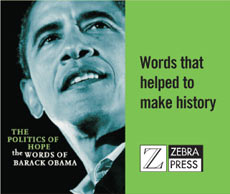
The Politics of Hope: the Words of Barack Obama
Compiled by Henry Russell
Zebra Press
2009
9781770220614
Click here to find out more about the book
In his poetically mournful, but hauntingly beautiful tribute at John F Kennedy’s funeral, then US Senate Majority leader Mike Mansfield spoke of “a wit in a man neither young nor old, but a wit full of an old man's wisdom and of a child's wisdom”. He could just as well have been speaking of the 44th President of the United States, who last year rode an unprecedented wave of youth support all the way to the White House, with promises not of innovation, but of change back to the values and quests on which America was founded.
For all of the same that there may be in the euphoria that surrounded their respective accessions to office, Kennedy never made it into the genealogy of political or intellectual forebears that Obama constructed for himself. For that, JFK enjoyed far too much in the way of elite backup and family advantage. Instead, metonymical references to colossuses of freedom, justice and opportunity such as Abraham Lincoln (whom Obama self-referentially termed “a young man from Illinois”), Franklin D Roosevelt and Martin Luther King run thick in Obama’s speeches, a selection of which has been compiled by Henry Russell in his little book The Politics of Hope: the Words of Barack Obama.
In this publication Russell sought to present not a critical review of Obama’s oratory oeuvre, but rather a celebration of it for the Obama faithful. It traces Obama’s public speaking over the decade that passed between his entry to the Illinois Senate in 1998, through his time in the Federal Senate on Capitol Hill, his 21-month presidential campaign and his eventual inauguration as President of the United States of America.
To be sure, the nature of politics – electoral politics in particular – often dictates that sequential political speeches may be repetitive in the extreme, and in this regard Russell did well to present only the most striking parts of the selected speeches, with the sole exception of Obama’s inaugural address, which is reproduced in full. The selection of the speeches is not geared for detailed political analysis, but rather to best reflect everything that Obama’s fans appreciate about him as a political speechmaker, including the odd bit of schmaltz.
This does not mean that the little book is completely without value for those with an interest in speechwriting or politics, or those that are a little more critically inclined, for it is prefaced with an appetising contemplation on the restorative qualities of Obama’s public quests by classicist Charlotte Higgins. This is then thoughtfully, if somewhat repetitively, embroidered upon in little preambles authored by Russell which lace every chapter and speech excerpt published here.
The book’s main preoccupation is Obama’s eschewing of the modern practice to dumb down political speeches, choosing, instead, to weave simple language into deft eruditions through the imaginative use of rhetorical devices employed since the emergence of democracy in ancient Athens and Rome. Taken individually, many of the excerpts are very good, but as a collection, there are a few details that do start to irritate the more critical eye.
Since they decided to go there in the first place, it is strange that Obama and his team of speech writers ignored the reams or rhetorical schemes and tropes at their disposal in favour of five core ones which, once one considers the entire collection presented by Russell, run the risk of fatiguing the reader. One of these devices is praeteritio – drawing attention to a subject by not discussing it. Where Obama uses it purposely, he does so at various stages to remind Americans of the greatness of their nation, to allude to sensitive topics such as race and to create a sense of intimacy between him as the speaker and his audience.
But then, Obama also uses a very particular mechanism to – as Charlotte Higgins puts it – “convey the sense that not only can he revive the American dream, but that he personally embodies – actually in some sense is – the American dream”. It manifests through a well-trodden formula, inserted at the beginning of most of his keynote speeches that, typically, starts like this: “Tonight is a particular honour for me because, let’s face it, my presence on this stage is pretty unlikely.”
He would then launch into an explanation of his biological forebears that would go more or less as follows:
I am the son of a black man from Kenya and a white woman from Kansas. I was raised with the help of a white grandfather who survived a Depression to serve in Patton’s army during World War II and a white grandmother who worked on a bomber assembly line at Fort Leavenworth while he was overseas. I have gone to some of the best schools in America and have lived in one of the world’s poorest nations.
In Russell’s compilation this refrain almost becomes a de facto extended praeteritio with nascent racial undertones. For it does not say that Obama should become president regardless of his racial identity, but rather because of it – America had no choice but to elect him. The impression this creates is of a person with an over-inflated sense of his own racial identity and the significance thereof for his ability to do a given job, as well as of an unattractive presumptuousness that his mixed-race background somehow automatically qualifies him as an authority on all things racial.
But this really is a minor criticism of the way in which the man chose to portray himself through his generally impressive orations compiled in this unassuming little book; the man whose abilities are still being tested in the most powerful office in the world and of who we still have much to learn. If his oratory abilities are anything to go by, we are bound to be in for a few pleasant surprises that will hopefully set the tone for the return of more organised and analysis-worthy political oratory and for a much more virtuous cycle of politics. Higgins puts it best in the closing sentences of her foreword when she says: “The presidency of George Bush provided plenty of evidence that a man who has problems with his prepositions may also struggle to govern well. We can only hope that Obama’s presidency proves the opposite.”