


Title: Freud and the celestial juggernaut
Author: Iván Kovács
ISBN: 9781776172948
Publisher: Naledi
The Hungarian-South African poet and artist Iván Kovács has recently released a new volume of English and Afrikaans poetry, Freud and the celestial juggernaut.
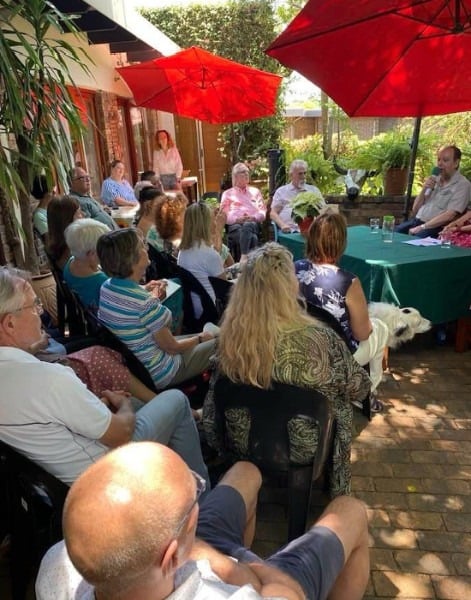
This interview was conducted with Iván by Hetta Pieterse at the Boekeplek & Kuierstoep, Aurelia Street, Garsfontein, Pretoria.
Iván, as an opening salvo – or perhaps a somersault – as a start to our conversation: if one looks at the scope of works you have already published, it seems that you have quietly been writing up a storm – perhaps unknown by many – across several works and different genres, and spanning three languages.
 So, the task for an audience is to get to know you as a poet of many voices and moods and of evocative landscapes. When this volume is opened, perhaps the theme of honey and gall – or of contrasts – of rebellion and utter stillness, of a landscape of calm, is a first impression from Freud and the celestial juggernaut.
How would you describe the meaning of the poem “Freud and the celestial juggernaut”, from which the collection takes its name?
Perhaps the first thing I can mention about “Freud and the celestial juggernaut” is that it was my very first poem accepted for the Avbob Poetry Competition back in 2017. I need to point out that the poem is not a personal vendetta against the great trailblazer of psychology, which in its time was still a science in its infancy. Psychoanalysis is still very much in use today, and it is an effective way of dealing with trauma and neurosis. My problem with Freud is that he didn’t go far enough with his exploration of the human psyche. I firmly believe that there is so much more to our humanness than a physical existence, and that human beings can function on various levels of consciousness. So, basically, this poem is a rebellion against a deterministic and materialistic point of view, which seems to be prevalent in our time. Perhaps our rational thinking has taken us too far, while our heart consciousness has been pushed aside and our intuitive faculties have been sidelined and suppressed, leaving us wanting when considering matters of the soul. To conclude my answer to this first question, I would like to quote Pierre Teilhard de Chardin, French philosopher and theologian, who said: “We are not human beings having a spiritual experience. We are spiritual beings having a human experience.”
Freud and the celestial juggernaut
Onkel Sigmund, in my head
there is no room for either ids or egos,
but simply put, a private world
of endless possibilities.
Big bangs expand my universe,
and blinding supernovae flare.
Inside my cranial cavity
ancient prophesies resound.
Forgive my infidelities,
it’s by these that I’m bound.
Oh, Onkel Sigmund, sly old fox,
let me tell you that I am
not a slave to my passions
and I don’t desire to crawl
back into my mother’s womb.
Even less do I want to kill my father
so I can have it off with mom.
Rather, I reach out far beyond
myself to where my truest being
is like a pendulum come to rest,
or a plumb line that can clearly
indicate the difference between
vertical and horizontal.
Oh, Onkel Sigmund, no matter what,
my eyes and ears are open,
and even if my years add up
to no more than three score and ten,
I carry my guiding star within me.
But you, dear Ziggy, use the unstable
and insane as your yardstick.
Have you ever considered
studying those who have dared
to reach beyond the human,
or did you suspect they would take wing
and so could not be contained?
While you, Old Fraud, rummage around
among dusty and discarded objects
in a musty and damp basement,
I sit on the roof of my house
and allow myself to be overwhelmed
by the stars of the night sky,
having visions of Buddhas and ancient sages
on whose lips I hang as they converse.
As I dream, I scale
the snowy Himalayan heights,
gaining intimate knowledge
of the clear white light.
You, however, want to drag me down
into some primordial slime,
to which I must respond
with a one-syllable “Fie!”
(Freud and the celestial juggernaut, page 21)
Could you tell us more about your background – why did you leave Hungary, and how did you eventually land up in South Africa? How has this influenced you as a writer?
I was born in Hungary in the city of Győr in 1949, but soon landed up in the care of my grandparents in a small village not far from Győr, while my parents both worked in Budapest. These first five years of my life were the happiest. After that, I was reunited with my parents in Budapest, which was a huge adjustment for me. After attending one year of kindergarten, I started my school career, but this had hardly begun when the Hungarian uprising against Soviet domination broke out. As an impressionable six-year-old, I witnessed much of what occurred during this tragic period, and when Russian tanks finally entered Budapest to subdue the uprising, our family fled Hungary and became refugees in Austria. From there, we applied for asylum in Switzerland, and it was there that I started school again in 1957. This was a relatively happy period for me, but in 1963 my father decided that we should emigrate to South Africa. To be frank, this was a huge shock for me. Prior to arriving in South Africa, I had already learned three languages, and now I had the added burden of having to learn English and Afrikaans as well. While I had done well at school in Switzerland, my grades dropped drastically when I started school in South Africa, which was a great blow to my self-esteem. Besides that, there were other problems to deal with, such as the noticeable cultural differences between Europe and South Africa and the almost unbearable homesickness which I felt for Switzerland. At times, it felt as if I had been reduced to the lowest of the low, and it took many, many years of recovery before I found my feet again. It was not until 1983 that my life took a drastic turn for the better, when I met my wife, Estelle, and we started to build a life together, which allowed us to pursue our dreams and goals.
Writing had always been an ambition of mine ever since I learned to read, and my first published poem appeared in the New Coin Poetry magazine in 1969.
I had always been an ardent reader and I had read many important literary works by the time I had the opportunity to study after my wife and I got married, so I decided to study art instead of literature and languages, because art posed a bigger and more exciting challenge. In 1988, I obtained my National Diploma in Fine Art, and besides my efforts at writing, I also started to paint. I had other interests as well and became an ardent follower of esoteric philosophy and a lover of international cinema.
Your collection has two Afrikaans poems, entitled “Villon veroordeel” (page 62) and “Villon se dood” (page 63). Why do you have such a special affinity with the French poet Villon?
François Villon first came to my attention when I was about ten years old. My father was reading Villon in a Hungarian translation by George Faludy, and he would often recite Villon’s poems when we had Hungarian guests. Faludy’s translation was remarkably suited for such occasions, and I was completely captivated by the music and colour of the poems. Much later, in 2017, I published Faludy’s version of Villon’s ballads, which I had translated from the Hungarian into English.
Villon veroordeel
Hulle het soos donker uile in die hof gesit,
En ek, die arme rot, moes vir die vonnis wag.
My mond soos ’n haaslip oopgeskeur,
Kon net mompel op die vrae van die gesag.
“Self-ver-de-di-ging is wat dit was –
Hy het sy hande op my keel gehad.
Toe gryp ek na my mes,
Want dis al hoe ek kon praat.”
Maar hulle, donker uile,
Tref my vinnig, strak met hul woord,
Hulle sê hul ken my en my soort.
Ek word toe verban buite die perke van die stad,
En kry boonop sestig houe op my blad.
Parys in winter sonder geld is erg genoeg,
Nou word die vonnis by die armoede gevoeg.
Vaarwel Parys, grande dame, Geslepe ou beminde!
Mag jou kroeë altyd propvol wees.
Die wyn wat so vrymoedig in die glase vloei,
Sal die ergste kwale van die burgerskap genees.
Vir ’n wyle gaan Pierre en Jacques
Op my gesondheid drink, skouer klop,
Galant oor die rekening baklei,
En as hul genoeg gedrink het na my beminde draai,
Om die geld wat ek hul skuld
Tussen haar dye terug te vry.
En ek, wat môre soos wolwekos
Die koue wêreld in verdwyn,
Wens jul almal ’n geseënde samesyn.
(Freud and the celestial juggernaut, page 62)
Villon se dood
Twee dae, nagte al
loop ek in dié woud.
Bedags is dit koel,
snags donker en koud.
Selfs die jakkals weet
dat ek honger, mak
op die derde dag,
inmekaar gaan sak.
’n Stroompie met eie klanke,
’n eikeboom oud en groot,
’n enkele ster tussen die takke:
g’n beter plek vir die dood.
(Freud and the celestial juggernaut, page 63)
Now, let’s move from Europe to South Africa. How would you describe your relationship to the South African landscape and South African poets?
Well, speaking of the landscapes first, Switzerland and South Africa can almost be considered diametrical opposites. Switzerland consists mostly of mountains and valleys, while South Africa has huge open spaces. In addition, we have a coastline extending from the Atlantic Ocean to the Pacific. We have deserts and savannahs, the Drakensberg mountain range, the lush greenery of the Lowveld, and that unique treasure called the Kruger National Park. It took many years of travelling and vacationing before all these wonders started to grow on me. Today, I can honestly say that I don’t want to be anywhere else except here.
Speaking about South African poets is something which I find more problematic. I tended to pay attention more to poets who were internationally known. TS Eliot, WB Yeats, Sylvia Plath and Walt Whitman are names that come spontaneously to mind, but I also looked at non-English-speaking poets like Rilke, Neruda, some of the French poets like Baudelaire and Mallarmé, and others. I must confess that I was never very systematic, and most of what I know today was self-taught.
Regarding Afrikaans poets, I firstly need to mention the “Sestigers” like Breyten Breytenbach, Ingrid Jonker and others who followed in their footsteps. Breytenbach I worshipped like an idol. But I also showed an interest in the “Veertigers” like Elisabeth Eybers and especially NP van Wyk Louw. But poets like Boerneef were very hard nuts to crack, and to my shame I soon gave up on them. In closing, I would like to say that I have always had too many diverging interests and consequently spread myself too thinly.
The “Magaliesberg” poem draws one into the local landscape with accuracy of detail given to the environment. The poem also evokes an inner calm and stillness. As we read the poem, it will probably evoke fond memories in those of us who have travelled this road many times to the Hartbeespoort Dam.
Magaliesberg
The tar road snakes its way
in gentle undulations
across the landscape,
dirt roads branching
to this or that farmstead,
occasional roadside stores
selling eggs, fruit and veg
and the inevitable cans
of Sprite and Coca-Cola.
For the longest stretches
the land’s as flat as a table,
a patchwork of arable fields
changing from farm to farm.Access to them varies
from ordinary to elaborate:
here two simple pillars
suffice; there, you find
a rusty wrought-iron gate
with a wagon-wheel motif
– all chosen for the statement.
More often than not you see
a simple, square, black platewith white letters, dangling
by a few links of a chain
like an unassuming tavern sign.Further back from the road
there are clusters of buildings
and the usual surrounding trees,
but unless you have
some business to do
with those who work the farm
they remain forever anonymous.
And as the backdrop, the Magaliesberg,
running parallel with the road,
from east to west, at times
like a giant sleeping snake,
at others like a troop of elephants
lumbering in single file
towards the Hartbeespoort
and that great watering hole,
the Hartbeespoort Dam.(Freud and the celestial juggernaut, page 26)
Your poem “Portrait of old Opperman” is a signature African poem, exemplifying your understanding of Opperman as a poet on the one hand, but also of the African landscape which he wrote about. The poem’s images are so forceful and visual that it takes on the character of a landscape painting. Reading this poem, I cannot help but touch on the visuality of your poems, which links to your identity as a painter of immaculately detailed paintings, in the style of the classic masters – again, a secret unknown to many of your readers. What inspired you to write the poem “Portrait of old Opperman”?
I remember that it was a close-up photo of Opperman’s face which illustrated one of his poetry collections. I was fascinated by the detail, which I immediately associated with a landscape. This was the impetus which inspired me to start writing, and with a bit of background study needed to flesh out the poem, it was mostly a question of translating the visual images in my mind into words. This also happened with other poems I wrote, such as The death of Odysseus and the poem about Paul Cezanne.
Portrait of old Opperman
He was a man of Africa.
The skin of his face
as wrinkled as a scrotum,
or as unruly as an aerial
photograph of the Kalahari.
He was a man of Africa,
familiar with its ways
and versed in its lyrics.
Poems flowed from his pen
like sparse rivers crossing
untamed, ancient landscapesshaped by a burning sun,
wild storms and winds,
immortalised by rough-hewn
rhymes, images and words.
His buffalo knows no metaphysics,
but seeks the sweet grass and the pool,
and his sacred cattle graze where
the hadeda waits in
the euphorbia tree above the husks
the antheap and the grass. …
He was old Opperman,
an imbongi and sangoma,
a wise man of Africa.
(Freud and the celestial juggernaut, page 23)
Your sensitivity and alertness to the existential challenges of our world and the polarisation and strife brought along by clashing political agendas and cultural diversity, shine through in your poem “A new world”. The poem’s rhythm almost reminds me of Leonard Cohen’s song “The future”. How do you see your relationship to our modern realities?
This is not an easy question to answer because I think that we are all caught up in a whirlwind of different ideologies and value systems. Our planet is in a crisis, and whatever happens will be of our own collective doing. I think that our mental development is way ahead of the wisdom of our hearts, and unless we open ourselves up to the human values that are within us, we will certainly be doomed. But many people today are becoming aware that there is much more to life than appears on the surface. Intuition and the sense that we are one humanity, are seeping into the consciousness of the masses, as if we are becoming aware of a higher level of being, as if love and compassion and right human relationships are finally starting to be the only option to save ourselves and our planet. This is evident in the worldwide demonstrations against war, violence, discrimination and other violations of human rights. Admittedly, there are elements which oppose this, but all we can do is have faith in our convictions and hope that those on the side of good will be victorious.
A new world
California is burning,
and Florida will drown.
Let’s hear all the voices
as the barricades go down!
In Khamenei’s Iran
the women are protesting,
their rage is spilling over,
the police go on arresting.
The pandemic’s barely ended
and now we have a war.
Who was insane enough
to tip the scales once more?
Swords hang above our heads,
all fear the nuclear threat.
Life has become a gamble
and death wishes to collect.
The financial situation
is heading for disaster,
with nations on their knees
and piled-up debt the master.
Worldwide catastrophe
simply keeps on growing
and Babylon the Great
refuses to stop whoring.
It feels like Armageddon,
with conflict spreading near.
A new world looks to be born
from the one of yesteryear.
(Freud and the celestial juggernaut, page 38)
As part of your understanding of many different identities, your sensitivity to gender issues finds specific expression in your poem “Marie Antoinette”, which on the surface is as frivolous as the French court and aristocracy of the day. Yet it has a sombre and ominous undertone, which becomes increasingly ironic and tragic towards the end.
Marie Antoinette
Who could have guessed on that bright and festive day
The court had been a trap and you’d thrown your life away?
Powdered and perfumed, and with your cheeks aglow,
Did you know that all of it had just been for the show?
Coach drives down avenues, the whole world at your feet;
A beau to make you laugh, your heart to skip a beat.
A prince and two princesses to confirm your motherhood,
While a few suspected lovers cast doubt on fatherhood.
Did you think back in the shadow of the guillotine
What your life had meant, what else it might have been?
Perhaps the royal protocols were a silly, childish game,
For now here is réalité – which is just not quite the same.
Not saying, perhaps, was best, that people without bread
Should simply change their ways and switch to cake instead –
Some things are better left unsaid; it’s not good étiquette.
Au revoir, our frivolous, little queen, poor Marie Antoinette!
(Freud and the celestial juggernaut, page 20)
How did the poem “Marie Antoinette” come about, and could you expand on what you wanted to express with it?
Inspiration for my poems often comes from the most unexpected sources. In the case of “Marie Antoinette”, I was watching the film about this French queen directed by Sofia Coppola, and I was completely captivated by Kirsten Dunst’s portrayal of her. It was less than 15 minutes into the film when I put the TV on hold, went to my study and started writing the poem. Obviously, I needed some additional information for what I wanted to say, which I looked up on the internet, but the poem was basically finished even before I finished watching the film. I saw Marie Antoinette as a victim of her times and her royal status, sadly predestined to her fate, but also a type of martyr who died at the hands of an angry and vengeful mob for the sins of the royalty. The poem is a tribute to her, a little monument by which I wish to remember her.
In your poetry, one gets the impression that you wish to take the readers on some unusual celestial juggernaut-like journey – from suburbia into outer space. Or perhaps you simply wish to expand our experiences and even our emotional range. Your work covers a rich kaleidoscope of emotions, from intense anger – or perhaps frustration – to utter serenity and internal equilibrium, achieved via meditation.
Would you say that the poem “Wesak” exemplifies the inner state of serenity and equilibrium and oneness with the world that you achieve when meditating?
I believe that human beings have a much wider scope and potential than we are made to believe. Many of us simply define ourselves by our professional and financial status, and perhaps a few random interests and hobbies; but when I set out on my quest to find meaning in my life, I came across many books that confirmed my sense that to be human, we have an obligation to use our full potential not only in making our physical world liveable and tolerable, but to come to know our inner universe, whether you call it the higher self, the collective consciousness or the soul. Knowledge is one thing, but consciousness is another. Meditation, when correctly applied, can open the gate firstly to the imagination, and then to the intuition, where ideas can be found. Ideas are linked to the future because they tend to make us innovative, and this applies to all branches of human endeavours. When they are accurately recorded through science and art, they always enrich our ever-evolving culture.
Wesak
I sit in the comfort of my home, with its store
Of books containing many an ancient text,
And envision a clear Tibetan night, where
The snow leopard still roams free, unvexed.
Cross-legged, with my body facing east,
I meditate on the occasion of a Buddha moon
And revelation comes in stages – none too soon.
My heart goes out to all living creatures
And all struggling souls become my kin.
The moon is especially bright tonight,
The sky shimmers with a velvety blue –
As if the forces of light were gathering,
Weaving silvery-white moonbeams
And, entwined, creating the world anew.
(Freud and the celestial juggernaut, page 40)
Lastly, let’s delve into the poems about the beginnings of your life, as well as its closure – death, or the suggestion of a transition. Sometimes this aspect is seen with humour, as part of a dance, or simply as a transition to a different state. You are the traveller, light on baggage and sometimes with a mischievous glint in the eye, sometimes with a slightly sardonic perspective. Could you expand on your views on death?
Let me start with a proposition or an assumption that both birth and death are but doorways into radically different states of consciousness, namely birth is an entry into a restricted world of physicality in which we need to experience certain lessons that can be learned only here on earth – a life where we can only experience reality by means of our physical senses and the cumbersome environment which earthly life can offer. But let me also propose that our higher selves have always been and always will be, and that each earthly life is nothing other than a playing field in which we need to gain experience in practical and tangible terms, before we can go back to a state of consciousness where such lessons seem to be self-evident and ultimately good and true. If the sages and mystics down the ages are to be believed, there are three distinct states of well-being that we can experience, namely happiness, joy and bliss. Most of us will agree that happiness is that feeling of contentment when our lives are relatively trouble-free, ie, when our basic physical needs like food and shelter are met, our family unity is assured, and we are granted certain freedoms of choice for how we want to order our lives. Joy takes us one step further and is said to be a quality of the soul. Some good examples would be when we are moved by things that most people would consider profound, like a feeling of oneness with noble ideals, the nearness of exceptional people who manage to change our lives for the better, beautiful music that sweeps us off our feet, or even a beautiful sunset which remains engraved in our memories. Bliss is rarer, but there are more and more people who have borne witness to it, and it has been experienced most commonly either by people who have had near-death experiences and who claim to have felt what they call the unconditional and all-encompassing love of God, or by practised meditators who have reached states of pure ecstasy – but in all cases, they are states which defy verbal description. Let me close by saying that to me, death certainly doesn’t mean annihilation, but a doorway to something better and higher.
Reflections of an old geezer
Is it inspiration or mental fever?
I do away with anxious doubt,
deleting all amassed debris
and face the mental drought.
No matter, the sap of life
still feeds my shrinking frame.
My muse allows no indolence,
and sets my ageing mind aflame.
But how will it end? With a cold
marble slab, a few inscriptions?
I can rest assured they all are
worth no more than fictions!
Let all resentments, old regrets,
Missed opportunities, overhasty frets,
Burn in the cleansing fire
Of a fading memory’s funeral pyre.
Let burn all the small embarrassments,
Neglects, uncertainties and the fears,
All those moments of passion that
Fuelled no more than egoistic jeers.
Let there be joy for no other reason
Than that the sun shines in the sky.
I’ve a few loved ones that are left me,
A heart light as a feather once I die.
(Freud and the celestial juggernaut, page 51)
Departure
– for E
When I am ready to depart
I want to travel lightly.
All I need is a small suitcase
In which will fit some memories,
My childhood self, for instance,
At play in some public park,
Sunlight shimmering throug
The foliage of a quiet forest glade,
The first night in your arms
When I learnt to ignite our love
And the ever-present radiance of
Your reassuring smile.
(Freud and the celestial juggernaut, page 48)
Iván, thank you for taking this journey with us, enabling us to open up the volume to new readers, while also revealing more about yourself.
As Joan Hambidge remarked in her review of Freud and the celestial juggernaut on Versindaba, this is a collection to read and reread, and it is astonishing that a poet whose mother tongue is not Afrikaans can make such a contribution.
- Photographs provided
See also:
New from Naledi: Freud and the celestial juggernaut by Iván Kovács