

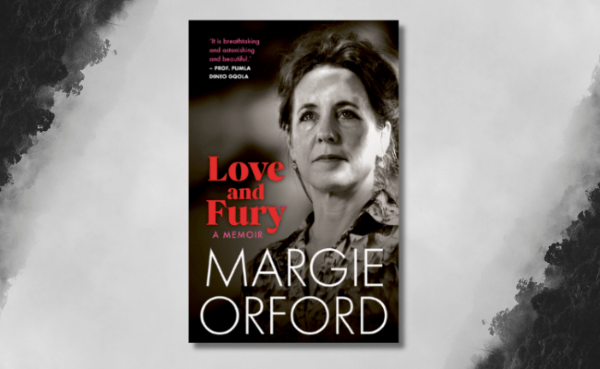
Love and fury: a memoir by Margie Orford (Jonathan Ball, 2024)
Love and fury: a memoir
Margie Orford
Publisher: Jonathan Ball Publishers (2024)
ISBN: 9781776190881
........
Of her free-spirited Namibian childhood she recalls the horror of watching a small black boy being beaten senseless by a pig farmer, and her own shameful silence. Of her school days she feels again the hands of a groping headmaster; and of her student activism, there is the recurring prison theme which reared its head again when she gave a nine-month writing workshop to a group of male prisoners, “men whose stories had filled my books”.
........
To unravel a torment you must begin somewhere – this title of a work by artist Louise Bourgeois is a fitting opening to Margie Orford’s revealing memoir.
“Her writing did not save her life, but it left a record of her pain and outrage.” In this quote from her memoir, Love and fury, Margie Orford describes the diary, a school exercise book “crowded with her rounded handwriting”, of an 11-year-old girl, “a skinny little thing, laid out on a mortuary slab”. Sadly in this instance, Orford’s ability to write indelible images, is simple but impeccable. She goes on to say, “Perhaps that is the case with all writing – it cannot stop or ‘unhappen’ violence.”
........
[I]n this book she has less “chosen” the events of her own life than been strong enough to grasp, grapple with and capture them – laid them, you might say, as if on a mortuary slab. Except, mercifully, she didn’t die.
........
So if the job of a writer is to leave a record, the measure of its value must depend on what it is that he or she has chosen to record. Having in her earlier works recorded so much of the violence and crime perpetrated against women as well as the ensuing suffering, in this book she has less “chosen” the events of her own life than been strong enough to grasp, grapple with and capture them – laid them, you might say, as if on a mortuary slab. Except, mercifully, she didn’t die. Not that it hadn’t crossed her mind to do so a number of times.
But let me not give away too much. It’s best to ride this book like a surfer rides a wave - feel each moment as it happens. Or is remembered, triggered.
Memory is an extraordinary thing – slippery, but sticky – and given half a chance, it will emerge, invited or not. Again, for a writer of memory, of memoir, the art is to make a good story. Early in the book Orford writes of how she describes her stint in a prison cell to a group of friends at a party to celebrate her release. In 1985, as a protesting student, she had been the victim of an “accidental arrest”. “‘I made a jaunty tale … I couldn’t eat,’ I said with a laugh. ‘It makes a good story, doesn’t it Margs?’ said a friend, the expression in his eyes speculative – or bored. That shut me up. I did not know how else to make sense of what had happened, except by fashioning my terror and fury into a tale.”
........
Memory is an extraordinary thing – slippery, but sticky – and given half a chance, it will emerge, invited or not.
........
That particular “story”, pivotal more than jaunty, is in fact much bigger, and she went on to write her final philosophy exam “inside”. The friend’s response may have stopped her in her tracks on that occasion, but Orford, it seems, has lived, and relived, her life in a heightened state of awareness of her feelings. “An unexamined life,” so Socrates was alleged to have said, “is not worth living.” In this book she has taken the opportunity to both examine and reflect on her memories and with the wisdom of hindsight interrogated her responses, reactions and emotions. As well as her writing.
It must be inevitable for a writer to “write what they know” – how can they not? But to look back on your own life of writing and understand with telescopic clarity how and why those events and words came together, and to what end, is a gift indeed.
Take for instance her Clare Hart books, the series of five thrillers that gave her the handle “Queen of Crime”, featuring her feisty lead character of whom she says: “[M]y private investigator, my justice warrior … Clare Hart, part avenging goddess – a modern day fury – and part Tank girl superhero, came to me fully formed and flawed, armed with her PhD in rape and femicide. She would be an activist journalist who was also a profiler, determined to ensure that living women were protected and dead ones avenged.”
And yet, as the clock ticked, she realised not only that her writing couldn’t “unhappen” violence, but that “The series of crime novels turned out to be an oblique self-portrait of what happens to a woman working closely with the victims and perpetrators of violence. It would be no plot spoiler to say that the work wore Clare Hart down, and it wore me out.”
So while the Hart books were “nourished” by Orford’s research into gender violence, she came to see that she was in danger of writing from what she calls the “pornographer’s gaze”, and the sixth novel in the series was stillborn.
........
Should anyone think that writing is a simple matter of tapping into your imagination, fleshing it out with a few choice facts, this is a book that will divest such a person of that opinion.
........
Should anyone think that writing is a simple matter of tapping into your imagination, fleshing it out with a few choice facts, this is a book that will divest such a person of that opinion. Orford’s writing, her published work in all its many forms, is only a symptom (I mean “only” with the greatest of respect). The heart of the book is very personal. It takes the reader on her travels, her circuitous journey from London to Namibia, New York, Cape Town and back to London with a significant “In transit” stretch as well as a detour or two along the way.
Of her free-spirited Namibian childhood she recalls the horror of watching a small black boy being beaten senseless by a pig farmer, and her own shameful silence. Of her school days she feels again the hands of a groping headmaster; and of her student activism, there is the recurring prison theme which reared its head again when she gave a nine-month writing workshop to a group of male prisoners, “men whose stories had filled my books”.
On marriage she tells of a wedding picnic under a tree in Hampstead Heath, of the entrapment of wifehood, a growing silence, and of unspoken bullet words at a milestone birthday. Of motherhood she recalls the woman who said, “If you want to write you must stop having babies”, and her brother who said, “I can’t believe my sister is living with a baby in a backwater.” It is telling, however, that she has dedicated this book to her three daughters, that here she calls Rose, Grace and Jamie. Of sisterhood, she writes of the inseparable closeness to someone who sees not a novel on the horizon, but a suicide note in the making. And of life-shattering loss.
.......
Of writing, she describes chameleon-like shifting from children’s books and textbooks to comment, manifesto, dissertation and a segue from crime to psychological novels.
.......
Of her state of mind she describes the temptation of an open window, of black-marabou thoughts, caged anger, a lost place in the world, offering a psychologist childhood stories to mask the real issues and of dulling, stockpiled pills. Of work, she thought that “by holding an imaginary gun to my head, I could fix myself, my life, my marriage.” And of love itself, she recalls a wordless warm, long-ago afternoon with a teenage boy, and, spinning forward to the present, she is finally relieved to be able to say that her “capacity for love had not been crushed”. Of writing, she describes chameleon-like shifting from children’s books and textbooks to comment, manifesto, dissertation and a segue from crime to psychological novels.
There is so very much more, but if I could close on a personal note … The first time I met Margie was decades ago at her mullion-windowed home in Cape Town to collect or deliver something, I forget which. She was smiling and gracious. I have since witnessed her launch, talk and deliver on panels, at festivals and in interviews, where she is engaging, entertaining, eloquent and funny. But reminding me of the serene swan on the water paddling furiously beneath the surface, I never knew her to be vulnerable. Till now.
They say that as you listen to a person tell their story, so your own rolls through your head, and I would say there isn’t a daughter, sister, wife, mother, lover – possibly even writer, activist and feminist – out there who won’t find resonance somewhere in this book. One of which she says it “kept me alive; I will give it that.”
Also read:
Margie Orford, author of Daddy’s Girl, in conversation with Janet van Eeden
Full particulars podcast: Nostalgia for the future – writing crime in a time of state capture