

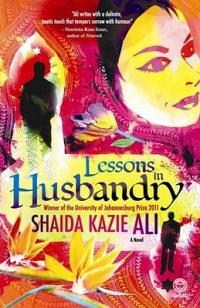
 Title: Lessons in Husbandry
Publisher: Umuzi
ISBN: 9781415201398
Price: R180
Buy Lessons in Husbandry from Kalahari.com
Shaida Kazie Ali’s second novel, Lessons in Husbandry (Umuzi, 2012), shares a number of stylistic and thematic features with her first, the award-winning Not a Fairytale (2010). In the earlier novel, Ali plots out the lives of two very different Muslim siblings – the wilful, feisty, dark-skinned Zuhra and the demure, obedient and paler-complexioned Salena, two sisters growing up in a repressive, patriarchal Indian family in Cape Town during apartheid in the 1970s and ‘80s. The two sisters’ poignant, sometimes harrowing recollections of youth - and their eventual emotional emancipation as adults - are interspersed with Zuhra’s wickedly subversive and vivid reimagining of selected Christian Andersen, Perrault and Grimm’s fairy tales. Well-known fables such as those of Blue Beard, Cinderella, Sleeping Beauty and Snow White (to name a few) are given a sardonic, feminist spin by Ali, and retold within a Muslim framework, also relating to seminal events in the two sisters’ lives. The novel is simultaneously deliciously dark and deeply moving. An original and daring debut, it garnered the author much well-deserved praise from critics, as well as winning her the 2011 University of Johannesburg Creative Writing Prize in the debut category. It was also shortlisted for the much-coveted Sunday Times Fiction Award.
Ali’s second book, while perhaps not displaying quite the same level of gothic vigour and verve as its predecessor, is as original and off-beat, but has a gentler feel. As with Ali’s debut it maintains a fine balance between tragedy and dark comedy, as well as slyly challenging patriarchal structures – and in this instance more specifically, overtly phallocentric interpretations of the Q’uran. Again, it is a story about two dissimilar Muslim sisters from Cape Town. The main difference here – and one which is fundamental to this plot - is that one of these sisters has been missing for over a decade, having vanished mysteriously during an overnight camping trip with her adoring father. Young, petite and popular, the effervescent 20-year old Amal, engaged to her doting doctor fiancé, Taj, has not been heard from since. Despite extensive police investigations, and the eternal searching of her bereft family, there have been no clues as to her fate.
But while she may not be physically present in their contemporary day-to-day lives, Amal’s absence dominates this text. We are introduced to her through the reflections of her surviving younger sister (by one year), Malak. The narrative is constructed as a memoir through which Malak attempts to process her sibling’s disappearance and come to accept it. Having lived, in some ways, as Amal’s surrogate – and “on the outskirts of her [own] life” - for all of her twenties, unable to fully process the trauma of losing her sister under such horrifying circumstances, Malak’s own needs lie dormant and stagnating. She has even gone as far as marrying Taj (at his suggestion) in a misguided attempt to assuage her parents’ overwhelming grief (and, she confesses, in a last-ditch attempt to lure Amal back) a few months after her sister’s disappearance.
When we meet her on her 30th birthday, Amal’s ever-present spirit continues to cast a pall over Malak’s entire existence. She is crippled by survivor’s guilt and has sublimated her own needs at almost every turn. She feels like an automaton going through the motions of life, reticent and incapacitated by the “what ifs” and “whys” surrounding Amal’s vanishing. She trawls missing person’s websites with a sense of morbid curiosity. She reads almost exclusively thrillers and whodunits, or watches similarly-themed television serials. For eleven years she has worn her hair in the same unflattering style in the hopes that, should Amal miraculously reappear, she will still be able to recognise her. She and the emotionally (and physically) absent Taj live past each other, their only real connection a shared sense of acute loss. Malak constantly dreams of Amal, dreams where water and the sea are the dominant signifiers and they converse cryptically.
This somewhat morbid premise, as presented here, sounds far more depressing than the book actually is. Despite the presence of Amal’s long shadow, Malak’s independent spirit manages to assert itself. Her dry observations and wry humour lift the tone of the book, as does Ali’s introduction of quirky (sometimes caricatured) secondary characters, such as Malak’s ghostly great-grandmother, Oma and Taj’s eccentric cousin, Precious – a sex-obsessed postgraduate student in Islamic feminist studies, with a penchant for sex dolls and dagga. The narrative is also interspersed with a smattering of recollections from the women who share Malak’s memoir-writing class. This is a clever exercise through which readers are exposed to different narrative voices and the notion of what a seminal role memory plays in life, colouring and influencing our present reality to a greater or lesser degree.
The novel is an enticing synthesis of mystery, eulogy, playful feminist tract and romance - and it is the central love story and sense of promise and liberation it offers which provide succour from grief for both protagonist and reader.
Malak is partnered in a successful bakery concern where she and her associate and best friend, Rakel (an older Jewish Holocaust survivor), bake and sell hundreds of exotically decorated cupcakes. It is while delivering an order to a guesthouse that Malak meets Darya, a young artist who specialises in producing dramatic seascapes – and the two are immediately drawn to each other. Unable to resist her powerful attraction to the young man, she enters into a clandestine relationship with him, all the while still married to Taj. When he proposes, Malak finds she cannot resist temptation, and their union becomes the driving catalyst for change in her life.
The novel has a strange, fable-like quality, enhanced by the non-specificity of Ali’s portrait of Cape Town and its surrounds. No street or place names are provided, and Malak’s observations and descriptions are often devoid of detail. This is a clever tool which emphasises our narrator’s detachment from her surroundings. One is also never entirely sure whether Ali intends to reveal what really happened to Amal, and you may find yourself continuously guessing at the truth, which also adds to the allure of the story. Pull at the plot thread of Lessons in Husbandry too insistently, and it may unravel. Rather enjoy this book for what it is - another of Ali’s trademark not-a-fairytale fairy tales.
Teken in op LitNet se gratis weeklikse nuusbrief. | Sign up for LitNet's free weekly newsletter.