

In the fourth edition of his memoir, Armed and dangerous, former intelligence minister Ronnie Kasrils recounts his journey as an Umkhonto we Sizwe operative and a member of cabinet following the collapse of apartheid.
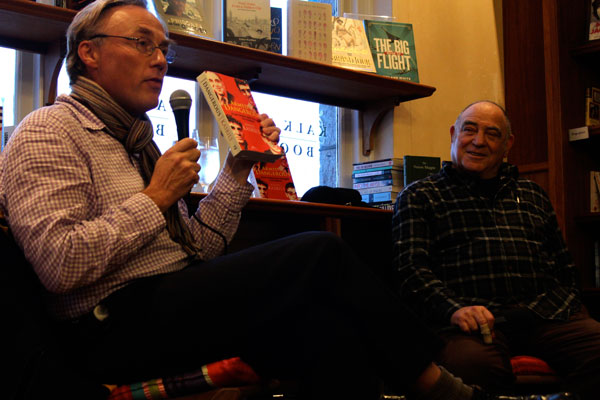
British journalist and author Tim Butcher was in conversation with Ronnie Kasrils at the launch of his book, Armed and dangerous, at Kalk Bay Books on 17 September.
Kasrils shared his captivating story describing how they brought the apartheid government to its knees, carrying out sabotage and bombing the regime’s infrastructure, slipping through borders disguised in different personas and coming into contact with former apartheid colonel and assassin Eugene de Kock in Swaziland.
In his extensive foreword, which is deemed to be the major contribution to the fourth edition, Kasrils explains that this edition has been dedicated to the born-frees, so that they can understand the sacrifices that were made and what lies behind where we are today.
The bookshop was filled to capacity, but the audience failed to resemble the born-frees to whom the book has been dedicated. Instead they resembled the born-frees’ parents and grandparents. Business Day columnist Palesa Morudu tweeted that they looked more like members of the former National Union of South African Students, South African Communist Party, Black Sash and the Democratic Party.
In November 1990 Kasrils, who had been an Umkhonto we Sizwe (MK) operative for 27 years, was described as armed and dangerous nine months after former president Nelson Mandela was released from Robben Island. The regime’s police were searching for him due to an alleged plot to overthrow the apartheid government and it was during his time in hiding that he wrote the memoir. He says it was written mostly from memory and with the aid of a number of letters that he had written to his late wife, Eleanor.
“I did not keep a diary. I wish I had, but of course we could not keep diaries. I did write extensively to Eleanor out of Angola and Dar es Salaam, after she had left. Later I wrote to her from Mozambique and even Swaziland and I have a lot of those letters, which helped to prompt me. But I wrote this book the second time when I was wanted in 1990 and I was underground moving from safe house to safe house throughout this country.
“I had a lot of time and I had just learned to use a computer. And so I began writing a memoir. I found that I have an aid and that’s a very good visual memory of particularly unusual things in life or dramatic things.”
He said that the Sharpeville massacre in 1960 compelled him to join the armed struggle against the apartheid regime. “When Sharpeville hit I really felt that I had to do something about it.” This led to his journey to Durban to assist his cousin, who was a member of the Communist Party, to evade the police. Kasrils subsequently joined the Congress of Democrats, which was made up of white people who supported the ANC.
“I joined the Congress of Democrats pre the founding of Umkhonto we Sizwe by Mandela. I had a good year and a half of protests, handing out leaflets and stuff of that nature and speaking at meetings.” However, halfway through 1961 he was approached to join the MK during its inception.
Kasrils says the uprisings in 1976 caught them by surprise, even though they had sacrificed a lot and tried to prepare the masses and let them know that the ANC was still alive, despite its banning.
“We knew that our struggle was just and things would change, but we did not expect to see black youth rise up as they did and face police guns. We do not have an exact figure, but I reckon that that whole year something like a thousand kids were gunned down all over South Africa.”
Kasrils says he worked very closely with President Jacob Zuma while they were in exile, but says Zuma could have benefited if he had finished his education. “This is a man who had very little education and was very bright. To his credit he studied and he got his standard six.
“People who came off Robben Island and had all these years went on to take matric and higher degrees, but Jacob Zuma showed no inclination. Mbeki allowed five or six ministers, including Sydney Mufumadi and Thoko Didiza, while they were ministers to go and complete degrees part-time. This was another indication of Zuma’s believing he knew better than anybody else.”
Kasrils is very critical of the level of corruption in the ANC. “There has been a definite decay in the political culture of the movement in a big sense – ANC, Communist Party and Cosatu. It’s not only since Polokwane and post-Mbeki that there has not been sufficient political education; even when Ronnie Kasrils was one of the elected leaders of the ANC and the Communist Party after 1994 there was not that much by way of concerted, sustained political education.
“We became very involved with governance and with the political power in running the state and I think there were too few left to do what Kgalema Motlanthe talks about. The aspiration of being in office and making careers has wiped away the thirst for understanding politics, which many people had in the camps,” says Kasrils.
This contribution was produced as part of a collaboration between LitNet and the University of Stellenbosch's Department of Journalism in 2013.