

Jacob Daniel Du Plessis Basson was born on 25 July 1918 in Paarl, and at the age of 94 he is still writing. His latest book has just appeared, titled Meneer die Speaker – Uit die Politieke Plakboek van Japie Basson, (Politika, Cape Town, 2012).
Basson began his colourful political career as a law student at the University of Stellenbosch at age 18 in 1936, and since then his infatuation with politics has never ceased. While a student at university he was the news correspondent to the Cape daily Die Suiderstem,a newspaper sympathetic towards the United Party government. His career in active politics began when he was appointed as the professional organiser for the United Party in Paarl and he started up a monthly journal titled Nasiebou,which was absorbed into Die Suiderstem a year later. This was followed in 1940 by a full-time post at the newspaper as political reporter sending articles from the parliamentary press gallery. Basson inaugurated Unie-Jeug/Union Youth, the UP’s youth front, in 1942. Thereafter he was elected as MP for Namib, SWA for the ‘50s. He sat as an independent MP for a few years, from 1959 to 1961, founding his own political party, the National Union. In 1961 he was elected MP for Bezuidenhout Valley, which he remained until 1980. After his time as MP, he served on the then President's Council for almost seven years. In his 30 years as a parliamentarian he wrote several articles and chapters in books. More recently, from 2004, he has brought out no fewer than five books.
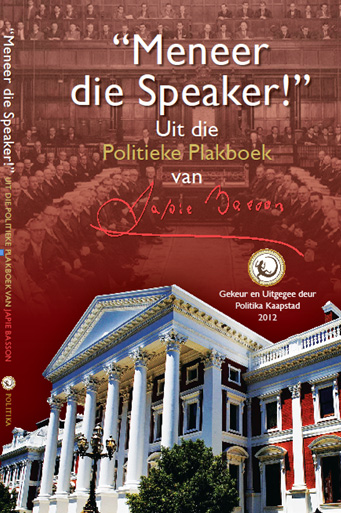
Japie Basson’s latest book, Meneer die Speaker – Uit die Politieke Plakboek van Japie Basson. Politika, Kaapstad, 2012.
Meneer die Speaker is a collection of Basson’s most treasured speeches which he delivered in his 30-year career as an MP in South Africa. Not only his speeches, but also some of his experiences as a long-standing politician are described. The speeches were mainly off the cuff, following true rhetorical style, which meant one had to be astute and well-informed. Interesting is the account Basson gives of how he changed parties several times, which then, according to him, was not that difficult, but not to be advised for younger politicians today. The decisions for him were always based on strict moral grounds. It was to be these decisions that moulded his actions, which he carefully sets out in the first chapter of the book.
The first section of the book, titled “Leiers, begogeldes en ongeroetineerdes”, explains Basson’s half-century-long career in politics, including details of some of the different leaders in South African politics he knew, met, and worked with, including interesting details about Sir De Villiers Graaff’s political career. The section ends with Die Burger editor Piet Cillié addressing a private gathering in 1980 on the occasion of Basson’s 30 uninterrupted years of service as a South African parliamentarian. These are rare insights from a very experienced journalist, about Basson and also about important issues of the day.
The second section of the book, “Ons is van Afrika”, takes the reader into “Darkest Africa” of the 1950s, at the time of the Mau-Mau revolution in Kenya. Certain of Basson’s views of Africa at the time were subsequently reflected during a visit to Cape Town by the British Prime Minister, Sir Harold Macmillan, accompanied by Lady Dorothy, between February 1 and 5,1960, as guests of South African Prime Minister Dr HF Verwoerd. As part of the visit to the city Macmillan was asked to address Parliament, although according to the rules it could not be from the floor of the Senate or the House. So the address was in Parliament’s dining hall, specially set up for the occasion. Basson was excited by the visit, especially because of his own close interest in rhetoric and speech-making, which now, from one of the world’s leading politicians at the time, was a rare treat to hear and listen to. Basson describes how the representatives of South Africa’s National Party government were absent from a garden party function hosted for the Macmillans by the British Ambassador Sir John Maud. It is clear how as members of the National Party they did not like what the British Prime Minister had implied when he referred to the growth of black consciousness in Africa.
The third section, “Kontensieuse konklusies”, is ten pages long, but analyses important philosophical issues, such as the implications of one person one vote; the true distinction between the concepts liberal and conservative; the right to nations’ self-determination; and political reform in South Africa.
Strong debates come to the fore in the next section, “Die Afrikaner-nasionalis as heerser”, for which The Pretoria News lauded him (8 Junes 1972). One of the debates conducted by him speaks out for the abolition of the Immorality Act, and as early as the 1960s he spoke out against racism, saying, “… I do not believe that any of our extreme racial laws will remain standing for very long” (p 107). This point is, however, contextualised on p 112 by what Basson says there about political integration: “In the final direction, and this is the one in which I believe we should move vigorously, black and white aspirations should each be channelled into a decentralized (federal) system of power, however far it is necessary for us to go.”
The final two sections contain some domestic detail, as well as meetings with important personalities. One such account is a special audience with Pope John XXIII at his summer residence Castelgandolfo on 7 September 1959. Basson explains the Pope’s work in the ecumenical field and how freedom of conscience was permitted for the first time in his papacy.
The book contains a vignette of Basson’s close friendship with South African writer Sarah Gertrude Millin. He was a regular visitor at her home in Johannesburg. Apparently she was well known for her marathon telephone conversations, one of which Basson experienced first-hand and which lasted for two hours.
The book ends with an account of personal experiences, with Basson feeling privileged to open several of internationally acclaimed Christo Coetzee’s art exhibitions.
Such are Basson’s talents, not just as a seasoned politician, but a humanist with a love for life and beautiful things. Meneer die Speaker gives a true inside account from a dedicated, level-headed person whose half a century in the political arena in South Africa. This book, together with his four other books and his leather-bound memoirs donated to the University of Stellenbosch archives, will provide future students of South African politics with a sizable archive from which to research a very difficult past.

Basson at 92, on the occasion of the donation of his memoirs to the University of Stellenbosch, 2010.
Photo: Politika.
Brief synopses of Basson’s four preceding books follow.
Raam en Rigting in die Politiek en Die Storie van Apartheid (Politika, 2004) covers some of the historical record of an era with Basson’s own experiences in it. Basson’s liberal stance comes through which enabled him to break away from the conservatism of the National Party in 1960 to found the National Union (Party).
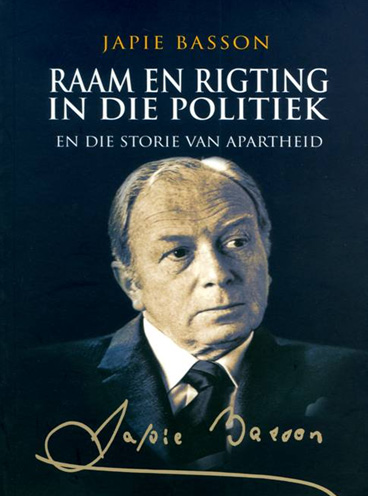
Raam en Rigting (2004), Basson's first book in a series of five.
Politieke Kaarte op die Tafel, Parlementêre Herinneringe (Politika, 2006) traces Basson’s personal experiences in efforts to promote a partnership with all South Africans. The book is full of episodes in Basson’s political life, and of particular interest here is his personal involvement in the politics of South West Africa (now Namibia), from 1947.
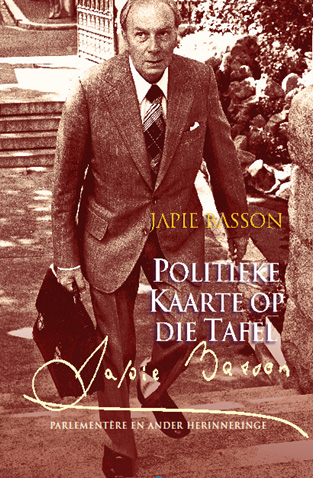
Basson's second book, Politieke Kaarte op die Tafel (2006).
Steeds op die Parlementêre Kolfblad (Politika, 2008) explains Basson’s role inside the opposition of South African politics and voices his strong criticism against the leaders in the National Party. It also explains his entry to the President’s Council in 1980. Readers will see how the prime minister of the time, John Vorster, demonstrated his dislike of Basson, and how Basson reveals the odious planned and violent disruption of political meetings during the time of Vorster in the National Party.
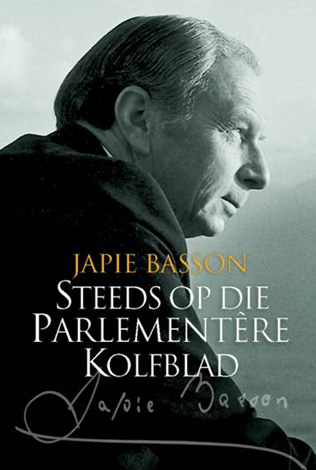
Basson's third book, Steeds op die Parlemêtere Kolfblad (2008).
State of the Nation as viewed from a Front Bench in Parliament (Politika, 2008) is a series of debates and articles reflecting a period of 12 years spanning some of the time of Basson’s career as the MP for Bezuidenhout Valley, and up to his entry into the President’s Council. These debates took place across several newspapers, for instance The Sunday Tribune,when in 1969 the editor invited Basson and his political opponent, Dr Jan Smith, to write weekly articles for this newspaper. He was invited in 1971 by the editor of The Sunday Times to contribute a series of articles on the state of politics in South Africa at the time. As with the other books, State of the Nation reveals Basson’s keen mind and his role in opposition politics of the time.
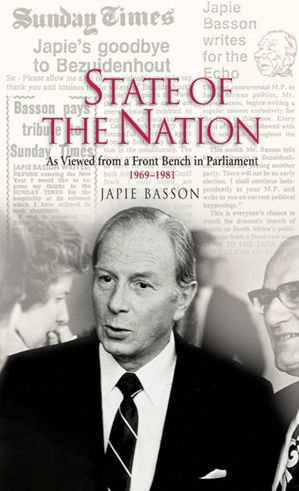
The fourth book by Basson, Sate of the Nation (2008).
It could be wishful thinking if one was hoping for a further book to appear from a nonagenarian approaching his 95th year. But then, who would have thought that in a period of eight years up to now we would have no less than five books from such a seasoned politician! All of these accounts by the politically polychromatic Basson, whose number of years of service as a parliamentarian are virtually unrivalled, have added considerably to South African political historiography.
South African journalist Gerald Shaw, having heard first-hand a number of Basson’s speeches from the press gallery, described his defiance of Verwoerd, and how he warned that black South Africans would not forever be satisfied with “crumbs from the white man’s table” and denounced JB Vorster’s assault on students and passers-by at St George’s Cathedral in 1972, accusing the National Party of “making war on the citizens of Cape Town”.
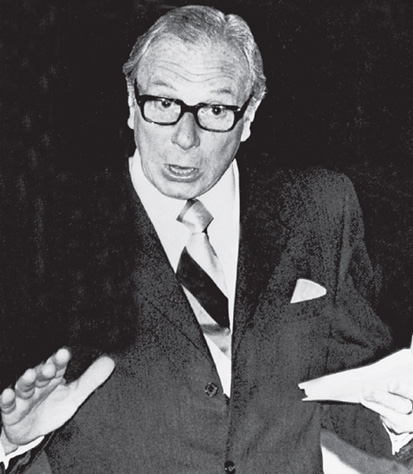
Basson delivering one of his speeches to Parliament. Photo: Politika Nuusbrief, June 2012
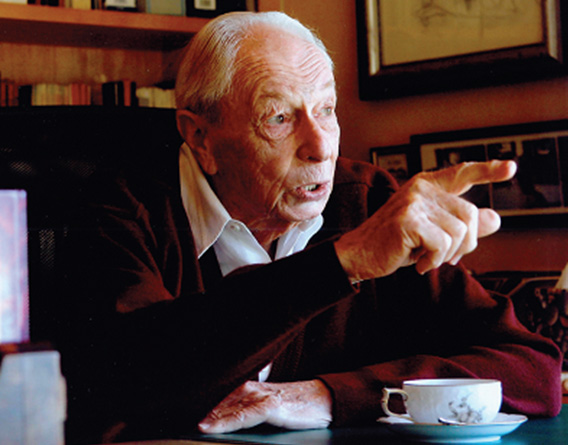
Basson in his study at his home in Cape Town. Photo: Politika Nuusbrief, June 2012.