


Tony Jackman
An e-interview between Paul Murray and Tony Jackman about Cape of Rebels, a new play from playwright and journalist Tony Jackman which tackles freedom of the press in two different eras of upheaval in South Africa, to be staged at The Hangar at NAF, July 2 and 3 at 7 pm, July 4 at 6.30 pm, July 5 at 12.30 pm, and July 6 at 7 pm.
Thanks for your time Tony, to answer the 10 questions.
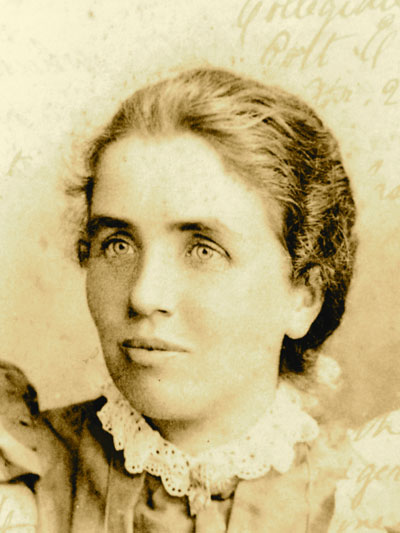
Alice Greene
What is the fons et origo of your interest in this project, how did you come to know about Leipoldt, Betty Molteno and Alice Greene in the capacities that you are casting them? How, if at all, is this project linked to An Audience with Miss Hobhouse’?
and
Whence your fascination with these interesting themes?
Everything to do with most of my plays goes back to Olive Schreiner. I first became interested in her and her works and life when I visited Cradock about 25 years ago and was inspired by the Schreiner Museum there. Reading and delving into her world – and I don’t mean her entire life, but the years before, during and after the Anglo-Boer War – brought the events of that war closer to me, and with any reading I’ve done since I’ve felt that I have got to know the period more intimately. It is now almost as familiar to me as the world around me.
That visit took me back to Matjiesfontein and the cottage built for her by James Logan and in which she lived from 1890 to 1893. This cottage is the setting of my first play, The Knocking, about the feud between Schreiner and Rhodes, and how the worm turned for her, as she described it in a letter: “Rhodes with all his gifts of genius and insight – and, below the fascinating surface, the worms of falsehood and corruption creeping.” The Knocking has not yet been produced, but it did have an airing at the first Schreiner Karoo Writers Festival in Cradock, in a staged professional reading performed by actors with script in hand.
This fascination with Schreiner brought me, through her letters, to her correspondents, such as Mary Sauer, Betty Molteno and Alice Greene. I was drawn into her world and times, and read such books as Pakenham’s The Boer War, Churchill’s account of his escape from Pretoria and trek to the coast, and the reports of Emily Hobhouse into British scorched earth atrocities. I had toyed for years with the idea of writing a play about Hobhouse, putting her on stage as Stephen Gray had put Schreiner on stage two decades earlier, and as Deon Opperman had done in his Dear Mrs Steyn. After the Cradock reading in 2010 I was asked by the redoubtable Sandra Antrobus, one of the festival founders, to “bring something next year”. So I returned to Cradock to spend a week in the Etienne van Heerden house in Market Street, writing my third play, An Audience with Miss Hobhouse, a one-hander which became the first of my then three plays to be produced.
All of this led to me becoming interested in Betty Molteno and Alice Greene, and with the formidable Marie (formally, Maria) Koopmans de Wet, who was dubbed “the queen of the rebel ladies” during the martial law period of the Anglo-Boer War. I heard about the salons she held in her home, now the Koopmans de Wet House Museum in Strand Street in Cape Town, attended by the city’s society of the day, including Schreiner, Rhodes, Molteno, Greene, et al. Leipoldt was among Mrs Koopmans de Wet’s circle and had her ear, and I started to picture in my head a stage filled with such people at one of her salons, and the issues and arguments of the day – the later years of the 1890s before the outbreak of war – being aired in the ensuing discourse.
Then I met the erudite Marthinus van Bart, the former architectural and cultural editor of Die Burger and expert on the period and its issues and people, and he gave me a copy of Songs of the Veld, a most wonderful little collection of the poems of what Stephen Gray called “the Cape clutch”, which Marthinus had compiled and introduced – a band of literate warriors who put their anger and passion about what was happening at the Cape during the war into poems to be published first in The New Age, the London periodical, and later, after the end of hostilities, in Songs of the Veld. It was these that Van Bart reintroduced to us more than a century later.
My interest finally settled on a handful of themes. Having lived through the struggle years of the 1980s and early 1990s in Cape Town as an arts journalist, and having frequented the Cafe Royal throughout those years, I knew first-hand the reporters and editors who covered the struggle during successive of states of emergency under PW Botha. I began to see parallels with what had happened during the later period of the Anglo-Boer War under martial law, when Cape rebels were persecuted – hanged, shot by firing squad, hounded – and it was made more difficult for the editors and reporters of the day to do their job. In both periods editors were detained or incarcerated as the authorities tried to control and suppress the news.
The threads gathered together to become Cape of Rebels, in which I put on stage three members of the “clutch”: Greene and Molteno, because I wanted to explore what their relationship might have been like, and Leipoldt, or rather the younger Leipoldt in his early 20s, then a war correspondent. This all presented an opportunity to bring elements of the poems in Songs of the Veld on to the stage. Then I brought in Marie Koopmans de Wet (who would in fact have been the starting point had I gone with the original idea of a play about her salons) to give Leipoldt a stage partner, as it were, who aided the persecuted Boer rebels and was a key activist of the day against what the British were doing in the colony.
In the final product we encounter two fictional characters in the present day, both women and struggle journalists who were once in a relationship. I mirror the two sets of women in their different periods, against the backdrops of the tumult of their times.
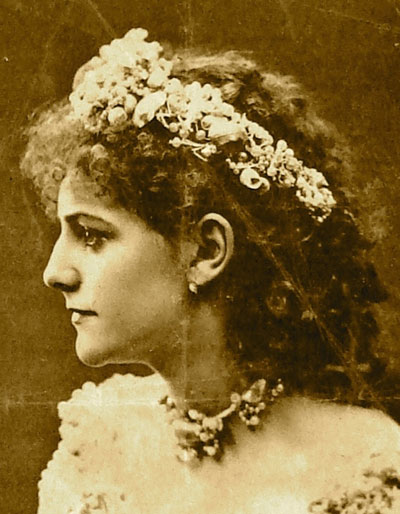
Betty Molteno
The poems that Leipoldt, Greene and Molteno wrote were published in The New Age in Britain after the Boer War had ended – so of what use and purpose, therefore, was it for poets and journalists to go “underground in order to get the news out to the world”? Surely it was too late?
Several of the poems were published in The New Age during the war, and then saw the light of day for the second time when Songs of the Veld and Other Poems was first published in London in 1902, and then banned in South Africa. Alice Greene’s poem “Miss Hobhouse”, written in October 1901, about the incident in Cape Town harbour when British troops carried her on board the Roslin Castle against her wishes (which features in a scene of my Hobhouse play), was first published in The New Age before December 12, 1901, the day Hobhouse wrote to Mrs Charles Murray to say that Greene’s poem “which has appeared this week in The New Age” had deeply moved her. This encounter is recreated in Cape of Rebels, so in a sense the Hobhouse play does have a link with the new work.
In the play I have the three members of the “clutch” spending more time than is suggested in Gray’s mention of a brief period of meeting in the Cafe Royal, in order to present the writers of the two periods in the same space. The Cafe Royal Hotel – although it is the restaurant and bar that is the setting – is the space occupied by the writers of both periods when writing and considering what they must report on and how to get it published.
Were they truly underground? I hold that they were. Editors were arrested and imprisoned (Cartwright’s case and incarceration at Pollsmoor is dealt with in my play). Leipoldt, then an accidental rebel, one could say, and war correspondent born at Worcester, was consequently an Afrikaner plying his trade under the yoke of the British colonial authorities. He wrote his war reports under pseudonyms in order to “protect himself from prosecution under martial law”, to quote Marthinus van Bart. Having lived through the more recent struggle, in that hub that was the Cape Town Press Club social hangout in the Cafe Royal, I saw the sense of taking that Gray reference to the clutch meeting “briefly” there and running with it so as to underscore the parallels between these two groups of writers in different eras.
As for relevance, the very existence of this play rests on the premise that we must always know as much as we can about what has happened before, in order better to be able to tackle any recurrence of such attitudes in our future or, more tangibly, in our present in South Africa and the world right now. There is much relevance in a world in which there are Isis beheadings, kidnapped schoolgirls and planes flying into skyscrapers.
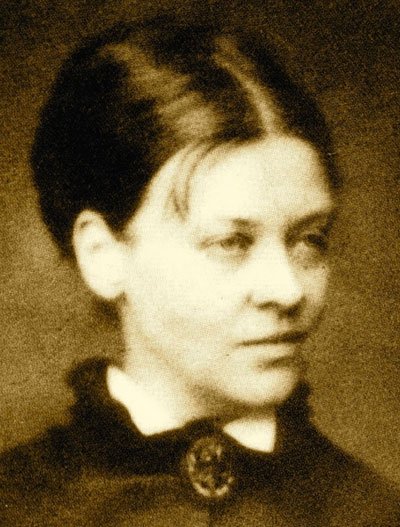
Marie Koopmans de Wet (credit: Iziko Museums of South Africa)
In 2004 Stephen Gray wrote about the poets – “Several poems came from the Cape Town clutch, temporarily gathered at their Café Royal. There were Betty Molteno … and Alice Green (who) gave out fine, ringing condemnations of the summary justice of martial law. Anna Purcell joined them on (the) women’s terrible sufferings. C Louis Leipoldt wrote about the public hangings of rebels.’’ My question: What was the nature of their poems, what the themes, were there themes in common?
Their poems were rather quaint, even melodramatic, to our modern eye, hence Greene’s exuberance in “Miss Hobhouse”: “The Terror reigns! Our lips are dumb. The Terror reigns! Our hands are tied. Yet hither did a woman come, across two oceans wide.” They were by and large not masterpieces of poetry, as I have a character acknowledge in a line in Cape of Rebels. But this was not the point. It was the content – the message, if you like – that mattered. But they were sweetly full of truth, and that is their appeal for me. The poems were almost invariably written for the British ear, in order to explain to them what was happening in the colony in Victoria’s name, or in their name. This mirrors Hobhouse’s own intentions, not merely to create a record of what had happened in the concentration camps and to the Boer women and children, but to demonstrate to the British quite why they were wrong and how badly they were wrong. The poems, then, serve the same purpose as the ringing newspaper editorial penned by an editor frothing at the typewriter, or the irate reader moved to speak out in a letter to the editor.
The poems tell stories of the hanging of rebels, just as a newspaper report would do, but in verse. They speak of freedom and the lack of it (Leipoldt wishing to awaken freedom fighters in “The Gibbet and the Grave”). Some draw parallels with historical injustices or outrages. My favourite in the collection is Greene’s “A Song of Freedom”, a robust, almost feverishly impassioned comparison of the Boers’ struggle with William Wallace’s fighting to free the Scots, the “mountain Swiss” under Austria’s heel, and the Netherlands under Spain’s yoke.
Betty Molteno’s “Scheepers”, dated January 24, 1902, just months before the war was to end, details the killing by British firing squad of Commandant JC Lötter and Cmdt Gideon Scheepers, who, interestingly, was compared by Molteno to the same William Wallace her life partner Greene had referred to in “A Song of Freedom”. The Greene poem came first, and one must surmise that the two compared such themes when in private conversation at the dinner table, and took their thoughts to bed with them.
Not every poem or verse in the Van Bart collection is necessarily a part of the output of the clutch. The introduction includes Schreiner’s “The Cry of South Africa”, written in May 1902, the month of the cessation of hostilities. This is a trenchant wail of a poem in which the author, embodied in the very rock she stands on, rails against the thing that war takes away that can never be regained by a mother: the loved one or offspring who does not return from war. “Give back my dead! They who by kop and fountain first saw the light upon my rocky breast! Give back my dead, The sons who played upon me; When childhood’s dews still rested on their heads. Give back my dead, Whom thou hast riven from me; By arms of men loud called from earth’s farthest bound; To wet my bosom with my children’s blood! Give back my dead, the dead who grew up on me!” I use this poem as a recurring theme during the play, by way of reminding us all that no matter what causes a war, no matter what other issues there might be, such death is at the heart of it all and is a consequence that cannot be ignored as much as it is the very reason why war should not exist. To quote Schreiner in “Woman and Labour”: “War will pass when intellectual culture and activity have made possible to the female an equal share in the control and governance of modern national life; it will probably not pass away much sooner; its extinction will not be delayed much longer. It is especially in the domain of war that we, the bearers of men’s bodies, who supply its most valuable munition, who, not amid the clamour and ardour of battle, but singly, and alone, with a three-in-the-morning courage, shed our blood and face death that the battlefield may have its food, a food more precious to us than our heart’s blood; it is we especially, who in the domain of war, have our word to say, a word no man can say for us. It is our intention to enter into the domain of war and to labour there till in the course of generations we have extinguished it.”
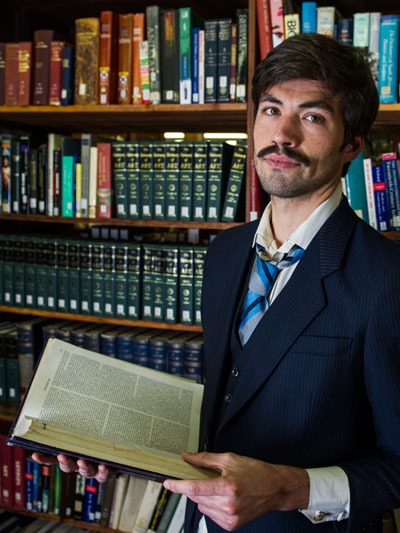
Ludwig Binge as Louis Leipoldt (credit: Jaco Marais, Die Burger)
Could you possibly elaborate on how English speakers from many different backgrounds spoke out in the struggle for freedom and justice, and how they made this universal (universalised it) while in the process campaigning for human rights? One thinks of John Ntengo Jabavu, at the time editor of two Xhosa newspapers, furthering the cause for freedom of all South Africans. Several of the editors of South African newspapers were banned and some were imprisoned or fined, hence the fact that they published under adopted names such as Leipoldt did.
My first answer is that I am not comfortable with the notion of singling out English speakers or any other group for discussion, because society is far more complex than identifying us merely by the language we speak or, for that matter, our skin colour. Coloured people speak English, black people speak Afrikaans. Jabavu, for instance, can be counted among the English speakers among liberals, as can Sol Plaatje, whose English was rounded to the point of being plummy.
But the question does present some other lines of thought. In a sense this is one of the things that Cape of Rebels is about, if you look past the more obvious themes in search of why I would bother to write it at all. When I think about these two periods of upheaval at the Cape, and of the scribes whose task it was – or who took it upon themselves – to write things down in order to inform others of matters the writers believed must be shared with the world, I see a world of rebels and liberals, of people who dislike and wish to stand against those who would oppress us in any way. I don’t care if the word “liberal” has become a swearword. I defy that. You may write on my epitaph that ‘he was a dyed-in-the-wool old-fashioned white Cape liberal’ because one day somebody will walk past my grave and say, “Oh look, somebody finally owned up to it.” And one day right-thinking people will see the truth, speak it, write it, and put this nonsense to rights. We cannot let the hawks win the day. Bring back the doves, and may they prevail.
Moving back to the point of the question: the editors of liberal, English-language newspapers – and some of their editorial staff – played a massive role in bringing word to the people despite the attempts to muzzle the press, and in the play this happens in both periods, the states of emergency of the 1980s mirroring the period under martial law. There were Albert Cartwrights in the earlier period, Tony Heards in the latter. There were Olive Schreiners in the earlier, Helen Suzmans in the latter. Whether Jabavu or Schreiner, Plaatje or Suzman, they stood up, spoke out, and wrote down their frustrations and anger, and refused not to be heard. And I love them for that. I always enjoyed my association, for example, with The Cape Times, the newspaper I first worked for and of which I was on the staff twice in my career as a journalist many decades after the newspaper had been the hawkish thing it later shucked.
I served under Tony Heard some years before he interviewed Oliver Tambo and published it, a brave act which ultimately led to his leaving the newspaper. I was and remain privileged to have known English-speaking South African struggle journalists such as Heard, Tony Weaver, Barry Streek, Kosie Viviers, Zubeida Jaffer and scores of others who did their job despite all the muzzling and ultimately were all part of the effort that won the day when freedom came in 1994. Having all of this airbrushed out of our history is a travesty.
But having said all of the above, it is not true that the staff of such liberal English-language newspapers were all English speakers or Anglo-Saxon. Eminent journalists such as Wessel de Kock and Kosie Viviers, and breakout journalists such as Max du Preez who, though an Afrikaner, operates chiefly in the English press, having founded and edited the ground-breaking liberal Afrikaans weekly Vryeweekblad in the later years of the struggle for which, I am inordinately proud to say, I wrote some reports under the pseudonym of Hardus Harding. It was a sweet bit of cheek at that time in my career.
And the newsrooms were not all entirely white, even though it is true that they were nowhere close to being representative. But take nothing away from people like Yazeed Fakier and Ronnie Morris, the kind of people who were prepared to reject advances to higher office based on their race and colour once freedom finally came. Both of them knew their worth and, equally important, knew the worth of their white newsroom colleagues and that most, if not all, of us stood on the side of the fight for freedom, whether or not we were activists.
Does your project project itself and look at the vital role at the time of the Boer War when Leipoldt and FC Kolbe wrote up the daily column in The South African News, when Leipoldt learnt a great deal from “the old dog”, Kolbe, who converted to Roman Catholicism, and was known as Monsignor Kolbe?
Kolbe is referred to in the text of the play and his status and role are clearly stated. But for dramatic and practical purposes I could not put them all on the stage, so I selected the duo of Greene and Molteno, with Leipoldt as the pivot on which everything turns, and Koopmans de Wet leavening things in her role as the “queen of the rebel ladies”. Kolbe, Anna Purcell and others key to “Songs of the Veld” and the clutch are represented in the text without actually being on stage. The text refers, for example, to Leipoldt’s contributions to The South African News and to Kolbe (in particular) and Leipoldt stepping in to keep the newspaper going while Cartwright was in Pollsmoor. There is the feeling of a band of scribes continuing to get the word out and keep newspapers vital and publishing despite the status quo, which again draws a parallel with what happened in newspapers in the 1980s.
How would you explain the words from Leipoldt in his poem written in Cape Town on July 30, 1901: “The gibbet and the grave gave life, and will/ give life again to those that will strive and strain/ for freedom and its cause; nor strive in vain/ those whose desires need force and cords to kill.// The thing is done; or right or wrong 'tis done,/ and only the remembrance shall endure./ But not the memory of a wrong shall stand/ more firm or rooted faster or more sure./ It shall serve to keep this dismal land/ more dismal till the final aim is won”?
Leipoldt speaks of the truth that those who have died for a cause they felt worth risking their lives for, have not died in vain if that cause is won. Others with the same fire in their hearts will ever be inspired by such martyrs, and in our present world we see the damnable evidence of this in those who die for causes which themselves are damnable, such as the suicide bombings of our age.
There is a sense of fatalism too in the dull acceptance that such a death cannot be undone even once the cause is won, hence our fascination with and respect for the monuments to those who have fallen in wars and annual ceremonies marking the heroes of those wars, alive or dead.
And the cause must never be given up until that cause is won. Leipoldt, had he been alive during our more recent struggle, would undoubtedly have rejoiced in the solution that finally came, that the cause was won no matter the odds and the loss of life that helped attain it. Again, this confirms to me that there is sense in drawing the parallels that I do between these two periods of upheaval and suppression.
The sad irony comes when you compare the theme of Leipoldt’s poem with that of Schreiner when she writes, “Give back my dead!”. Leipoldt admires the persistence of the freedom fighter against all odds, and respects and affirms his or her sacrifice. Schreiner mourns the great and irretrievable loss in achieving it.
How do you make the jump, 80 years on? What techniques does your project embrace or adopt to ensure the audience can follow (obviously the themes of censorship, suppression, going underground are themes that are explored). But historically, how is the link achieved? (If at all – does it have to be?)
Well, it doesn’t have to be, but the parallels are there and I have spotted them and drawn attention to them. Even though there are two different periods explored in the play, the themes are common to the whole story. So it’s about the themes and the issues they have in common more than about the wars. The venue of the Cafe Royal is key to this: it was having sat in the Cafe Royal so many times among the struggle journalists of the 1980s and then learning that the clutch had met there to discuss their Boer War / martial law / Cape rebels poetry that inspired my fascination with these parallels. It boils down to relevance. Relevance to our own world today is pretty much the entire point of it. There are those who would muzzle the South African press in our present world. They need to know that there is a history of the media resisting such attempts and be warned that we will fight back.
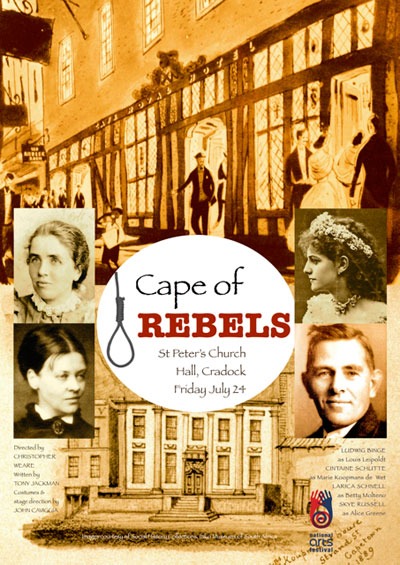
More practically, this is a collaboration with director Christopher Weare, whose concept and production employ a number of theatrical devices to shift our attention clearly between the two times, from quick hairstyle changes and elements of costume to the manner in which characters speak and even move in different eras and a soundscape of such disparate elements as rifle shot, horses’ hooves, car horns, snatches of relevant music such as Bright Blue’s “Weeping” and Johnny Clegg’s “Asimbonanga”, street clatter, and the thrum of bar conversation.
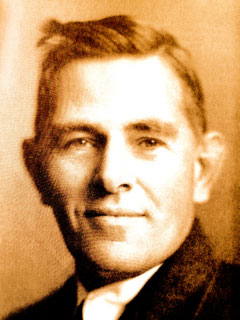
Louis Leipoldt
Could you explain more how the project works with “later Struggle years of the late 1980s-early 1990s” – media suppression, journalists going underground, writing up the history of the 1980s relating to the right to publish and to be heard, “a trenchant theme for our own times in southern Africa”? And how is this a throw-back, if at all, to the turn of the century in South Africa?
I chose to focus on the later years of the struggle for Cape of Rebels, particularly the End Conscription Campaign and the death of Neil Aggett, the Trojan Horse massacre, and PW Botha’s Rubicon speech; in other words, key turning points during the 1980s that helped push us towards the democracy that was to begin to show itself as the decade played out. I think the matter of issues relating to the right to publish has been covered in some of the questions above.
Quo vadis the freedom of the press in South Africa, freedom of reporting, processing of information … for the “truth” to be heard, the role of the TRC …? Are we assured of continued press freedom in South Africa?
The Fourth Estate, historically, has always fought for its own freedoms and I believe it will fight on should there be further efforts to muzzle it.
I don’t believe we can predict the future, only take educated guesses and assess what may happen based on what we know about what has happened before. My money is on the press’s coasting out the current regime while pushing back at the state’s attempts at repressing it, with the hope that the ANC government that takes over from Jacob Zuma will correct this aspect of the ANC’s recent behaviour. In any event, the political opposition is more vigorous than ever, and it seems clear that elements as diverse as Cosatu and Mmusi Maimane’s DA will be vocal and active in supporting our right to publish the truth, unfettered.
Good luck for the running of the play at the NAF. Thanks for a set of thorough replies to the questions.