

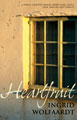
 Title: Heartfruit
Author: Ingrid Wolfaardt
Publisher: Human & Rousseau
ISBN: 9780798149938
Pages: 456
The twentieth century is considered by many to be the most terrible century in Western history. Categorised by the overwhelming presence of the will to dominate and dispossess, it is a century marked by war and violence, poverty and displacement, on a scale previously unknown. While it is Europe that suffered most during both the period that spans the two world wars and the troubles which have arisen over subsequent decades, South Africa has not been exempt from its share of hostilities. For South Africa the twentieth century was ushered in by the Boer War, a fight for land and power. Relatively shortly thereafter we took our place in the world wars, followed by the violence and brutality under apartheid, through the 1940s and into the 1990s, and the Border War with Angola in the 1970s.
It is this theme of violence, of a striving for power over land and people, which forms the background of Ingrid Wolfaardt's debut novel, Heartfruit.
The novel opens with Isak Minnaar, owner of a Cape fruit farm, driving through France. The farm is struggling financially, and he has come to Europe in the hope of getting buyers for his produce. From the first line of the novel - "This land is not his land" - one of the major themes of the story is clear: the desire to possess the land. In France Isak makes a trip to the town of Perron, after which his grandfather had named the farm. Perron is known, along with the Somme, as one of the bloodiest killing fields of the First World War. In the Perron museum he sees photos of that period and he remarks, "This is Oupa's war. Thousands of lives for a metre of soil", a situation which one of the characters sums up succinctly as "Land, men killing men for land".
Having failed to find buyers, Isak's last resort is to go to the Netherlands to visit his brother, Danie, whom he hasn't seen for years. While there he has an accident and is hospitalised with severe injuries. It is during the time that he is bed-ridden that the bulk of the narrative occurs - reminiscences of his life as a child, as a teenager, and as a young man - all of the major experiences of his life which have led him to this point.
As his past comes to the fore, the reader is given insight into the mind of a young boy who is faced with the difficulty of wishing to enforce his will over the "volk" that live on the farm, while, in fact, it is one of the "volk", Raatjie, his "kinnermeid", who means more to him than his own parents. Isak has a difficult relationship with his parents. His father has never recovered from the love he felt for a woman he met while fighting in Italy during the Second World War; consequently he has numerous affairs and drinks excessively. Isak's mother is depressive, self-involved and needy. The weakness of his parents is intolerable, adding to his desire to be strong. Isak's yearning for mastery and power is not limited to his interactions with the "volk", but extends to his bullying and mistreatment of his younger, weaker brother.
After a successful high school career as a star rugby player, Isak is called up for military service. Once his training is completed, he is sent to fight in the Border War. It is war that gives him the sense of power which he has been seeking in his life. Only years later does he realise, with shame, that war does not, in fact, make you a man; rather, "an unjust war makes a soldier into a killer." Lying in his hospital bed, Isak wonders, "What horrors has he seen? Can a man ever be the same after war? Can he ever live without fear? Can he ever live without guilt?"
For Isak the war is not over, he cannot escape it. He sees war everywhere: "The fighting never stops. The fighting is in the streets and the fighting is in the boardrooms. The fighting is with guns and the fighting is with fruit, with each other and with yourself, you can't get away from it."
The same will to dominate which has marred interactions throughout his life, is evident in his relationship with Amelie, the woman he marries. Unwilling to allow himself the weakness of love, Isak steadily withdraws his affection from her, as this, he believes, is a "subtler, more powerful tool of domination". Removed from relationships based on reciprocal love and respect, Isak is denied happiness in his life.
In the end, as Isak recovers in the hospital, having remembered his past, having seen and learnt through the memory of events, he realises that the land is not his land, it can never be his land; no matter how strong the urge to possess, it is not possible to own land or people. It is only once Isak has understood this that he will be able to learn to live without guilt and fear, and embrace the possibility of happiness.
Ingrid Wolfaardt writes with clarity of voice and with a careful understanding of the emotions of her characters. She successfully immerses the reader in the lives of her characters, their environment, and their situations. It is without difficulty that I number her among the better class of writer currently being published in South Africa, and I would recommend her novel to anyone wishing to be published, for it is this standard of writing which is needed in South Africa.
However, it was with disappointment that I noted the numerous typographical errors which riddle the text ("closest" for "closet", "Klu Klux Klan" for "Ku Klux Klan", "quiten" for "quieten", "accept" for "except", "too" for "to", to list a few). My disappointment regarding this is twofold. Firstly, there has been a boom in publishing in South Africa over the past few years. Many new publishing houses are printing books that are well-presented and carefully proofed. I am surprised that an established publishing house like Human & Rousseau would not have been more careful in their proofreading. If they wish to maintain their position as one of the leading publishing houses they will need to step up their game. Secondly, this novel took six years to write and was rewritten numerous times; it was carefully researched and shows a genuine respect for the subject matter. It feels like an insult to the author's commitment to have the text marred by so many unnecessary errors.
Having said that, I would like to reinforce the fact that I believe Ingrid Wolfaardt is an author of whom we can have high expectations, and I look forward with interest to her next novel.