

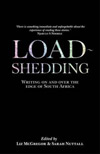
 Title: Load Shedding: Writing on and over the edge of South Africa
Editors: Liz McGregor and Sarah Nuttall
Publisher: Jonathan Ball
ISBN: 9781868423231
Publication date: March 2009
Pages: 248
Toward the end of 2007, editors Liz McGregor and Sarah Nuttall, under the auspices of Wiser at Wits, brought out At Risk, a collection of essays which portrayed life in South Africa. I wrote then that we needed more books of this kind: essays by a variety of writers which shine a light on facets of the past and issues of the present. I’m delighted that this second volume, Load Shedding, showcases the same depth and quality of writing, again by a range of writers.
These essays, many very personal rather than academic or journalistic, were written while all South Africans were under the shadow of load shedding – that time, now almost dimly remembered, in which the power would shut off for four hours at set times, often plunging us into darkness.
However, as the editors point out in the foreword, the title is as much symbolic as literal: “We wanted to signal not just the actual conditions of darkness that it refers to but the term’s suggestive symbolic and psychic dimensions. 2008 was a hard year for South Africans ... It marked the end of the Mbeki era, with the president fired from the ANC, and the rise to prominence of Jacob Zuma.” From high crime levels to xenophobic attacks, to the trauma of waiting for the lights to go out – 2008 was a landmark year.
The essay which opens the collection, Liz McGregor’s “If only there was a God”, is an intensely personal and moving piece about the death of her parents. She describes first the death of her mother from Alzheimer’s, and the more shocking and, of course, unexpected murder of her father. He had, in the past few years, cared for his Alzheimer-stricken wife at home, changing her nappies, feeding and bathing her, “and medicated her, mostly for her incessant anxiety. She must, at some level, have realised what was happening to her, and it terrified her.” Recovering from the pain of losing his wife, and dealing with prostate cancer, her father regained the humour and passion of his old self. But his newly found peace was not to last, as he was murdered a year later.
Reeling from the loss of both parents McGregor finds some comfort in knowing that for her there is no option of leaving the country, as friends might suggest, and that “There was, for him, a profound sense of the responsibilities of belonging.” And one of those responsibilities, she writes, was the possibility of violent death. This is one of the most moving pieces in the book – a personal essay that takes in the political realities of our time and makes sense of it in a profoundly gracious way.
In Michael Titlestad’s “My Defence Force” past and present move against each other. In training to tackle crime he remembers his time in the South African Defence Force in the ’80s. His time there started benignly enough, with a determination to “get it out of the way”. And while basic training was endured, and successfully so, in time severe lassitude offset by fear claimed him. The effects of the army on both Titlestad and others is quietly detailed.
Imraan Coovadia’s “Midnight” is a clever, subtle exploration of being Indian in South Africa (“uncertainty is the major force in our lives”) and the uncertainty of the future in this land.
Makhosazana Xaba’s “Serene in My Skin” blows a powerful light on the Xhosa/Zulu divide which splits families apart even in today’s South Africa. She, too, reaches into the past to muse on life growing up in what was Natal in the 1970s, as the piece traces her observation of the hatred of Indians for blacks and the insidious practice of black boys who would rape the girls on overnight train journeys as part of a “game”. It’s chilling to read: “No one called these boys to account for the rapes. They raped in the trains and casually sat next to us in classrooms.” Xaba’s piece penetratingly probes issues of identity and of the conundrum of having a president who has been on trial for rape.
Achille Mbembe’s marvellously meditative “Excerpts from my diary: February to December 2008” again uses the past as a departure point, while reflecting on everyday life in Johannesburg. He writes about blackouts which continue all week: “Everyone of them sends me into a deep depression. Each electricity stoppage provokes an irresistible desire to leave South Africa.” The picture that emerges is bleak: “I feel like I’m suffocating. Cultural drought. Indolence, torpor, and mediocrity. ... They fear whatever is unfamiliar to them. Is this the consequence of the years of isolation, or a Calvinist holdover?” At times he thinks of leaving, never to return, “but another part of me insists on remaining here”. The old conundrum, of stay or flee, present even in a foreigner.
Anther “foreigner”, Karina Magdalena Szczurek, in “Given half the chance” blends the fate of a family caught up in the Rwandan genocide and now resident in this country, with that of her own wanderings. It makes for fascinating reading: from fleeing Communist Poland as a ten-year-old, making a life in Austria, then the States, before returning to Europe, to meeting the man who would bring her to South Africa. The journey is that of exiles everywhere: uncertainty mixed with hope and rootlessness, and Szczurek’s poetic prose captures it well.
"Poetic" is also a word that springs to mind when recalling Ashlee Polatinsky’s almost ethereal piece, “Absences”. Reaching out to her father in this essay, she describes his many absences in her life as his other daughter prepares to depart to Scotland. Ruminatively she writes: “I want you to know ... that I have always grieved you ... that grief has made a gap in me.” It is a beautiful and sensitive piece.
These are the highlights for me, but there are many other essays that speak to me, among them Deborah Posel’s story of betrayal and misunderstandings in “Marginal Gains” and Sarah Nuttall’s story of grief in “I Love You, I Hate You”.
As with its predecessor, Load Shedding illuminates life in South Africa for all of us, through our varying experiences. We need to see one another reflected by the light of one another’s minds, thoughts, hopes, fantasies and dreams.
And again, I hope there will be successive volumes.