

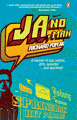
 Ja, No, Man: A memoir of pop culture, girls, suburbia … And Apartheid
by Richard Poplak
ISBN: 9780143025498
Penguin SA
Trade Paperback
R160
Growing up in South Africa in the '70s and '80s was a kak time for everyone, but certainly more so for black kids who had to deal with an inferior education system, entrenched racist national policy, violence, political protest and violence disguised as political protest.
When those experiences read like a raw map of grief and oppression, the travails of some suburban white kid with a maid and a private school education pale in comparison. And it would be easy, at first glance, to write this off as the wrong kind of memoir, that staid staple of local literature that has become the butt of more than one comedy routine, the Disneyfied “white-kid-learns-that-black-people-are-people-too” genre.
But drawing comparisons in a kind of one-upmanship of suffering that invalidates one group’s experiences is dishonest. The apartheid regime was evil all round, a fundamentally damaged system that fundamentally damaged everyone who lived through it to varying degrees. Every perspective on that time adds to our understanding of it, particularly when it’s presented not as dry polemic, but as an eminently readable romp of a story.
Poplak’s family moved to Canada when he was 16, so he’s had the advantage of distance to recontextualise his youth and answer curious Canadian friends’ questions about what it was like growing up in South Africa, then largely considered by the rest of the world as a fascist state up there with Nazi Germany.
But if his friends were hoping for stories of bloody riots and shootings and necklacings from a white perspective, they’d be better off reading Graham Boynton’s unapologetic journalistic account, Last Days in Cloud Cuckoo Land.
As in the case of Alexandra Fuller’s Don’t Lets Go To The Dogs Tonight or Diane Awerbuck’s Gardening At Night, that sense of normality is partly what makes Ja, No Man so resonant. This is not a book about astonishing achievement, about heroes or activists or people who made a difference. Rather, it’s a portrait of ordinariness under a terrible regime.
The result is a book that is candid and provocative and frankly funny, but also deeply uncomfortable to read at times. Poplak doesn’t shy away from plunging into the dark places or critically interrogating his childhood. He manages to tap the wide-eyed delight of his younger self and simultaneously put it into perspective with a merciless adult scrutiny.
It’s largely an irreverent coming of age, loaded with Boy’s Own adventure, surviving school, making it into the cool kids' hangout, dodging bouncers at bars, and psychotic cultural imperialists at veldskool (frighteningly similar to Nazi Youth indoctrination).
There are witty meditations on the rooi gevaar and underage drinking, as well as how white South Africa tried to cope with the incongruity of American media, black musicians like Lionel Richie and Michael Jackson, and television programmes like The Cosby Show.
Poplak has a hilarious riff on the disconcerting appearance of black communications officer Lt Uhura on Star Trek. “Gene Roddenberry’s daring act of progressive casting was entirely lost on me. The very thought of a black woman working alongside whites was so outlandish that I simply couldn’t process it. Lt Uhura must have been from outer space. My South African brain worked around the problem: I figured they were saving on green face paint.”
It’s all funny and tragic and spot-on, a blackly humorous reflection of everything that was wrong with South Africa and how we took it for granted. But confronting his own naivety, which sometimes translates into callous ignorance and even cruelty, makes for unsettling reading, especially when it’s so very close to home for anyone who grew up politically privileged and middle-class in this country.
His relationship with his maid, Bushy, is probably the most uncomfortable part of the book, tracing the trajectory of their relationship from co-conspirators in lizard catching when he was a toddler to “internecine skirmishes” in boyhood and outright war in adolescence. Five years after emigrating to Canada he returns to South Africa and goes to meet with Bushy in her new place of employment. He finds the indomitable one-time best friend and nemesis of his youth reduced to a broken woman, emaciated, flea-bitten and defeated. Overcome with a complex mess of emotions he writes, “A surge of impotence washed through me like a wave of bile, and the gulf between Bushy and me was so glaringly apparent that this felt like an out-of-body experience. What was I doing in the same room as this creature? We didn’t inhabit the same planet, and we never had. In the world I grew up in, no white person and black person ever did.”
While Poplak’s wry humour suffuses the narrative, deftly carrying it through the vilest of epiphanies and painful self-realisation, his inability to resist a joke also occasionally damages his point, such as the piece exploring the insanity of the split schooling system: “The revolutionary journalist Stephen Biko put it nicely: 'The most potent weapon in the hand of the oppressor is the mind of the oppressed.' The Inspectors and those they worked for – they were in the mind-creation business. In black South Africa, they created the minds of the oppressed; in white South Africa, the mind of the oppressor. Another favourite of The Whistler [Poplak's teacher] was Prokofiev’s Peter and the Wolf. He loved that tune. And while he was indeed the wolf, I should never have assumed that we white children were the little lambs. We were not that. We were wolf cubs. Aroooooooooooooooooooooooooo!”
The addition of that one silly sound effect completely undermines the keen and chilling insight into the architecture of apartheid education. It’s irritating, but that levity is also Poplak’s greatest strength. It’s what keeps the book afloat above the swampy mire of so many other apartheid memoirs drowning in bitter self-righteousness or transparent attempts at exoneration.
Poplak is fearless in exposing all the triumphs and uglinesses of his youth, testicle tick infestations and all. It’s a rollicking book, but it’s also a canny and funny insight into the deeply troubled (some might say psychotic) psyche of the country and the ambivalence of the time. As Poplak said of his childhood, “Sure I knew Apartheid was wrong. But what, exactly, was right?”
Fourteen years after democracy we’re still trying to figure it out.