

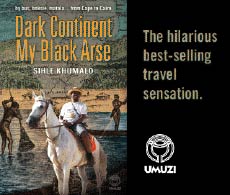
 Dark Continent, My Black Arse
by Sihle Khumalo
ISBN: 9781415200360
Category: Travel
Publisher: Umuzi
RRP: R130
Click here to find out more about the book
Click here to purchase Dark Continent, My Black Arse from kalahari.net now!
It’s surprising how rare black travel writing is. Therefore, as Zakes Mda aptly remarks on the back of Sihle Khumalo’s Dark Continent My Black Arse: "This is just the book we have been thirsting for: travel writing by an African adventurer who explores and tries to explain his own continent."
But before we follow Khumalo on his shoestring trip from Cape to Cairo we have to ask the basic question: Is black travel writing inherently different from other travel writing? In other words: Do blacks have different travel experiences, and do they write about them differently?
Before I read Dark Continent I was tempted to say "yes". When I recently taught the travel writing module for Wits postgraduates, one of the students made it clear that as a black male he didn’t give a damn about ecological stuff, heritage sites and conservation. What he and his buddies wanted to do in a nature reserve was to drink, make lots of noise and have a good time. Animals? Yes, on the braai, please. Up yours, travel! was his dictum, firmly rooted in black consciousness.
In his subsequent assignment he extensively quoted Njabulo Ndebele’s Fine Lines From the Box, in which Ndebele gives some thoughts on black tourism. He calls the game lodge "a leisure sanctuary where moneyed white South Africans can take refuge from the [racist] stresses of living in a black-run country". In his view it’s a remnant of old colonial power, a place where meek blacks still play servant to the white master. For a black visitor this is a disconcerting experience, writes Ndebele: "The black tourist is conditioned to find the political sociology of the game lodge ontologically disturbing. It can be so offensive as to be obscene … He is expected to engage in conversations around the campfire, about bush stories and lion kills, and hunting jokes that hold no interest for him … The entire world of contemporary tourism carries no intuitive familiarity for him."
With all that in mind I picked up Khumalo’s book with more than a touch of curiosity.
Where and how does he fit in?
Well, unlike my student and Njabulo Ndebele he’s not bitter and twisted. He doesn’t seem to have too many hang-ups about colonialism and race. Khumalo sounds the way he looks on the picture that was taken near the pyramids of Cairo: sitting on a horse, smiling brightly, and proudly wearing a touristy T-shirt and a straw hat. Clearly he has been enjoying the whole trip.
Sihle Khumalo was born in rural KZN, studied at Natal Technikon and the Wits Business School and went on to a well-paid corporate job with Anglo American when he was still in his early twenties. He was one of those golden post-apartheid boys for whom the sky was the limit. The whole spiel: big car, parties, booze, girls.
But Khumalo left the corporate world because he was sick and tired of it. He didn’t want to be stuck in a comfort zone. So at the age of thirty, with a wife and a baby, he decided he had enough. He wanted new challenges (he’s one of those people who needs challenges, be it bunjee jumping or travelling the hard road to Egypt). As he had always dreamt of travelling up Africa, following the footsteps of Colonel Ewart S Grogan, he decided to cross the continent from south to north, to see the state of Africa for himself. He would do Paul Theroux’s bitter Dark Star Safari in reverse: travel overland from Cape Town to Cairo, using public transport and surviving on a limited budget, which would mean rattling taxis and flea-ridden guest houses.
So off he goes, unemployed and with a snapped Achilles tendon. Khumalo follows the route South Africa, Namibia, Zambia, Malawi, Tanzania, Kenya, Ethiopia, Sudan, Egypt. Each chapter starts with a small historical overview highlighting the various fathers of the nations; hence we get Nujoma’s Namibia, Kenyatta’s Kenya, etc. Only poor Sudan is mentioned as Fatherless Sudan.
And in between Khumalo covers the distance, meeting people, eating the local food, jumping in and out of buses, trains and taxis, making all kinds of resolutions and business plans, coming up with playful thoughts and associations, and – very important – trying to chat up girls. He makes friends with locals and tourists, is ripped off once or twice, craves a good beer in a luxury hotel and discusses world politics (Mandela!), women (bums!) and football (Bafana!), soon realising that this is the lingua franca on the road. He’s not a black consciousness snob; he visits all the touristy highlights and enjoys them tremendously.
This, of course, doesn’t differ a lot from the experiences of your average young backpacker.
What does set Khumalo apart is his sheer irreverence. He has taken on the persona of a 100 percent Zulu boy. And this Zulu boy doesn’t mince words, especially when it comes to male pride and girls. So we see him getting all uptight when he suspects that someone is gay. We also learn that African men have the biggest penises in the world (the Sudanese apparently stand out) and that the Ethiopian women were the most beautiful on the trip. Additionally we are told that Egyptian women are "unattractive as well as very stuck-up" and that he did not see even one beautiful woman in Sudan. Each chapter ends with these little afterthoughts, as if to counterbalance the serious historical bits at the beginning.
Khumalo’s personal low, apart from fighting bureaucracy and almost suffocating in a dusty train in Sudan, is being snubbed by a Dutch woman called Leonie who has "fine, shapely legs and juicy lips and boobs" but refuses to sleep with him.
Such remarks could and should be highly irritating. But Khumalo gets away with it, essentially because he’s self-deprecating, vulnerable and almost naïve. This is not a hardened, cynical traveller like Theroux or VS Naipaul, but a young curious African who experiences flashes of absolute euphoria and moments of utter despair as he crosses his continent. Moreover, he has a witty way with words.
Interestingly, he quickly loses his blackness. Because as soon as he crosses the border he’s a stranger in a strange land who doesn’t speak the language and doesn’t understand the local customs. His looks and the way he dresses make him as much an outsider as any other young traveller, because every "guide", hustler or money-changer immediately spots the foreigner, the same way the dealer spots the junkie. And foreigners mean money, whether they are black or white. So Khumalo, just like anyone else, falls prey to the vultures lurking near bus stops and train stations and has to deal with incredibly complicated and infuriating bureaucracy.
It’s this perspective of someone whose perceived insider status gradually changes to that of an outsider that makes Dark Continent My Black Arse so readable and enjoyable. This unusual point of view, in combination with an off-beat style and a witty sense of humour offsets some of the negative traits of the book. Because purely as a travel book Dark Continent is not all that great. It’s written as a journal, where we follow the writer chronologically during his trip from A to Z, with a few reminiscences and absurdities thrown in to break the monotony.
No one told Khumalo about the "show, don't tell" credo. Hence words like magnificent clutter the pages. And there isn’t much in terms of a narrative either. The main questions are: Will he make it all the way to Cairo? And: Will he sleep with any of the women he chats up? The answer to the first one is obvious, given the publication of the book. The answer to the second one isn’t that interesting, since there is not much at stake whether he does or doesn’t.
The final chapter, "Looking Back", is devoted to contemplation, and could have been more extensive. Part of it reads like a self-help book with observations such as "I must never sell my soul to have purely material things" and "I also thought that, without being too selfish, I would spend more time with myself and strive to be the person I want to be by not succumbing to any flavour-of-the-month pressures."
Then he poses a much more fascinating question: what went wrong with the African continent? Bravely, he doesn’t look for the easy way out, which would have been lamenting colonialism and racism. Instead he tables two interesting facts: first of all that the Boers, despite treating their dogs better than their fellow countrymen, built an economy and infrastructure that has no equal anywhere on the continent; and secondly that African leaders, both traditional and political, have betrayed their people in a big way.
Sitting happily on the beachfront of Alexandria in Egypt, having just finished his exhausting trip, he doesn’t really feel like going into the nitty-gritty of these observations. Understandable but unfortunate.
What we do get, however, is another reference to that stunning Dutch girl Leonie who refused the share a room with the author and so hurt his big black male pride. She must feel honoured to have the final words of the book dedicated to her: "Thanks for nothing Leonie."