

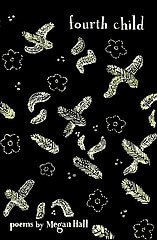
 Publisher: Modjaji Books
ISBN: 9780980272901
I’ve always imagined memories to be like fragments of cloth that we tear from the past in order to clothe ourselves in the present. Sometimes, certain patches are torn out to make place for new ones - the memory of an old love gets replaced by the experiences with a new one. Sometimes, sections simply wear away, like the second, third, fourth day of grade five. Quite often, we ourselves pack the memories we don’t want to think about, the memories that have been sewn on with the thread of grief and pain, into old wooden chests to be left in dusty, forgotten attics. In fourth child, Megan Hall’s debut anthology, Hall opens up her chest of memories to present a wealth of simply written, accessible emotion, stitched together with aesthetic artistry. Some poems fold like crocheted handkerchiefs into pockets positioned over hearts: small, light, and compact, while others hang like forgotten coats or jackets in their haunting evocations of real people.
It is particularly the latter image that springs to mind as one peruses Hall’s poetry, for the volume is in many ways about the act of saying goodbye and being left behind, or leaving behind. What else? For just as there are many ways of loving, are there not just as many ways of saying goodbye? At times, Hall’s tone is matter-of-fact, like in “Meeting at Night”, where she expresses to her lover the reality that “tomorrow or next year, I will leave, you will leave -/ we’ll write letters across this country, and others,/ letters that don’t mention our infidelities with each other:/ on paper we are faithful, if not celibate”. Other times, her tone is far more cynical: “I hope you grow to be a really mean motherfucker,/ and travel far, but stay close, and regret me always” (“To a friend, on getting older”).
The recurrent theme, however, is that of deep loss, of true mourning, for even worse than losing someone is losing someone you should have known, but never did. It is this unique loss that shapes and forms this collection, as the title poem, “Fourth child”, makes clear. Addressing “… my grandmother”, Hall acknowledges that “On the 49th day, God was kind, and made me your fourth child”.
The poems “Gunshot”, and “Suicide notes” broaden our understanding of this epithet, and add a pathos and depth to Hall’s writing by opening up the main themes and subject of her writing. “Gunshot”muses its way through fictional scenes of gun-inflicted deaths in movies before turning to reflections on the speaker’s mother’s own suicide caused by “two gunshot wounds to her head,/ one voluntary, the other ‘a simple reflex movement/ of the hand’.” This leaves the speaker in “Suicide notes”as “the property to be disposed of in your note;/ it may have been the first time you owned me in this way.”
With such a dominant theme of death and loss you might be wondering if the collection is only a gathering of melancholia and gloom. While many of the poems do speak of heartbreak and mourning, there are also softer tones that soothe the bereaving pen. Hall’s poetry is saved from drowning under the lyrical heaviness of grief by the light of poems that remind of love that heals, love that patches, love found after love lost, love of lovers old, love of lovers new, love, for example, like that of her grandmother. In “Seams”we read how her grandmother’s “love is in the seams, the lengths of lace,/ the afternoons spent being patient,/ while I wasted another length of material,/ attempting a pattern beyond my skill”. In the title poem, “Fourth child”, this feeling of ineptitude is taken deeper when Hall laments not her incompetent ways with words, but rather her complete lack of material: “she [her mother] took the words we needed with her./ Though I sift her ashes, I won’t find them, know they’re gone.” Yet not all is lost, for in “Wedding”, the final piece of the collection, Hall speaks of some measure of consolation: “In her empty wedding dress, green sash,/ my mother makes her empty presence known,/ living in our words, quietly.// For this I’ve waited all my life: those missing, those missed.”
Despite Hall’s hesitation to claim prowess in sewing, much of her work exhibits her mastery of sewing words into poetry, something that is affirmed by the orange-brown sticker on the front cover declaring fourth child to be the winner of the Ingrid Jonker Prize. The strength of this volume is not uniqueness of form or style, but rather uncluttered, readable, evocative imagery. Just like Epainette Mbeki, who is described in “Dancing on Robben Island”, one can imagine Megan Hall sifting through the treasures still to be found in her memory chest, “her glance still say[ing]: Here/ there is something I can achieve.”