

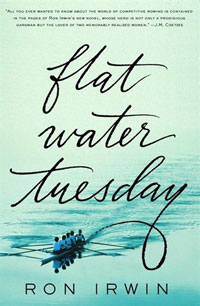
 Titel: Flat water Tuesday
Skrywer: Ronald Irwin
Uitgewer: Pan Macmillan
ISBN: 9781250035981
Koop Flat water Tuesday by Kalahari.com.
"Make peace with the past." For the protagonist of Ron Irwin’s Flat Water Tuesday, Rob Carrey, this past is outwardly that of his experience of challenge and triumph as a member of the celebrated four-man rowing team of The Fenton School in Connecticut, the God Four. More troublingly, this past is the fifteen years since that golden time during which he and the surviving members of that successful team have had to learn the difficult lesson that sporting triumph is no insurance against failure in life.
As a powerful individual sculler Rob Carrey’s first challenge at Fenton is to accept that if he wants to represent the school at rowing (even though he is there on a rowing bursary) he must become a team player and join the four-man rowing team. He does not make this transition willingly, nor does he carry over the lesson in becoming less selfish to the major relationship he has later in life with Carolyn Smythe. Their break-up, which is made more difficult by their continued collaboration on a documentary film project, is Carrey’s main point of reference at age thirty-five for the cost of the lessons he and his Fenton rowing mates did not learn.
The major challenge of taking an endurance sport like rowing as the organising activity for an exploration of intertwining lives and relationships in a school environment and beyond lies in representing the solitariness and mind-numbing monotony of the training it requires. At the level of the dynamic of the sport itself, the solitary intensity of rowing poses more of a challenge to the writer than a game like baseball (one thinks of Chad Harbach’s The Art of Fielding, 2011), where each “play”, inning, game and season provides a fresh opportunity for a turn in character development and plotting.
Irwin spares no detail in recounting the gruelling training the God Four put in for the prestigious race against their school’s old rival, Warwick, that marks the climax of their year and one-plot strand of this novel. Unlike team sports like cricket or soccer or baseball, where a game consists of bursts of concentrated teamwork, rowing measures an individual’s commitment to the team by his willingness to push his limits in enduring pain. Strength is built through repetition and measured in numbers: a daily grind of runs, weights, sessions on the ergometer or the river. Each cocooned in his own pain, in training the members of the God Four compete against one another for better numbers and ratings: the pace of the oar stroke, the number of bench-pulls, races on the indoor rowing machines.
At times the sections describing the team’s training and racing become tiring to read because of the limitations of the first-person point of view, from which Irwin narrates all of the novel. In these sections we can experience the intense focus and exertion of only the main character, Carrey, whose point of view often contracts to a fierce concentration on enduring pain or defying the stern rowing coach or outdoing his admired and detested teammate Connor. There is room only for seriousness here, and the result is some flatness in so far as the narrative comes down to counting repetitions, tracking each character’s performance against that of the others, interspersed with barks of encouragement and provocation from coach Channing and the coxswain, Ruth Anderson.
Rowing shares with cycling (rather than, say, running) the ideal of merging the human body with a machine to produce a spectacle of graceful speed in simulation of flight. For the rower or cyclist there is nothing graceful in the sheer physical work of powering the machine. However, for the spectator the aesthetic pleasure lies in observing the apparent fluid ease with which four rowers synchronise their efforts like automatons to glidethe boat like a bird across water. Similarly, the individual cyclist, even in the heat of a race, is one entity in the peloton, which, seen from the side or above, resembles a flock of birds altering its arrowing shape as it negotiates the turns and gradients in the road. It is this outsider’s perspective on the spectacle of graceful speed that is lost in Flat Water Tuesday by anchoring the point of view on the rower Carrey alone. While an occasional shift to the third person might have compromised the self-absorbed retrospective quality of the novel, there would have remained some room for flexibility in the narrative point of view to counterpoint with levity or detachment the seriousness and focus of these athletes’ concentrated exertion.
One of the liveliest aspects of Flat Water Tuesday is the dialogue among the characters. Irwin captures well the sharp edges of schoolboy repartee, the arrogant poses that are cruel on weakness and that conceal insecurities. He is equally strong on carrying through the conversational tone of Carrey’s thoughts to his actual conversations with Carolyn.
The most delicately handled moments in the novel are those involving the mixture of tension and intimacy between Carrey and Carolyn. Two examples stand out: the morning he uses coffee, cookies and a playful bite into her shoulder to break the wall of silence between them and draw smiles and laughter from her; and the news she tells him on their trans-Atlantic phone call – itself emblematic of the emotional distance between them – that brings the ice into their relationship.
In Irwin’s novel the seasons provide a unifying set of associations for the two storylines between which the narrative alternates: Carrey’s year at Fenton and the state of his life fifteen years later. One of Irwin’s strengths is in using the changes in the seasons to foreground the theme of passing time, of seasons as a correlative for stages in life. They occasion passages of beautiful writing, like this one:
Autumn began to turn relentlessly into winter at Fenton. Every morning I would open the curtains in my dorm room and bathe in the symphony of color that the fall brought to the valley. Those millions upon millions of turning leaves marked the end of the season. The brilliant colors in the cold light against those gothic buildings and the darkening grass seemed at once beautiful and forbidding. Real cold was coming soon but the leaves held against it. Route 7 was a flaming tunnel of overhanging leaves. They blew across the practice fields in golden red swirls, sprites searching for summer. They floated down the river in pockets of yellow and brown and gathered in huge, inviting piles all around the campus. The boardwalk began to smell of arboreal decay. (161)
Autumn, most poignant of the seasons, here offers a physical correlative for the passage of time towards the climactic race against Warwick in the summer of Carrey’s year at Fenton. But it also provides a measure of the distance between the two stages in Carrey’s life between which the narrative shifts: his schoolboy self, headstrong, competitive, ambitious, and his thirty-five-year-old self, reflective, without illusions about the difficulties of love and loss. While the seasons physically manifest passing time they also provide, in their cyclicality, a sense of constancy behind the changes that one can relate to all that has not changed at Fenton, in Carrey’s surviving teammates, and in the history they share. In Carrey’s mind his rowing mates remain the individuals they were on the God Four team, just as the sporting fields of Fenton remain unchanged by the high energy and pageantry of the games played on them. Carrey recognises this changelessness after the formalities of his school reunion, which, along with the race against Warwick fifteen years before, forms the other climactic event of the novel:
I covered her gently and stood by the window watching her sleep. The river was brooding blue, the hills indigo. All around the grass fields were vibrant and green. You could feel that strange energy coming from them, the ground having absorbed hundreds of games of soccer and lacrosse, field hockey and football, baseball and rugby; the energy of youth pounded into the earth, released at dawn. (351)
The novel ends with two pages of extraordinary balance and quiet power. The sentences gather pace and momentum like a video in fast forward, reminding one of the closing paragraph of Joyce’s The Dead.
But then the pace alters and the prose attains a state of reflective – and for the protagonist, accepting – pause, like that moment when an aircraft coming in to land with all its thunderous gravity seems to become suddenly noiseless and weightless just before touching ground.
Teken in op LitNet se gratis weeklikse nuusbrief. | Sign up for LitNet’s free weekly newsletter.