

 On the fifth night
Michael Howard
Publisher: MindMark Publications
ISBN: 9780620709026
Authors on their new books: Michael Howard answers Liné Enslin’s questions on On the fifth night.
Hi, Michael. On your website, you say, “I am the same as you: 37 trillion cells … a mirage in a desert of consciousness.” On the back of your new novel, On the fifth night, you also call Mark’s story an “eternal testament to the glorious mystery and uncharted depths of human consciousness”. Can you please explain both instances? And also, is the human consciousness (a topic most people find difficult because of its abstract nature) a topic that fascinates you?
Consciousness fascinates me no end. We have various theories on what consciousness is – how the conscious, the subconscious and the unconscious mind relate and connect. It is all still predominantly uncharted. Religion, especially the mystical traditions, delves into the experience of it. Science, especially psychology and neurology, tries to understand it using the scientific method. We sense the word “consciousness” describes levels of human being, but we can’t quite put our finger on what exactly these levels are. The whole concept is like a mirage – there, but untouchable; real, but somehow unknowable. It disappears as we try to explain it … like an illusion; we are unable to fathom with our limited senses. Ultimately, this is the desert – the nothingness of consciousness.
How does one become more aware of the content of one’s subconscious state?
Interpreting this question depends on what one defines as subconscious. I believe “sub-” and “un-” are just grades of the hidden stuff – the stuff not commonly conscious. We become aware of our subconscious/unconscious by letting go of the habits of our conscious minds. Everything we’re conscious of is programming – the culmination of our genes and our circumstances. By letting go of this stuff, we free up the hidden stuff. At first, some of this stuff may be nasty … the less deeply hidden stuff. But as we go deeper, letting go more and more of everything, we feel a certain sense of being removed, of being aware of self, yet unattached. This is the deep, true self … the earliest version of self … the origin. The practice of letting go is simple, yet profound. Meditation and mindfulness techniques help.
Mark Hanson (the main character in your novel) and Michael Howard sound very similar … You also share the experience of a wife with Huntington’s disease. How autobiographical is your novel?
Part one is very autobiographical … with a bit of extra drama thrown in. The rest of the book brings my studies and experience with consciousness to bear on a parable-style tale. I imagined what life and death would be like for a man who commits a terribly ugly act of violence against a loved one, and then has to come to terms with it … until his own death … and beyond.
Can you please tell us a little bit about Huntington’s disease and how it affects one’s life? How easy or difficult was it to write about it and give the reader an honest depiction of what it looks or feels like?
Huntington’s is the worst possible disease I can imagine. It destroys brain cells indiscriminately. Nothing is left by the time the person dies – not any physical capabilities, nor any cognitive ones. It really forces one to question what it is that defines a human being.
It was relatively easy to write about. I guess when one has lived with the disease for so long, it’s not a big jump to share things on a page. The difficulty of being in the public eye fades with time, and one gets used to sharing more honestly. The alternative is denial and pretence.
The title refers to the fifth night. Why the fifth night?
Tim dreams about blue – self-control – on the fifth night. This is the aspect of spiritual intelligence that Mark most needed to stem the rising tide of his inflamed ego when he punched his wife. So, the fifth night is Mark’s epiphany.
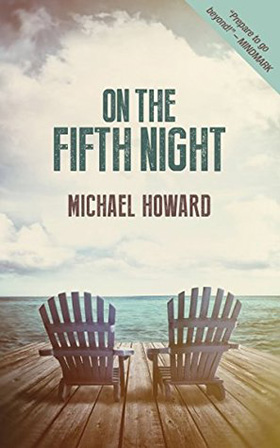
Do the two tanning chairs, the dock and the sea on the cover have a specific symbolic meaning? The water immediately makes me think of the water the subconscious mind is often associated with – the surface being the most accessible and the deeper parts the elements of the subconscious we have less access to.
I searched long and hard for a cover image. This one just spoke to me the minute I laid eyes on it. It’s rich in appropriate symbolism. The association of water with the subconscious mind is one. Probably most symbolic for me is the expanse, the eternal romance between shore and sea. There’s something mystical about the expanse. Then there are the two empty chairs – a kind of sadness. The occupants of the chairs are gone. Life is short. Yet the chairs are still sitting empty on that dock, implying existence is eternal. Another symbolism I love is side-by-side lovers. Their love is mature. They weren’t staring into each other’s eyes like young lovers. They were staring out into the expanse together. All of these themes are central to the parable of Mark’s journey.
You are also the creator of The seven aspects of spiritual intelligence. Please tell us about this programme.
I developed the first version of the seven aspects in the late ’90s and early 2000s. I’d studied engineering, theology and philosophy, and was just coming to terms with my late wife’s illness. I was, and still am, an avid meditator and seeker of meaning, both from scientific and spiritual perspectives. The programme has undergone quite a few reloads since then. These days, I offer seminars on the subject at my mountain retreat facility in Magaliesburg. We’ve custom-designed trails and seven meditation havens, representing the journey to greater spiritual intelligence. So, we do a bit of teaching in the conference room, and then we set off on a walk and practical spiritual experience. It’s relatively new, but I’m extremely excited about its uptake so far.