

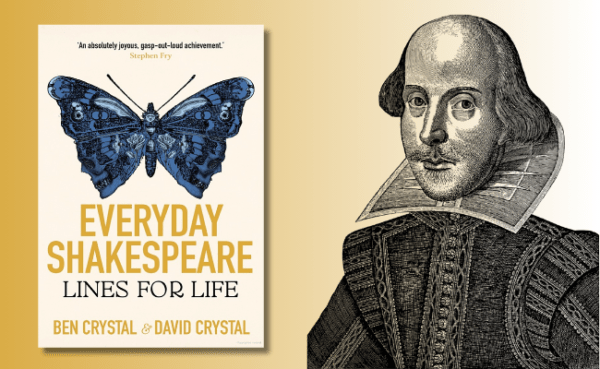
Book cover (left): Everyday Shakespeare: Lines for life (Ben and David Crystal). Available here. Illustration (right): Image by Gordon Johnson from Pixabay
Many, many years ago, in the days when English education traditions were still the norm at my old school of Pretoria Boys High, Shakespeare ruled supreme. The Bard was all.
Into our English class, the relevant “master” would swan, swathed about the shoulders like Dracula with a black toga, mortar board firmly planted, and fix his gimlet gaze on us squirming 14-year-olds.
“To thine own self be true!” he would thunder, and then challenge some hapless fellow to identify which of Shakespeare’s plays the quote featured in (easy answer: Hamlet) – and then follow up with “slept a wink”, which absolutely no one got (impossible answer: Cymbeline).
An early introduction to Shakespeare then and in the years that followed, was typical of my generation, and I encountered Shakespeare in many guises, from plays and films to everyday quotes. He was the soap opera writer of his day; and even now, most of the popular soap operas on TV sets around the world owe their basic structure and tension to Shakespeare’s five-act plays, with each act comprising one to 15 scenes. Today’s episodic series from, say, Netflix has exactly the same formulae: the unfamiliar juxtaposed with the familiar, the frequent turning points in the story, the inciting moment, the denouement, the dark night of the soul, the saving the cat event, etc. Any student of contemporary theatre and cinema will recognise in modern scripts exactly what Shakespeare successfully achieved 400 years ago in capturing the highs and lows of the human condition.
.....
Any student of contemporary theatre and cinema will recognise in modern scripts exactly what Shakespeare successfully achieved 400 years ago in capturing the highs and lows of the human condition.
.....
I wouldn’t say I was exactly a devotee of the Bard at school, though, and to this day, random Shakespearean references can leave me feeling distinctly guilty of neglecting the works of the great man. Fortunately, a refresher course is at hand in the shape of this inspired new book (review details above): Everyday Shakespeare.
Do you remember “Thought for the day” – a homily trotted out in the daily newspaper or just before the news on the radio? Well, here is your thought for the day provided by Shakespeare. The premise is clever, with 366 main quotes selected as a mirror for us to peer into to see whether any part of ourselves might be visible. On each dated day, as in a diary, as you read his lines, you’ll get glimpses of loves you’ve known, jealousies you’ve felt, relationships you’ve experienced and situations you’ve encountered that may bring a smile – or a wince – of familiarity.
The authors, a father and son duo of Shakespeare scholars living on the island of Anglesey in North Wales, have, as they say, gently curated the passing of the year across a collection of themes, inviting a series of thoughts to flow together over a week. They draw attention through their selection of quotes to matters of modern life, as well as points of literary, linguistic and theatrical interest. They offer notes of context, identifying who originally said the words, in which play and why.
.....
I couldn’t put this book down. It now resides at my elbow at breakfast, where I can turn to today’s date and read the relevant quote to my wife.
.....
I couldn’t put this book down. It now resides at my elbow at breakfast, where I can turn to today’s date and read the relevant quote to my wife. It provides space, as the authors say, to step back briefly from taking part in life, and instead to reflect simply for a while on how we all live. The Shakespearean quotes all strike a chord.
The year has also been “themed” on the Bard’s terms. For example, May invites a touch of nature and July explores politics and tyranny, while August leans into profound yet accessible wisdom. And so it goes – Shakespeare was deep in his emotional intuition and bold in his philosophical outlook.
Turn to the entry for 5 July, for example (with a picture in mind of Putin about to meet Kim Jong-un of North Korea to discuss arms supplies!), and the quote is: “Tis time to fear when tyrants seem to kiss.” This reprises Pericles and Antiochus, and their tale is briefly told on the page – but the very concept of tyranny fascinated Shakespeare in his later years. He adds the famous line from Pericles that acknowledges the fear that’s at the heart of all tyrants; any hope of them getting better or becoming kinder is foolishness: “Tyrants’ fears, Decrease not, but grow faster than their years.”
.....
[T]he popular myth that Shakespeare wrote too much, and that what he did write was inaccessible and elitist, is comprehensively dismissed. Crystal reveals the plays for what they are: modern, thrilling and uplifting drama.
.....
A very useful companion to Everyday Shakespeare is an earlier book by Ben Crystal entitled Shakespeare on toast (Icon Books). Here, the popular myth that Shakespeare wrote too much, and that what he did write was inaccessible and elitist, is comprehensively dismissed. Crystal reveals the plays for what they are: modern, thrilling and uplifting drama.
He quotes the great American actor Orson Welles as saying: “Shakespeare speaks to everyone.” His plays could be set in any country, since what he writes about is what it means to be human. His writing is translated all over the world.
The South African connection
There is also a strong South African connection. I am indebted to the Shakespeare Society of Southern Africa1, which has a good deal to tell us about the various translations into many of the 12 official South African languages, as follows: the first formal translation of Shakespeare’s work into a South African language was undertaken by Solomon T Plaatje, one of the most important figures in the country’s political, cultural and literary history. Plaatje was a founding member of the South African Native National Congress (later the ANC) and travelled to Britain around the time of the First World War to seek support for his campaign against racist oppression in what was then the Union of South Africa. While in the UK, he was asked to make a bilingual English-Setswana contribution to the international Book of homage to Shakespeare, published in 1916. Plaatje went on to translate six of Shakespeare’s plays into his mother tongue: Diphosho-phosho (The comedy of errors), Mashoabi-shoabi (The merchant of Venice), Matsepa-tsapa a Lefeala (Much ado about nothing), Dintshontsho tsa bo-Juliuse Kesara (Julius Caesar) and Othello and Romeo and Juliet (for which he did not provide a Setswana title). A number of translators have followed in Plaatje’s footsteps, but only a handful of these texts are readily available and accessible.
.....
The first formal translation of Shakespeare’s work into a South African language was undertaken by Solomon T Plaatje [who] went on to translate six of Shakespeare’s plays into his mother tongue [Setswana].
.....
Another significant Shakespearean transition from English to Xhosa was RL Peteni’s novel Hill of fools / Kwazidenge (1976/1980), based on Romeo and Juliet. Probably the most famous Zulu version of Shakespeare is Welcome Msomi’s 1970 play Umabatha (Macbeth).
Over the second half of the twentieth century, a number of celebrated Afrikaans writers – particularly poets – translated Shakespeare’s work. Prominent examples are Uys Krige’s Twaalfde nag (Twelfth night, 1967), Breyten Breytenbach’s Titus Andronicus (1970) and Andre Brink’s various translations. Perhaps the most prolific translator of Shakespeare into Afrikaans was Eitemal: Macbeth (1965), Hamlet (1973), Midsomernagdroom (A midsummer night’s dream, 1975) and Die wintersprokie (The winter’s tale, 1975). A few years ago, a production of Macbeth was directed by Marthinus Basson.
In 2000, Yael Farber’s SeZaR! combined Shakespeare’s Elizabethan English with Zulu, Xhosa, Sesotho and Setswana. The Isango Ensemble performed a multilingual adaptation of the narrative poem Venus and Adonis as part of the Globe to Globe Festival in London in 2012. uVenas no Adonisi included Zulu, Xhosa, Sesotho, Setswana, Afrikaans and English. More recent theatrical experiments in Shakespearean trans-languaging on South African stages range from Umsebenzi Ka Bra Shakes (2019) to DNA’s Macbeth (2021).
A man for all seasons
William Shakespeare’s unparalleled contributions to literature, drama and poetry have left an enduring mark that resonates through centuries. His plays and sonnets not only entertained audiences of his time, but also laid the foundation for modern theatre. His exploration of universal themes like love, power, jealousy and ambition, as well as his profound understanding of human psychology, continue to captivate contemporary audiences. The richness and versatility of his characters offer a timeless mirror to society, prompting introspection and empathy.
Beyond his impact on drama, Shakespeare’s linguistic legacy is immeasurable. He coined and popularised countless words and phrases that have become integral parts of the English language. Expressions like “break the ice”, “wild goose chase” and “all’s well that ends well” are just a few examples.
.....
[Shakespeare’s] works illuminate the human experience, offering insights into our nature and society. His linguistic contributions continue to shape the way we communicate.
.....
Furthermore, Shakespeare’s influence extends to art, music and film, as his works have been adapted and reimagined across various mediums. His ability to convey complex emotions, intricate plots and universal truths has ensured that his writing remains relevant and cherished.
In essence, his works illuminate the human experience, offering insights into our nature and society. His linguistic contributions continue to shape the way we communicate. Shakespeare’s legacy is a testament to the enduring power of literature to transcend time and inspire generations.
Notes:
1Shakespeare Society of Southern Africa, shakespeare@ru.ac.za
Everyday Shakespeare: Lines for life by Ben and David Crystal was published in the UK in May 2023, Australia in August 2023 and the USA in September 2023, and is available here.