

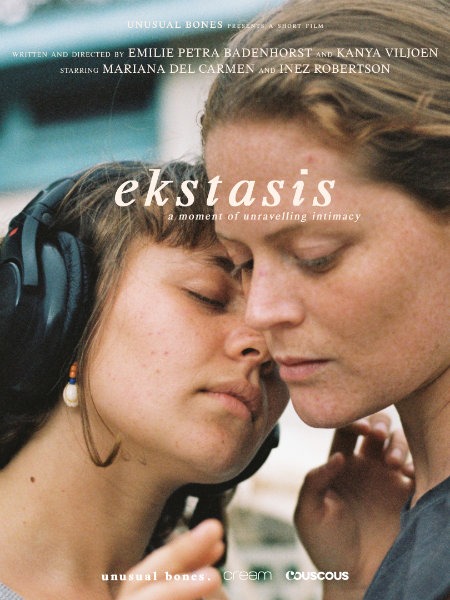
 Ekstasis
A short film
Unusual Bones. in association with Couscous and Cream
Written and directed by Emilie Badenhorst and Kanya Viljoen
Ekstasis can be seen on the Vimeo account of Unusual Bones.
First and foremost, Ekstasis reminds us of the senses we have otherwise forgotten to cherish. From water drops cascading down the skin to the smell of naartjie juice on your fingertips, this stunning study of the interconnectedness of identity is perhaps the gentle reminder we all need to savour the human experience and all its delicious complexities. Emilie Peta Badenhorst and Kanya Viljoen look not only at the blurring of relationships in that strange limbic space between friendship and something more, but also at the fragility of family dynamics and how quickly they can come tumbling down.
...
This stunning study of the interconnectedness of identity is perhaps the gentle reminder we all need to savour the human experience and all its delicious complexities.
...
Inez Robertson and Mariana Del Carmen give a beautifully raw performance as the film’s leading roles, with the free-spirited and feisty Marizaan perfectly balanced out by the strong and quiet presence of her best friend, Phella. Through these young women’s honest performances, we find not only the delicate intimacy that makes up the core of the film, but we also learn just how important silences can be when words are simply not enough. “Why can’t people just fucking say what they want to say to each other?” screams a confused and overwhelmed Marizaan in light of learning of the growing friction between her parents. A very bold question to pose in a time when communication has been overpowered by the falsities of online personas. This is perhaps why the simplicity and almost nostalgic art direction, from the warm yellow tones of Marizaan and Phella’s kitchen to the clean minimalist nineties-like fashion, set the viewer’s mind back to what might be considered a simpler time. But, even with barely any presence of modern distractions, it is still the silences, the things unsaid, that truly strike clear and true.
Marizaan and Phella’s unconventional love scenes expressed through dance-like movements are so inherently sensual and intensely intimate, that the blandness of the unemotional sex scenes that usually plague modern romance stories feels inconsequential in comparison. To allow the simplest of touches, fingers lightly skimming skin and the chaste press of cheek to cheek, to become so heightened and heart-rending is no easy feat, but this perfectly paced slow-burn love story does just that. Jason Prins’s cinematography echoes the quiet intimacy of Marizaan and Phella’s relationship, giving the sense almost of a home movie with its documentary-style handheld camera and cosy close-ups. In conjunction with the soft, inviting and at times haunting score, there isn’t one moment when you don’t feel fully immersed in this little corner of Cape Town and the coastal town of Velddrif.
...
Marizaan and Phella’s unconventional love scenes expressed through dance-like movements are so inherently sensual and intensely intimate.
...
Badenhorst and Viljoen manage to give a clear comparison by placing the more expressionistic and emotionally charged youth, seen especially through Marizaan, side by side with the firm and sometimes unforgiving Afrikaner culture represented through Marizaan’s parents – a societal staple with an overbearing but well-meaning good Christian mother and her stern and silent husband. How perfect a comparison to create between the tender beginnings of a relationship of South Africa’s next generation, and the crumbling marriage whose structure was built in a bygone era most wish to forget. Like with many other problems that still plague a post-apartheid South Africa, one could even argue that Marizaan’s parents’ inability to speak freely with one another – to let emotions remain bottled up instead – is another issue passed down to the next generation without any hope of finding a solution anytime soon.
From the get-go, we see Marizaan practising her final exam piece, headphones on and eyes closed to the world around her. Dancing to a tune only she can hear, she already lays out what her future struggles will be – a constant battle of the metaphysical kind, while words otherwise escape her. It is an impeccable representation of the inner struggles of this next generation of youth. A generation who are looking inward and attempting to understand their identities, rather than hide them. Immersed in the multilingual and diverse landscape of South Africa, we ride an emotional roller coaster alongside these characters, flitting between the different facets that make up the self, trying to figure out just how all the puzzle pieces fit together and whether or not there are some parts that need to be reshaped in order to reflect the truest, most honest version of ourselves.
Overall, Ekstasis has lived up to its name. I was immediately ensnared by the story and fell in love with not only the message, but also the way in which it was told. Badenhorst, Viljoen and the rest of their incredible team of creatives have done a magnificent job in exploring the difficulty experienced when shifting between these boundaries inflicted upon us by society. Through Marizaan’s and Phella’s eyes, we learn that the resulting pain can come hand in hand with a kind of bitter-sweet beauty rewarded only to those brave enough to try.
See also:
Read on Voertaal:
Colonisation and immigration, an interview with Ashlin Winckler
Kommentaar
Sounds lovely.