

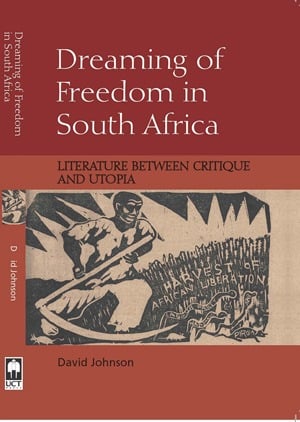
Dreaming of freedom in South Africa: Literature between critique and utopia
David Johnson
Publisher: UCT Press, 2020
ISBN: 978 1 77582 260 8
At the beginning of the first chapter of his Dreaming of freedom in South Africa, David Johnson quotes eminent historian Jay Winter, who, in his Dreams of peace and freedom (2006), illustrates how the 20th century has been punctuated by inspirational moments of utopian dreaming. His concern is not with what he terms the "major" utopianism of totalitarian monsters like Stalin, whose communist and fascist visions of a new civilisation produced a mountain of corpses. Instead, Winter focuses on a more wholesome tradition of "minor utopians" who, in "dreaming their dreams" of a common humanity, envisaged "partial transformations of the world" through measures such as the 1948 Universal Declaration of Human Rights. Paying fulsome tribute to this humanitarian heritage, he affirms the exceptional vigour "of men and women who dared to think differently, to break with convention, to speculate about the unlikely in the search for a better way". Equally – if not even more – to the point, their imaginative creations were "almost always short-lived, and were followed by defeat, disillusionment and despair".
.............
As a country which remains an unlikely New Jerusalem to cheer you up, South Africa is fertile ground for turning over withered dreams of enlightenment and freedom, and for burrowing down to excavate lost utopias of a radical kind.
..............
As a country which remains an unlikely New Jerusalem to cheer you up, South Africa is fertile ground for turning over withered dreams of enlightenment and freedom, and for burrowing down to excavate lost utopias of a radical kind. It is also, of course, a good place for spotting dystopias. While Johnson’s main concern is with dreams of freedom, his intriguing new book reminds us that "prophecies of the future" consist "in the form of nightmares as well as of dreams". One example of a nightmare time-travelling vision which gets a welcome airing here is Arthur Keppel-Jones’s imagined history of a South African future. Conjured up in 1947, When Smuts goes: A history of South Africa from 1952 to 2010 predicted an unfolding cataclysm whose grim features included mass plague, complete economic disintegration, the extinguishing of freedoms by tyrannical rulers, and an invasion of the country by a Western military coalition.
Although the future dreaming explored by the present volume isn’t inspired by this kind of dystopian text, there might well still be place for When Smuts goes on the bookshelves of more nervous South Africans. With a pronounced historical and literary cast of mind, the learned author of Dreaming of freedom in South Africa is the ideal scholar to examine the many and varied vocabularies in which an emancipatory future was imagined after the end of racial segregation and apartheid. Professor of literature in English at Britain’s distance-learning Open University, David Johnson included in his earlier books critical studies of the meaning of Shakespeare in South Africa and of intellectual visions and travellers’ evocations of the early Cape Colony, both drawing on an immense range of sources, past and present. Preoccupied with the ways in which a disfigured colonial past continues to infect a disfigured post-apartheid present, Johnson specialises in post-colonial literature, with a particular focus on southern African literature and history. He is also, be it noted, not only a South African, but a native of Kimberley. Perhaps he is the Northern Cape’s compensation for Cecil John Rhodes.
As you might expect of a distinguished Marxisante academic, the style of Professor Johnson’s book is rigorous, analytical, closely argued and almost forensic in its interrogation of a chosen collection of South Africa’s "literary dreams and political visions". As it is so densely written, a full appreciation requires full attention to what is being teased out for its significance, or to how thinking is being elucidated. In other words, despite its modest length of just over 200 pages, Dreaming of freedom may not suit casual, lazy or dreamy readers, but rather, as with the classic reader desired by the authors of fat English Victorian novels, like George Eliot and Charles Dickens, someone who is disciplined in being slow, careful and intensely focused. That said, Johnson’s study isn’t without lighter touches. He concludes with a timely discussion of a 2014 compilation of essays in the Johannesburg Sunday Times by a gaggle of local writers who projected what their country might look like in 2034. While some displayed a predictable mix of "nostalgia, despair, resilience and hope", by far the lion’s share of these imaginary depictions predicted catastrophic levels of national disintegration.
It’s rather tempting to imagine Professor Keppel-Jones (who died in 1996) sitting up in his grave in Canada to wag a finger: "Well, I did warn you." In reflecting on the brighter utopian side of this coin, Dreaming of freedom chides the authors of a handful of optimistic prophecies for their blinkered visions of an alternative future. None imagined a truly reinvented South Africa, a country which had transcended the "limits of the nation and capitalism". Instead, the most hopeful idealisation was of a place that might come to resemble a "well-administered northern European welfare state – the Netherlands or Norway – but with better music and weather". Aside from the omission of wine from this comparative image of a social-democratic Eden, not everyone would necessarily pass over Scandinavia’s Abba and Roxette or Amsterdam’s Nederpop in favour of Brenda Fassie or Mango Groove.
Before we reach this book’s sombre closing note on how "varieties of despair" have displaced an older "tradition of hope", it provides an exceptionally detailed and engrossing account of that earlier phase of lofty dreams. In his highly intelligent exhumation of a largely neglected prior history of bold ideas of liberation, David Johnson provides much to contemplate. What gives his book its especially concentrated quality is its microscopic examination of a body of ideological fragments – visionary novels, poems, pamphlets, manifestos and other documents – some of them fairly trivial, it could be said. These direct our attention to an alternative tradition of South African political literature, enthusiastically radical in its stance and resolutely internationalist in its inspirational reach.
...........
What gives his book its especially concentrated quality is its microscopic examination of a body of ideological fragments – visionary novels, poems, pamphlets, manifestos and other documents – some of them fairly trivial, it could be said. These direct our attention to an alternative tradition of South African political literature, enthusiastically radical in its stance and resolutely internationalist in its inspirational reach.
............
Dreaming of freedom commences with writings in the dreamy crucible of imperialist nation-building, the late 19th century, when Rhodes and his circle were on a mission to unite southern Africa’s British colonies and Boer republics into a single white nation. One famous writer who expressed her dreams of a destiny of South African freedom was Olive Schreiner, who foresaw the achievement of an "ideal state" only in a very distant future, given the handicaps of "the South African nation". These were the complication of "the native question" and the suffocating grip of "the foreign monopolists and the imperialists". Denounced by Schreiner as "locusts", the former were devouring South Africa’s future. That biblical allegory was an early taste of her new country’s addiction to Old Testament versions of a cataclysmic destiny. A more hopeful spirit was embodied by SEK Mqhayi’s 1929 utopian Xhosa novel, UDon Jadu, in which a sweet and saintly new egalitarian nation of Mnandi emerges under the benevolent stewardship of the British Empire.
In his wide-ranging opening survey of dreams of freedom, Johnson treats his readers to an entertainingly mixed bag. So, out comes not only a fresh look at the well-known, like Karel Schoeman’s 1972 Na die geliefde land, which imagines a rural Afrikaner community stuck in internal exile in a black-ruled South Africa, but also introductions to the odd and the obscure. Among those dug up by the author is Garry Allighan’s 1961 Verwoerd – the end: A look-back from the future. In it, the future is 1987, and the country has been enjoying a quarter of a century of wonderful progress, thanks to "separate development" and its Bantustan policy.
The core of Dreaming of freedom comprises four chapters that explore visions of the future which emerged out of South Africa’s major 20th century traditions of organised anti-colonial and anti-segregationist and anti-apartheid resistance. Weaving in historical titbits, an international backdrop and literary references, Johnson is an animated guide to the most lofty aspirations of the Industrial and Commercial Workers’ Union, the Communist Party of South Africa, the Non-European Unity Movement and the Pan-Africanist Congress. Perhaps the most vivid – and surely the most poignant – of these accounts is of the ICU. To the left of a nationalist ANC, intellectuals within its fragmented ranks turned to journalism, fiction and poetry to craft visions of an emancipated South Africa, stimulated by an eccentric cocktail of "insurrectionary" Christianity, black pride and self-reliance, communist doctrine and even the Victorian English poetry of Charles Swinburne.
"Soviet freedom in South Africa" is an amusing title for the author’s chapter on the CPSA and its clunky blueprints in the 1920s and 1930s. Johnson is always scrupulously fair to his subject, even when South African communist aspirations of "a new Jerusalem, Heaven or the Holy Grail" were founded on a repellent devotion to Stalin’s magic medicine for making "backward nationalities" race towards a socialist freedom. A different brand of dreaming along South Africa’s left-wing fringe surfaced in an independent socialist or Trotskyist presence, fused into resistance politics as the NEUM in the 1950s. Its intransigent intellectuals rode a frothy tide of public lectures, reading groups, magazines and newspapers to establish "a political-intellectual milieu that enabled the propagation of radical ideas". Those who typically joined book circles and swotted up essential readings like Kenny Jordaan’s 1952 Jan van Riebeeck: His place in South African history were always a small minority, but they were a contagious minority of dogmatic individuals who generated an influential attitude of mind.
Perhaps they can be thought of as a kind of genetic peanut butter, with even a little going quite a long way. With the denouncing of liberalism, ANC multiracialism and orthodox communism as "hot air and drums" to hoodwink the country’s oppressed masses, the attainment of freedom could not consist of "the enfranchisement of black South Africans", but required the whole capitalist world to be turned upside down through revolution. For the NEUM’s thinkers, "the history of segregation in South Africa" was "but one specific version of imperial and colonial history". Although inhabiting a very different mental universe to the Marxism of the NEUM, the educated, urban clusters within the largely rural and uneducated PAC were seized by their own visions of an Africanist utopianism. That turned on the great march of a transcendent "Pan-Africanist collective identity" across the nation and beyond through the continent, "from South Africa to Africa". Johnson’s deft appraisal of Africanist poetry and other writings within PAC circles and his skilful profiling of literary representations of the movement’s confrontation with the apartheid state by politically sceptical novelists are a haunting reminder of those flickering Pan-Africanist dreams of a Promised Land. They may live on in later Black Consciousness generations, but otherwise, in a xenophobic post- apartheid South Africa, it’s hard to miss the setting of that sun.
Still, as in the rich treatment of its other dreaming political traditions, Dreaming of freedom leaves us with a surprising taste of how eclectic some resolutely Africanist militants could be in their choice of reading. The PAC’s Robert Sobukwe, whose impassioned cry was for "the creation of a United States of Africa", was a fan of the English establishment novels of CP Snow, of the comic fiction of PG Wodehouse, and of the Greek tragedies of Sophocles. This country’s current sub-literate political class could do with taking a leaf out of that book. David Johnson’s graveyard conclusion comes as no surprise. With the odds always stacked up so overwhelmingly against grand aspirations, what else but to nod to his conclusion that the "utopian impulse is in poor shape"? If not, consider looking up Langston Hughes’s famous old 1950s poem "Harlem", which starts by asking, "What happens to a dream deferred?"