

Deaccessioned
Curated by Lizabé Lambrechts and Nicola Deane
Oude Leeskamer
Until 13 June 2026
Whether we like it or not, decay is everywhere about us and within us. It is happening in our brains, our bones, our mouths and our neighbourhoods. Although dispassionate and equitable in its distribution, decay is often politically divisive. Depending on your current orientation to inherited structures and infrastructures of power, you might greet the entropy of decaying edifices with liberationist glee, capitalist connivance, supremacist outrage, nostalgic mourning or an absence of decided views. Either way, inexorably, stealthily, decay continues its metabolic work – breaking down matter and reformulating it.
Deaccessioned is a pristine and feral exhibition, currently on show at Oude Leeskamer in Stellenbosch. Its curators, Lizabé Lambrechts and Nicola Deane, have dared to break through a cultural resistance to decay and become more intimate with its many strange valences as an omnipresent social and existential force. “Rather than signalling loss or disappearance,” they write, “decay is approached as an active and generative process through which materials continue to change and transform, producing new meanings over time. Instead of resisting this condition, our work attends to the entangled agencies that shape material life: time, mould, insects, environmental exposure and human handling.”
This is a brave praxis within a museological or institutional context where decay is routinely met with restoration (returning the deteriorating object to its former state) or excommunication from the body of the archive (avoiding the rot proliferating within the sanctum). In this instance, the moment of deaccessioning was the exhibition’s bold starting point – to be more specific, the deaccessioning, in August 2025, of a range of miscellaneous objects from the Hidden Years Music Archive that “fell outside of the standard archival value systems”.
This archive is an epic story in and of itself. Established by singer-songwriter, producer, music archivist and publisher David Marks in 1990, the Hidden Years Music Archive is a repository of urban folk tunes, township jazz, country rock, choir works, maskanda and various forms of traditional music. It holds around 175 000 items, including sound recordings, photographs, posters, press cuttings, notebooks and diaries, and is dedicated to the preservation and study of alternative and popular South African music.
Over several years, working as the principal researcher and project leader at the archive, which is hosted by the Africa Open Institute for Music, Research and Innovation at Stellenbosch University, Lizabé Lambrechts collected these remnants and by-products of archival processing. They included removed staples and fasteners, broken tapes, colour positives in advanced stages of decay, and photographic negatives fused together by water damage.
When the “decay archive” was eventually deaccessioned last year, Lambrechts reached out to various artists, musicians and writers to respond to these jettisoned artefacts. True to the multiplying, sporadic nature of decay, the exhibition is decidedly rhizomatic and mycelial in form, unfolding through collective sculpture (Heléne van Aswegen and many others); performance trace / porous fabric (Nelisiwe Xaba); original musical composition incorporating multispecies provocation, time travel and code (Cara Stacey); spoken-word-archival-sound work (Pieter Madibuseng Odendaal); handwritten letters (Athol Fugard); and multiple image/text assemblages (David Marks, Jolyn Philips, Stacy Hardy, Wamuwi Mbao, Paula Fourie, Aidan Erasmus, David Mann, Diana Ferrus, Ivan Vladislavić, Ronelda Kamfer, Nathan Trantraal, Charl-Pierre Naudé, Pieter Madibuseng Odendaal, Vuyokazi Ngemntu and Mbe Mbhele).
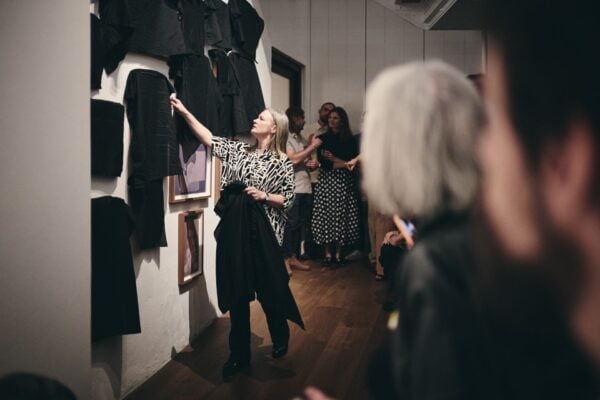
Artist/curator Nicola Deane unveils selected images in the © Spectres of decay series on the exhibition’s opening night. Photo: © Jurie Senekal
For me, the affective power of these finely choreographed assemblages exceeds arithmetic. Here, one plus one does not equal two. The depth of thought and linguistic concision each and every writer has suffused into their assigned image/s opens up new meanings that blossom out from the reforested surface of each corrupted negative, metaphysically exceeding the limits of its frame. Thematics that refract and echo across and between the image-text couplings include: photography, light and time; archival boundedness and flux; mortality/immortality; absence, loss, ghosts and ancestral continuation; the aesthetics and sensuality of decay; scored, cracked, blurred, moulded and branching images; digital hallucinations; and bacteria, fungi, creatures and other features of the more-than-human world. Some of the texts are written in English, others in Afrikaans, some in Afrikaaps and some with phrasings in Xhosa.
“Decay presents as pollution of the pure,” writes Mbao in a text titled “Spoilage”. “Other readings are available. … Perhaps another way to think about ruin is as an effect that makes other things sayable. The urge is to solve. That is our way of managing. Here, the decay makes visible some sense of disorganisation. It undermines our efforts. But what are those efforts for?”
The exhibition opens with a mesmeric series of Giclée prints by Nicola Deane and Jurie Senekal, titled Spectres of decay: The archive breathing at its horizon. Marooned relics, like dust, rusted fasteners, damaged tapes and mould-stained papers, were placed onto expired photographic paper from Senekal’s personal archive (the oldest being a box of Agfa Brovira Crystal paper from 1955) and exposed to sunlight in a process of lumen printing. Two anarchival collections are brought together and transformed by light into a haunting and numinous assembly of presences.
The ghostly magic of the photographic process was brought to life in a Houdini-esque performative spectacle on the exhibition’s opening night. Deane lifted black cloths from the frames of a group of images in the series, exposing them to light for the first time and initiating an ongoing process of exposure that would last for the duration of the exhibition and beyond. For an instant, we were catapulted back to the vaudevillian days of early photography, when photographers would shroud themselves in dark cloths in the act of recording the moment.
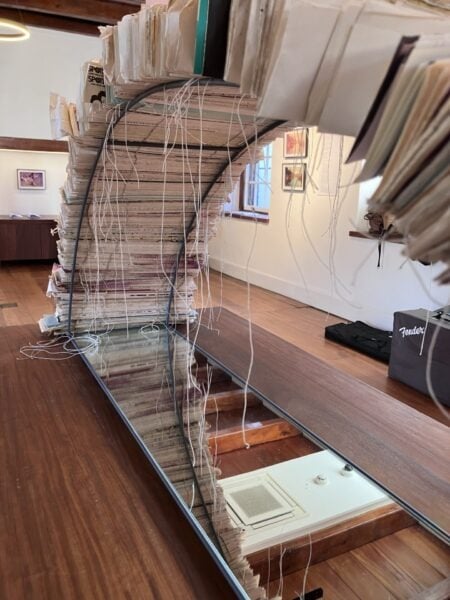
Heléne van Aswegen, © Deaccessioned collective sculpture, 2026. Photo: © Lizabé Lambrechts
When I returned on a rainy winter’s day a few weeks later to view the exhibition again in a quieter register, I found myself uncannily overcome with feeling at the sight of these strange, hovering imprints of absence. Who knew that the light ghosts of a handful of discarded paper clips and dissembled staples could be so oddly affecting? Perhaps it has something to do with the dissonance between the poeticism of the titles and the unassuming ordinariness of the gone objects – “Horizons of interiority” accompanying the auratic remains of what seems like a page of an old telephone directory: “P.O. Box Johannesburg, 2000, Telephone 832 …” all faded out and bleached away by time.
Stepping into the main gallery space, you are greeted by the various image/text assemblages, or “Provocations” – the digitised images of decaying photographic materials speaking in a common aesthetic language well described by David Mann in his microfiction “Surfacing”: “Inks rupture and bleed into one another, pooling. Speckled yellow, clotted red and pale green and blue are framed by a galaxy of mould spores. The image, whatever it is, was ruined long before the fire. Now, it’s becoming something else.”
They are accompanied by a few striking 3D objects that expand the exhibition’s multiform aspect. In the centre of the room is a magnificent artist-book sculpture by Heléne van Aswegen, made as a community-based art project with no fewer than 70 participants, from deaccessioned paper documents to mould, fungus, string, a mirror and wire. Stacked together, they form a paper arc. The reflection in the mirror beneath it, turns this half-moon into a full moon of fragments against the backdrop of the room’s ceiling, sunk unfathomably deep into the building’s foundations.
Similarly breathtaking is a large sheath of porous, patchworked fabric, stitched together and repeatedly mended with painstaking personal care and devotion by dancer and choreographer Nelisiwe Xaba. The cloth was a core prop in her excoriating performance piece vROT, which was staged as part of Decay as Mourning: Future-Thinking Heritage Practices, the international conference that was the exhibition’s catalytic conceptual context. It is suspended in the gallery space, and the winter light pours through the remnant cloth’s many fragile cavities with piercing tenderness.
Its tenuous threads echo the feathery, dissembled handwriting of playwright, novelist, actor and director Athol Fugard (1932-2025) in his precious final letters to his two young children, Halle and Lanigan. With great curatorial care and sensitivity, a selection of these letters, made by his widow, Paula Fourie, has been folded into a concertina-like book that can be unfurled by attentive visitors. The writer’s consciousness of his own demise is inked into his words as he writes them.
Says Lambrechts: “I thought long about how to include (the) letters … in the exhibition in a respectful way and decided that, instead of having them displayed on the wall …, I would have them bound in a book so that visitors would have to bend down and put effort in to page through, decipher and try to understand them. I wanted to create an intimate moment between the viewer and the texts that was more personal than what a wall text would allow.”
Another acutely haunting presence in the room is that of the writer and storyteller Diana Ferrus, who died at the age of 72 on 30 January this year. Ferrus is best known for her 1998 poem “I’ve come to take you home”, written in tribute to Sarah Baartman. It became a powerful catalyst in the international campaign for Baartman’s repatriation, and was read at the French Senate ahead of the return of her remains to South Africa in 2002.
Through the words of Ferrus’s poem “Sonder Treur”, I am reminded that energy never dies; it just changes form – and decay is simply the process by which that transformation happens.
ons dra miljoene jare se lewe soos a karos om ons skouers,/ daardie karos bly ons verweer teen die gewone, teen goedkoop ondertone, uitbuiting van wysheid/ … decay verrai nie, bring ongereptheid na vore,/ vereis niks van ons nie, net verwondering oor wat lig en donker saam kan voortbring./ decay lê vir ons en wag.
(we carry millions of years of life like a karos around our shoulders,/ that karos remains our defence against the ordinary, against cheap undertones, exploitation of wisdom/ … decay does not betray, brings forth pristineness,/ requires nothing of us, only wonder at what light and dark together can produce./ decay lies in wait for us.)