

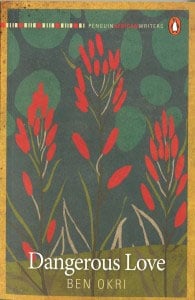
 Dangerous Love
Author: Ben Okri
Publisher: Penguin South Africa
ISBN: 9780143528265
Price: 140
Buy Dangerous Love from Kalahari.com
In the opening paragraphs of Dangerous Love, a novel first conceived more than 30 years ago (it is essentially a rewrite of Okri’s The Landscapes Within, which was issued in 1981) and first published in 1996, our young protagonist, Omovo, a boy of about 19, has his head shaved by an incompetent barber’s assistant plying his trade in the Lagos ghetto. Initially it is not the character’s intention to have all his hair removed in such dramatic fashion, but a bungled haircut leads to more drastic measures. In urban Nigeria of the late 1970s, where American disco (think afros and bell-bottoms) and high-life fashions are the order of the day, his clean-shaven scalp gives the young artist a strange, haunted look which immediately marks him as outsider. His neighbours and friends repeatedly ask him whether he is in mourning, which he vehemently denies.
The incident can be read as an extended metaphor which encapsulates many of this complex novel’s central themes: the incompetence and unprofessionalism of the apprentice echoes the incompetence of the post-war government in Nigeria (the novel is set about a decade after the cessation of hostilities in the horrific civil [Biafran] war which claimed the lives of over a million Nigerians) – something Okri brings to the fore repeatedly. The novel portrays the country’s citizenry as trapped rats, traumatised by violence and horror, now collectively gnawing away at the social fabric of their society. Unemployment is rife, violence is prevalent and a menacing atmosphere permeates the air. Omovo continuously refers to the “miasma of Lagos life”. Secret societies indulge in sinister practices. The occult and spirit world are present in the lives of characters – spirit children, strange dreams and a ritual murder are some of the things Omovo is confronted with during the course of the novel.
The protagonist’s decision to mark himself visually as outsider reflects and echoes his sense of isolation and disaffectedness – something he struggles with throughout the story. At the same time it is a defiant act which allows him to take some small measure of ownership of his identity as an artist. It is a signifier which lets him announce his individuality and displays his recognition of the impact of powerful, rebellious visual statements. Omovo is his own canvas, so to speak, and his art becomes the only means through which he can empower himself in this fraught society.
Lastly, but most crucially (and despite his denials to the contrary), Omovo is most certainly a man in mourning – and will remain one for the duration of this tale. He mourns for his long-suffering and abused dead mother, for his truculent, cash-strapped, alcoholic father, for his two banished brothers, for the deplorable state of the nation, and, most certainly, for his own overwhelming sense of purposelessness.
Forced to drop out of school without completing his final exams (due to lack of funds) Omovo is employed as a clerk in a chemical supply company – a job he abhors for its boredom and for the climate of corruption he finds himself inhabiting. His quietly defiant displays of moral rectitude (he stubbornly refuses to succumb to the bribing tactics of clients) and stand-offishness make him unpopular as a co-worker. His boss is eager to be rid of him and replace him with a down and out nephew willing to display the obsequiousness required of this type of entry-level position. (Some of the novel’s more grimly amusing passages are those describing Omovo’s interactions with his colleagues.)
Omovo’s home life is similarly unpleasant and tense. He lives in a dingy apartment in a run-down compound with his father and the latter’s calculating second wife, Blackie. His father has booted his two rebellious brothers out. These two young men send cryptic letters home hinting at sordid lives at sea as stowaways and sailors. There are lurid descriptions of filthy communal bathrooms in the compound. Squalor and lack of privacy are emphasised, as well as the hunger for scandal and gossip among commune dwellers. (There is a large pool of viscous scum outside the apartments which later becomes the subject of a painting by Omovo, seized by military officials at a gallery opening because, they declare, that it “undermines national authority and the nation’s progress”.) Yet Okri does balance this bleak view with some charming and jolly interactions between these down-and-out neighbours. It is not all Sturm und Drang, though everyone seems to be hanging on by a very thin thread.
Omovo’s friends, whom he sees only occasionally, are Keme, an earnest and principled young journalist, Okur, a slightly older man in his late twenties who served as a child soldier during the war and who clearly suffers from post-traumatic stress disorder, and Dele, a rich friend who, despite having impregnated his girlfriend, plans to flee Nigeria for the great white hope represented by America. Each friend is tortured by his own demons, and while the young men seem to have sincere regard for one another, they are all adrift on the same existentialist sea and can do little to really alleviate or solve one another’s problems.
The two things that thus keep Omovo going in this depressing state are his clandestine friendship with Ifeyiwa, a beautiful young married woman living in a neighbouring compound with her possessive husband, Takpo, and his art work. Mentored by a kindly Igbo signwriter cum painter, Doctor Okocha, Omovo uses drawing and painting to express and grapple with his angst and overwhelming sense of alienation and ennui. His relationship with Ifeyiwa, who had been ripped away from her schooling and forced into an arranged marriage by her impoverished family, offers both young people a modicum of emotional and intellectual solace. They discuss books, poetry and art. They find themselves to be kindred spirits and develop a passionate bond. While they know their love is doomed, they cannot stay away from each other. Ifeyiwa, even more so than Omovo, cuts a tragic figure: warm, passionate and intelligent, she is trapped in a loveless and abusive union with an intractable and jealous man. Like Omovo’s father, Takpo expects traditional patriarchal mores to be respected and adhered to, even here, in a more urbanised environment. Both these men are bullies who take out their feeling of disempowerment and humiliation on those they deem weaker than themselves. It is to Okri’s credit that they are not, however, portrayed as one-dimensional bullies. In fact, all his central characters are complex, multifaceted and interesting.
The novel is ambitious in its scope and complex in its rendering. The author’s prose veers between colourful social realism and more surrealist passages which reflect Omovo’s inner life and nightmare visions of his society. The latter make for difficult, and at times laborious, reading. While the young man’s angst and his emotional highs and lows are convincingly captured, it can be hard going for the reader.
There is also some fascinating inter-textual interplay. Many of Okri’s vivid surrealist passages as well as the novel’s themes reminded me of Ghanaian author Ayi Kwei Armah’s seminal text, The Beautyful Ones Are Not Yet Born (1968), in which a nameless male protagonist struggles to come to terms with endemic corruption in post-independence Ghana. Like Omovo, that protagonist refuses to take bribes, and suffers the consequences. Like Omovo, he quietly endures, but with constantly eroding fortitude. It is interesting to note that in one of the last few chapters of Dangerous Love, Omovo works on a painting of a young victim of a ritual murder he and Keme had horrifyingly stumbled upon in a city park. He considers naming the painting The Beautiful Ones, but then reconsiders. We are told that he “wanted to use his own words”. Perhaps this could be read as Okri’s acknowledgement of the influence of the Armah text on his own writing?
In the same passage we are told that years later Omovo will rework this painting (now titled Related Losses), “vainly trying to complete what he knew was beyond completion, trying to realise a fuller painting on a foundation whose frame is set forever … succumbing to the dangerous process of looking back, making himself suffer a long penance for a past artistic shame at a work unrealised by youthful craft”. This seems to be an allusion to Okri’s own decision to revise and rework The Landscapes Within into the present novel. (His author’s note also explains a little of this process.)
While Dangerous Love is not without its flaws, it is a haunting tale that both effectively dissects post-war Nigerian society and poses some interesting questions about the role of the artist in a ravaged world. While a love story lies at its core, its scope and themes are more far-reaching. Most chillingly, it reflects and echoes many of the problems we face in South African society today: corruption, a disaffected youth, high unemployment figures, artistic and media censorship, violence against women, and the struggles of traditionalism versus modernism. Omovo reflects in one scene: “He thought about the entanglement of bureaucracy and corruption that had spread throughout society. He thought about the older generation, how they had squandered and stolen much of the country’s resources, eaten up its future, weakened its potential, enriched themselves, got fat, created chaos everywhere, poisoned the next generation, and spread rashes of hunger throughout the land.”
Okri bears witness to his country’s tragic moral and economic decline. It could be said that a novel like this should serve as a prophetic warning, but unfortunately, here in South Africa we may already be too deep in the quagmire. The rot has set in.
Teken in op LitNet se gratis weeklikse nuusbrief. | Sign up for LitNet's free weekly newsletter.