

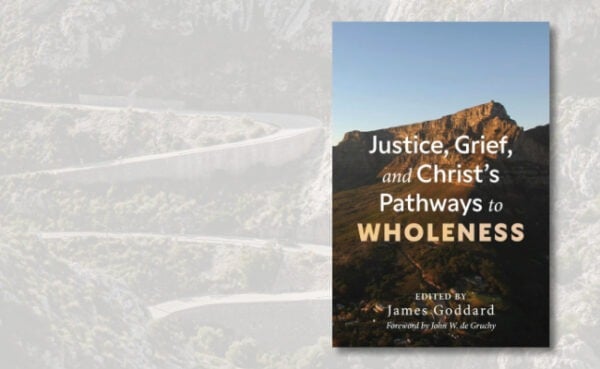
Title: Justice, grief and Christ’s pathways to wholeness
Editor: James Goddard
Publisher: Wipf and Stock Publishers
ISBN (paperback): 9798385257171
ISBN: (ebook) 9798385257195
ISBN: (hard cover) 9798385257188
...
The miracle of Pentecost was not sameness, but intelligibility across difference. Not the abolition of language, but the discovery that many languages could still build one world.
...
“Gloria, gloria, selfs in hierdie tye,” sings a child as her family is deported from Venda. She’s mistakenly turned Gloria in excelsis Deo (Glory to God in the highest) to “Glory, glory, even in times like these”. That moment captures the central message of James Goddard’s Justice, grief and Christ’s pathways to wholeness (Wipf and Stock, 2026): God’s providence was at work in the Trek from the Cape Colony into the interior, and in the passage from apartheid to democracy; therefore, exclusivist interpretations of Afrikaner Calvinism were a learning curve rather than the destination.
The anthology has reflections by John W de Gruchy, Cobus van Wyngaard, Laurie Gaum, Rex van Vuuren and Faure Louw – white, male Reformed theologians (Van Vuuren is a psychologist) sharing stories of faith at work in their own treks. Their intention is to equip “generationally privileged” faith communities as they respond to what the publisher’s blurb describes as “the current meta crisis” of “hastening authoritarianism, regional wars, the cost of living crisis, climate collapse and the Sixth Extinction”. They pursue a faith of authentic wholeness, rather than faith practised from a position of power. The contributors didn’t arrive at this wholeness through armchair philosophy; they each paid a price for what they know.
The book hiding under the book
“Our shared South African context is one of longed-for reparation,” Goddard writes in the introduction, admitting a few paragraphs later that “there were to-be-expected” debates on how anyone can “write about wholeness wholly, if no women have been invited to join our conversations as coauthors”. A corresponding footnote lists the reopening of the Cradock Four Inquest and white South African Christians’ response to Afrikaner “refugees” in the United States as events crying out for prophetic voices.
When Christians advocate LGBTI+ rights, the abolition of slavery or the equality of women from within an interpretive tradition, they don’t throw its source material away; they drill deeper into it. Likewise, dominees seeking to lead Afrikaner Calvinism deeper into the 21st century show the post-apartheid reality to be where God’s providence was leading history all along. Intentionally or not, the anthology structurally mirrors the four Gospels of the New Covenant as the followers of Jesus wrestled with the changes of their time; thematically, it captures this shift in, for example, the burning of the Tshilidzini church. When the “Whites only” pew disappears, an onlooker observes that while the horizontal beam of the cross (human relationships) was destroyed, the vertical beam (the relationship with God) remained standing. That’s a covenantal interpretation that says that under the wounding, a resurrection was gestating.
Books on the same topic
The anthology extends the anti-apartheid activism of early dissidents like Beyers Naudé into a modern, autoethnographic landscape. The contributors trace a trajectory away from an institutional ideology of power and spatial segregation, framing their generational privilege and complex ecclesiastical roots through personal vignettes of trauma, defrocking and social unlearning. This reframes their Reformed faith from a tool of division into a search for relational justice, therapeutic healing and Christ-centred wholeness. Van Wyngaard disrupts the “laager” mentality by shifting missiology into an urban landscape; Gaum draws from his experience of defrocking to shatter rigid binaries of holiness and sin; Van Vuuren uses existential phenomenology to sacrifice rigid dogma for psychological authenticity; Louw uses narrative therapy to externalise systemic wounds.
This work happens at a time when the literary landscape risks fracturing into two extremes: progressive writers who’ve largely abandoned the concept of an exclusive “Afrikaner covenant”, and right-wing groups who insist that the Vow of Blood River was immutable. Goddard’s anthology rejects moral compromise between these extremes, while keeping a channel of communication open that the rest of us can overhear. That’s why, I believe, the book was written by Afrikaners, for Afrikaners, in English.
A Christianese expression comes to mind: “People can debate your beliefs, but they can’t debate your testimony.” Given the stakes, the contributions are less epistles that argue, than gospels that testify to a Jesus who’s in AIDS wards, communion cups and a man’s lips that are softer than expected; a Jesus who’s an ever-present embodiment of Compassion, and whose crucifixion is mirrored in the slaughter of the metaphorical bull, pig and ram.
The structural limitations
The biblical New Covenant also faced a challenge, where God’s Old Covenant with Israel had been viewed as exclusive. Gentiles (literally, members of “the nations”) were expected to convert culturally and religiously to participate. Christ’s disciples lived under an expectation that God would abolish the Roman Empire as Gentile rule.
Christ didn’t fulfil the Covenant by overthrowing the Roman Empire; Christ’s apostles were shocked when God’s Spirit seemed perfectly fluent in otherness, empowering people of different nationalities to speak one another’s languages. But for the New Testament to work, Gentiles had to be “explained” and humanised into the Jewish disciples’ frame of reference.
So, as I read of Munjadziwa saying she felt sorry for her sexual assaulters in the anthology, I wondered whether she would have been included in the book if she’d replied with an imprecatory psalm, calling God’s judgment on those who’d harmed her.
The theology of justified anger
As practical as it may be for a dominee to meet their reader where that reader is by offering them conciliatory stories, pastors who sound like therapists can make Jesus seem less like the overturner of tables and more like the Lamb who faithfully absorbs violence; the Holy Spirit becomes more a comforter and less a tongue of fire. To borrow from the Jungian psychology that appears in the book, holistic theology integrates different pictures of God. If Christian imagination has historically accommodated God as a stern white patriarch, it should also be capable of imagining divine anger through the experience of a black woman. Emotional range and diversity will, in time, be necessary for exercising power alongside, not over, other image-bearers of the divine.
Power sharing and democratised capacity
South Africa’s challenge is no longer simply moral reconciliation, but coordinated survival. The capacities produced by Afrikaner covenantal thinking – planning, infrastructure, institutional memory, long-horizon cooperation – cannot simply be discarded because the metaphysics that once organised them has shifted. The question is whether those capacities can be democratised without reproducing the exclusions that sustained them.
The miracle of Pentecost was not sameness, but intelligibility across difference. Not the abolition of language, but the discovery that many languages could still build one world. Justice, grief and Christ’s pathways to wholeness is a community working to translate itself into that future.
See also:
Moraliteit anderkant familieverband: die opkoms van vroeë Christendom
Why we’re letting the ANC destroy South Africa (and how we can stop)