

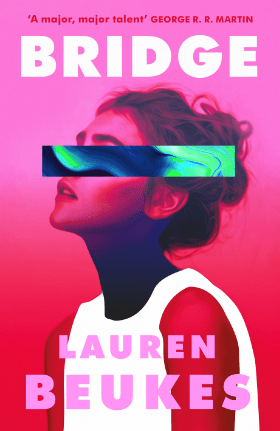
 Bridge
Lauren Beukes
Publisher: Penguin Random House
ISBN: 9781415211144
Bridge into troubled waters
I opened Lauren Beukes’s latest novel Bridge with equal measures of anticipation and trepidation. Anticipation, because I have long been an admirer of her work; in fact, her first two novels, Moxyland (2008) and Zoo City (2010), formed the basis for my master’s study into the dystopian aesthetic. Trepidation, because early reviews of her latest offering painted the novel in a less than flattering light.
I believe that, to understand any author’s work, one should be familiar with her oeuvre. Over the past 15 years, Beukes has consistently offered windows into her distinctive worldview, drawing on classic science fiction genres such as utopian/dystopian, cyberpunk and Afrofuturism. She creates worlds ranging from those vastly different to ours, to those which are frightening exactly because they seem so familiar, and she does so with equal measures of success and defeat. Beukes does not shy away from experimentation; she bravely goes where few have ventured before. Her courage paid off with the success of her 2013 novel, The shining girls (2013), which was adapted into a hit television series starring Elisabeth Moss of The handmaid’s tale fame. A mere year later, Beukes followed with Broken monsters (2014), a second science fiction detective novel set in the United States. Many of her followers felt betrayed by Beukes’s shift from home soil to the North American continent, a sentiment I did not share until the release of her perfectly timed pandemic novel, Afterland (2020). I have long felt that one of Beukes’s keys to success is the almost prophetic quality of her writing, her ability to make the reader feel as though the world she is painting is imminent. This is especially evident in her earlier novels; however, with Afterland, I felt that this quality turned on its master: the novel read like a lukewarm, modernised retelling of the classic 1915 feminist science fiction novel Herland by Charlotte Perkins Gilman. Released in perfect synchronicity with the global lockdown in 2020, Afterland left many feeling high and dry. Stephen King, who incidentally is also an avid follower of Beukes’s work, said in 2000 that every author is entitled to writing one bad book, and as I embarked on Bridge I desperately hoped that for Beukes, Afterland had been it.
“Reading lets us live in someone else’s shoes. Literature builds bridges; it makes our world larger, not smaller.”
– RF Kuang (Hoek 2023)
I have long believed the world to be divided into two groups of people – those who have lost their mothers and those whose mothers are still living. Bridge (short for Bridget) has recently lost her mother to brain cancer, and now she must sift through the remains of their troubled relationship. Like many post-lockdown works, Bridge is centred on loss and mourning. It is as if the zeitgeist insists that we mourn collectively for all we have lost in recent years. This novel coaxes the reader into grieving this loss alongside the main character. Beukes uses exquisitely crafted turns of phrase to illustrate the very fibre of grief. Her writing has always been fiercely clever and witty, but in a marked departure from her usual approach there is a new intensity, even a vulnerability to her style. This departure may not sit equally comfortably with everyone. Through leading us into the grieving process of the protagonist, Beukes invites us to immerse ourselves in the fragility of life. The text is interspersed with references to atrophy, burial, death and dying; “there are buried things everywhere you go” (133).
While anger is an excellent motivator, this novel builds on a different stage of grief entirely, namely that of denial. Naturally, Bridge will be in utter denial of her mother’s passing. Up till now, I have held that denial is the most debilitating stage of grief, yet Beukes convinced me that denial may also be a brilliant motivator, provided you have access to some form of psychedelic which allows you to transfer consciousness between dimensions. Having lost my own mother nearly two decades ago on the verge of becoming a mother myself, I found the concept of searching for one’s mother across dimensions heartbreakingly relatable. It is the most natural thing in the world to create a reality in which a loved one is still alive.
“[F]eel the yawning chasm of it, a Mariana Trench of loss, and you are sitting at the bottom with the entire weight of the ocean pressing down on you.” (128)
And then, a mother is necessarily also the bridge through which we enter this world. Every single one of us crossed that bridge to get here, irrespective of the relationships we may have with our mothers throughout the rest of our lives. In this manner, even the loss of a flawed mother must be grieved.
However, the most important departure from Beukes’s usual characterisation lies in the way in which she writes Bridge in a sympathetic light. Historically, Beukes’s female characters are hardened by life; they are steeped in trauma and are cynical and streetwise. Whereas the female characters in Beukes’s earlier works are all fiercely strong women, Bridge shines in the fragility of her loss. There is power in her weakness, yet this is a new, gentler strength. A power which comes from collaboration and draws on flawed relationships, from small incremental victories in the feminist tradition, through nurturing and healing.
........
Beukes illustrates how our humanity depends on those around us, on our shared existence.
........
Throughout Bridge’s desperate search for that ever-elusive sliver of hope – “hope is a small and brittle thing” (13) – Beukes illustrates how our humanity depends on those around us, on our shared existence. She does not shy away from the difficult matters of grief, dying and extinction. Rather, she leads us to acknowledge that while “truth may be a construct” (83) and we are living at a time when it seems that the whole universe is being torn apart and wherein everyone is fighting incredibly hard for this life, we cannot afford to buy into escapist fantasies of other lives, be they off-planet or in other dimensions.
As Donna Haraway (2016:1) says in Staying with the trouble, we need to settle troubled waters by rebuilding quiet places, but we cannot give in to the temptation to do so by trying to make an imagined future safe. Instead, Staying with the trouble calls for learning to be truly present. In Bridge, Beukes leads us to understand that the only life worth living is here, now, in the present, with those whom we choose as our kin.
Works cited
Beukes, L. 2008. Moxyland. Fourth impression, 2014 ed. Auckland Park: Jacana Media (Pty)Ltd.
Beukes, L. 2010. Zoo City. Seventh impression, 2014 ed. Auckland Park: Jacana Media (Pty)Ltd.
Beukes, L. 2013. The shining girls. New York: Harper Collins.
Beukes, L. 2014. Broken monsters. Cape Town: Umuzi.
Beukes, L. 2020. Afterland. Cape Town: Umuzi.
Beukes, L. 2023. Bridge. Cape Town: Umuzi.
Haraway, DJ. 2016. Staying with the trouble: Making kin in the Chthulucene. Paperback ed. London: Duke University Press.
Hoek, S. 2023. First thing. The Daily Maverick. 11 December 2023.
King, S. 2000. On writing: A memoir of the craft. New York: Simon and Schuster.
Perkins Gilman, C. 1915. Herland. 2010 ed. New York: Knopf Doubleday Publishing Group.